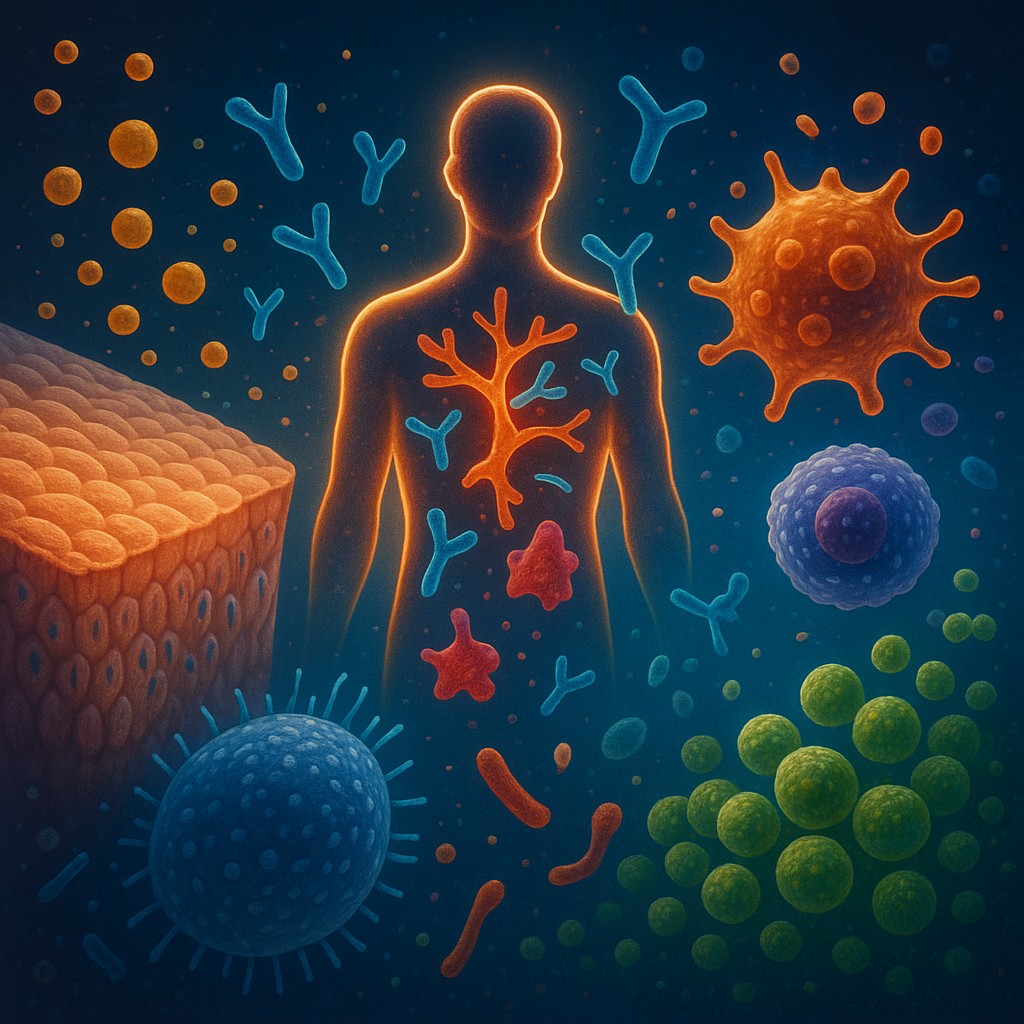
Imagine you are the ruler of a massive, high-tech fortress. Every second of every day, this fortress stays under siege by trillions of invisible invaders. Some are just looking for a warm place to stay, while others are biological vandals intent on stripping the copper pipes and tearing down the walls. Without a sophisticated, layered security force, your fortress would be stripped bare by sunset. Fortunately, you possess the most complex security system in the known universe: the human immune system.
It is easy to take your health for granted until you wake up with a sore throat or a stuffed-up nose, but behind the scenes, a literal war is raging. Your immune system is not a single organ like the heart or liver; rather, it is a vast network of cells, tissues, and organs that speak a complex chemical language. This network includes scouts, heavy artillery, intelligence officers, and even memory banks that store "mugshots" of every villain that has ever tried to cross your borders. To understand how you stay alive in a world teeming with microscopic threats, we have to look at the elegant, sometimes brutal mechanics of biological defense.
The First Line of Defense: The Body's Moat
Before a single white blood cell fires a shot, your body relies on physical and chemical barriers that handle about 90 percent of the work. Think of your skin as a vast, waterproof suit of armor. It is slightly acidic, making it a hostile environment for most wandering bacteria. This is not just a passive wall, either. Your skin constantly sheds its outer layer, which is a brilliant way of throwing intruders out with the trash. If a germ lands on your arm, it faces a dry, acidic desert where the ground beneath its feet is constantly disappearing.
Of course, your "fortress" has openings like the mouth, nose, and eyes, which act like delivery bays and ventilation shafts. To protect these vulnerable spots, the body uses mucus, tears, and saliva. Mucus is essentially biological flypaper; it is thick, sticky, and full of enzymes that can dissolve the cell walls of many bacteria. When you sneeze or cough, you are initiating a high-speed ejection protocol to clear out the "trash" caught in the trap. Even your stomach joins the defense, acting as a vat of hydrochloric acid that incinerates almost any pathogen, or disease-causing agent, that hitches a ride on your lunch.
The Rapid Response Team and Inflammation
If an invader manages to breach the skin through a paper cut or a scraped knee, the body immediately activates the Innate Immune System. This is your "first responder" crew, and they prioritize speed over precision. They do not care who the invader is; they only care that an intruder is inside the perimeter. Within minutes of a breach, specialized cells called mast cells release a chemical called histamine. This chemical causes your blood vessels to leak and expand, which is why a wound becomes red, swollen, and warm.
This swelling is actually a smart tactical move. By expanding the blood vessels, the body makes it easier for "soldier cells" to rush to the injury site. The stars of this phase are the neutrophils and macrophages. Neutrophils are short-lived shock troops that arrive in massive numbers to eat bacteria and then die, often forming what we know as pus. Macrophages, whose name means "big eaters," are much larger and live longer. They roam through your tissues like giant vacuum cleaners, swallowing pathogens whole and digesting them with powerful enzymes. It is a messy process, but it holds the line while the body prepares its more sophisticated weapons.
Specialized Assassins: The Adaptive System
While the innate system is brawling at the front gates, the body is busy prepping the Adaptive Immune System. This is the "Special Forces" wing of your internal army. This system uses B-cells and T-cells, which are types of white blood cells that do not just attack anything they see. Instead, they study the enemy to create a custom weapon designed to destroy one specific type of virus or bacteria.
B-cells are the body’s master chemists. Once they identify a specific invader, they turn into tiny factories that churn out millions of antibodies. Antibodies are Y-shaped proteins that act like custom-made handcuffs. They swarm the invader, latching onto its surface and neutralizing it so it cannot enter your cells. They also act as glowing beacons, signaling to other immune cells that the intruder needs to be destroyed. Meanwhile, T-cells handle the grimmer work. Killer T-cells roam the body looking for our own cells that have been hijacked by a virus, forcing those compromised cells to self-destruct for the greater good of the body.
How Your Body Learns and Remembers
The most incredible feature of the adaptive system is its long-term memory. The first time your body meets a new virus, like the one that causes chickenpox, it can take days or weeks to build the right specialized weapons. This is why you feel sick during a first infection; the invaders have a head start. However, once the battle is won, your body keeps the blueprints. It creates "Memory B-cells" and "Memory T-cells" that stay in your blood for years, or even your entire life.
If that same virus tries to enter your body again, these memory cells recognize it instantly. They do not have to spend days figuring out a strategy; they immediately start mass-producing the correct antibodies. Usually, this response is so fast and powerful that the virus is wiped out before you even feel a single symptom. This is the basic idea behind vaccines. By introducing a harmless piece of a pathogen, such as a protein or a weakened version of a virus, we "train" our memory cells without having to endure the dangerous disease first.
| Feature |
Innate Immune System |
Adaptive Immune System |
| Response Speed |
Immediate (minutes to hours) |
Slow (days to weeks) |
| Specificity |
General (attacks any intruder) |
Highly Specific (tailored to one foe) |
| Memory |
No memory of past infections |
Long-term memory of past infections |
| Main Components |
Skin, Macrophages, Neutrophils |
B-cells, T-cells, Antibodies |
| Status |
Always active and ready |
Activated only when needed |
Communication and the Language of Cells
You might wonder how a cell in your big toe knows there is an infection in your lungs. The immune system coordinates this through a signaling language using proteins called cytokines. Cytokines are like the "text messages" of the cellular world. When a white blood cell finds a threat, it releases cytokines to recruit help, tell the brain to turn up the heat (causing a fever), or tell the bone marrow to produce more white blood cells for the fight.
Fever is a perfect example of this coordination. While we usually think of a fever as a bad thing, it is actually a deliberate defense strategy. By raising your body temperature, the immune system makes your internal environment less comfortable for bacteria, which often need a very specific temperature to reproduce. At the same time, a higher temperature speeds up the metabolism of your immune cells, making them faster and more efficient. As long as a fever does not get dangerously high, it is a sign that your "General" has ordered a scorched-earth policy to win the war.
Common Myths and Misconceptions
There are many myths about the immune system that can be confusing. One of the most common is the idea that you can "boost" your immune system to a superhuman level. In reality, you do not want an overactive immune system. When the system becomes too aggressive or cannot tell the difference between "self" and "other," it begins attacking your own healthy tissues. This is the root cause of autoimmune diseases like Type 1 diabetes, rheumatoid arthritis, or lupus. The goal is balance, not maximum aggression.
Another misconception is that being "too clean" is always better. The "Hygiene Hypothesis" suggests that our immune systems actually need some exposure to dirt and common environmental microbes, especially during childhood, to learn how to calibrate properly. Without this training, the immune system can become "bored" and hypersensitive, overreacting to harmless things like pollen, peanuts, or pet dander. This overreaction is what we call an allergy. Your immune system is like a high-performance athlete; it needs regular, low-stakes practice to keep its skills sharp.
The Microbiome: A Living Ecosystem
One of the most fascinating discoveries in modern medicine is the role of the microbiome. We are essentially walking ecosystems, carrying trillions of "good" bacteria in our gut that help our immune system function. These beneficial bacteria take up space, leaving no room for "bad" bacteria to land. They also produce chemicals that train our immune cells and help regulate inflammation throughout the body.
When you eat a fiber-rich diet, you are feeding the trillions of microbial allies that keep your immune system in check. If this ecosystem is disrupted by a poor diet or the overuse of antibiotics, the immune system can become sluggish or confused. This shows that the immune system is not just a military force; it is a complex social contract between your human cells and the vast microbial world living within you.
Supporting Your Internal Security Force
While you cannot simply "boost" your immune system with a magic pill, you can support it so it has the resources to do its job. Your white blood cells are some of the most active cells in your body, meaning they need a constant supply of energy and nutrients. Vitamin C, Vitamin D, and Zinc are not "cures" for the cold, but they are essential parts of the machinery immune cells use to build weapons. Without these building blocks, your army cannot produce enough ammunition.
Sleep is also essential. During deep sleep, your body performs maintenance on its immune memory. Studies show that people who are sleep-deprived produce fewer antibodies after being exposed to a virus. Stress also plays a major role; when you are chronically stressed, your body produces cortisol, which suppresses immune activity. Evolutionarily, this made sense; if you were being chased by a predator, your body did not want to waste energy fighting a minor cold. But in the modern world, chronic stress keeps that "off" switch flipped, making you more likely to get sick.
Final Thoughts on Your Biological Armor
The more we learn about the immune system, the more it seems like a miracle of engineering. From the simple physical barrier of your skin to the complex genetic shuffling required to create a specific antibody, your body is a masterpiece of resilience. You are never truly alone; you are protected by a loyal, tireless security detail refined by millions of years of evolution. By understanding how this system works, we can stop treating our bodies like fragile glass and start treating them like the powerful fortresses they truly are. Health is not just the absence of germs, but the presence of a well-trained, well-fed internal army always ready to stand its ground for you.