Space Opera
XB41's Cracked Dome: A Rider, a Vulnerability, Democracy
September 25, 2025
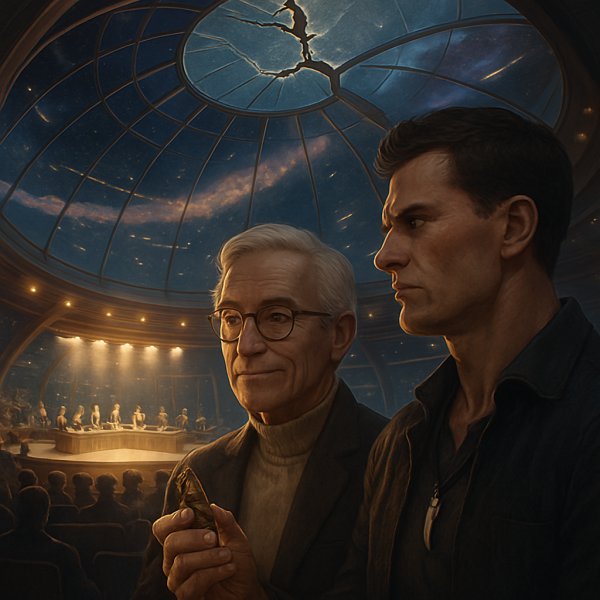
The dome of station XB41 split into a warm silence, smelling of ozone and way-too-strong coffee. Transparent panels gave onto the Shipway, a river of sparks and stellar banners, and beneath the conference lights the leaders of the galaxy spoke as if every word could sculpt the future. Hubert held a small brass knight in his palm, worn, its head cocked as if listening. He rolled it between thumb and forefinger, a subtle tic, while the voices around him rounded into polite consensus.
John, beside him, kept his jaw set. He wore a white wolf tooth on a black cord, his fingers constantly brushing it as if to gauge the world’s presence. His senses took everything in - the distant acceleration of the core, the vibration of footsteps on the walkway, the smell of leather and varnish. He did not like crowded rooms. He did not like speeches. He liked protecting Hubert.
Hubert smiled, not for the leaders, but for himself. His smile was a plan - he knew how to gather people. He knew how to ask a question and let silence push the other to speak, how to offer the right line at the right moment. Tonight he had prepared more than a clever question. He had prepared an obligation: to return power.
The first spark came with no physical violence, but with the same sharpness as a thin blade. A batch of holographic archives activated at the center, replacing the expected presentations. Images, contracts, decades-old sealed voting records slid across the bay like black butterflies. Faces at the table altered. Chancellor Serin squinted until the shadow of his wrinkles seemed to bite his face. Admiral Corvus rose to his feet. Magistrate Lian crushed her silk in her fist.
Hubert put his knight on the table. His voice cut through the room, clear, calm, and curious in a way that was also a weapon: "Can someone explain why fundamental laws were passed without popular consultation?"
Silence thickened. Security systems went active. Screens began to stutter, then a sharp, systemic cut severed part of the communications. The lights fell to a bluish hue, and Captain Tarek, a square-jawed man, stepped forward with measured purpose. His metal bracelet tinked - a habit, a metronome. He announced the session suspended for a "security verification."
Hubert looked surprised, but no one was fooled. The truth he had exposed was no accident. John smelled the tension like something sweet. Cameras scanned the crowd. A security barrier lowered from the ceiling to isolate the dais, and the leaders huddled into a tighter circle. Who had planted the archive inside XB41’s secure network? Hubert knew. John knew. But everyone asked the same silent question: was this rebellion, or terrorism?
The answer began as a story told in images. Intercepted messages displayed plans - interstellar police units, censorship centers, foreign bases primed to intervene if "order" faltered. The leaders had already chosen the ending. The core problem was not only corruption, but a machine that repaired itself in silence. If no one stopped it now, it would eventually swallow any possibility of choice.
Hubert’s plan was not to sit on a throne. His intent, long whispered to John in warm corridors, was sharper: to seize the galaxy’s decision center temporarily, to open the way for a truly democratic process. The idea ate at him at night. His secret fear - the only one he would not voice even to John - was facing the same mirror naked: if you hold power, how do you not come to love it?
The first complication came when security closed external links. No transmission left the station. The leaders shouted orders that never left the room. Ambassadors panicked, demanding to know who had sabotaged XB41 - and above all, who controlled the flow of information. Hubert and John found themselves at the junction of two worlds: to appear as troublemakers, or as the ones exposing a betrayal.
They had little time. John proposed brute force - neutralize the locks through the engine room, grab the codes, impose a total cut. Hubert answered in a softer, more calculated voice. "We must win people’s hearts here, not just their shouts. If we become the ones who impose, we will only repeat what we hate." He stroked the brass knight, feeling the line between a game and strategy.
They moved through the station like accepted shadows. John slid through ducts, his hands remembering the texture of each ladder and chain, while Hubert walked the ripples of murmurs, saying the right things to worried advisors, laughing with a secretary, promising answers to an over-eager journalist. Persuasion and force complemented one another - and yet each concession closed like a clamp. Who would they have to sacrifice to reach the dawn?
Tension rose when Magistrate Lian stood and made an announcement. "If security cannot guarantee order, we must take control of the core." Her silver ring clicked against her tablet, a nervous habit. Lian embodied the hard line - subtler than Serin but ready for decisive measures. "We will isolate the voting system and appoint a provisional council," she said. "We have the means."
Hubert felt a cold in his throat that had nothing to do with air conditioning. To take control, even in the name of restoring democracy, risked ensuring that choice would never return. John put his hand on Hubert’s shoulder, and in his look was the age-old question of wolves - do you strike now, or wait for the prey to weaken?
The turning point came as a quiet betrayal. Captain Tarek, maintaining a veneer of neutrality, opened a data bay - a too-human tic. Hubert discovered older archives kept by a small circle of elected officials - a black parliament that had manipulated laws and crises for decades. Among the names gleamed one he knew: Hubert’s father. The revelation hit like a wave. His family had been an instrument, not merely a victim. His own blood had helped raise the wall he wanted to demolish.
Hubert wanted to run, to sever every tie, but John held his arm, his grip an anchor. "You cannot erase the past," he said, hoarse. "But you can choose what you do next." Hubert’s fingers tightened on the knight. His deepest fear - becoming like those he fought - grew sharp and clear. In that clarity came a decision.
The night that followed was the heaviest. Systems rebooted in fits. Security convoys were sent to neighborhoods where pressure could be released. Hubert climbed to the center of the dome and asked for the floor. His face filled screens like a vase containing a dangerous flower. He drew a long breath.
"I could take power," he said, without flourish, choosing each word. "I could suspend your privileges, lock your systems, appoint a council that would be... mine for a time." He let the sentence hang and the room contracted. "But if I do it, I will become what you are. And you know that the best cure for a locked regime is not another lock."
There was a murmur. Serin hissed through his teeth. "Then what do you propose?"
Hubert put the knight on the table as a sign. "Open the channels. Deposit here, now, all documents, and allow every city, every station, every colony to decide in thirty days. I will make the secure voting network public. If I ask these people to follow me, they will not have to choose under a threat. They will choose."
The risk was immense. The leaders could fake a vote. Armies could intervene. Tarek, man of protocol, played his last card by declaring that, mechanically, the vote must remain local - not centralized - under the pretext of security. His small clink and hard gaze masked the indecision of a man who never knew which side to pick.
Then John did what he had not planned to do in public. He stepped to the main console, his fingers on a cold interface. He revealed a fragment of code - a flaw he had found after living among the ducts and maintenance networks. "I’ll open it," he said simply. "Not for you, Hubert. For them."
John activated the flaw. The locks came apart like flowers in rain. XB41’s communication channels opened to the public. Thousands of screens across the galaxy flickered, showing minutes, votes, manipulations in the clear for the first time. Citizens saw the archives, heard confessions, and for many it felt like surfacing after being underwater.
Complications burst into organized chaos. Some garrisons rebelled, loyalist squadrons tried to intervene, but transparency had a power even blasters could not silence. Colonies stepped back, civic groups formed, representative committees sprang up like embers. Hubert spoke not as a commander handing down orders, but as a moderator proposing a procedure. His legitimacy grew from something older than titles: trust.
The transformation peaked when Hubert, under the galaxy’s gaze, refused the provisional authority being offered. He instead asked for an elected assembly as soon as the voting systems were certified by an international panel of auditors. He set his brass piece on the council table like handing someone a key to a door without hinges. "Take this piece," he said, and everyone understood. "It is not for me. It is a symbol. Let each keep a piece of power. We will begin again."
There were tears, shouts, threats. Some leaders fled to hangars, others tried to forge new alliances. But the mechanism had changed. The flaw John had opened let voices of all kinds be heard. The world would not be fixed in a day, but the path had been opened.
After the storm there was a collective breath. Hubert walked to the dome’s walkway, the lace of starlight brushing him like a cold caress. John came to his right, the wolf tooth between his fingers. They watched the Shipway. From that height the galaxy looked less like a map of territories and more like a network of pulsing, hesitant lights.
Hubert put his knight on the rim again, and this time he left it. The small piece shone, modest beside the rings of power that had surrounded it. "I wanted power," he murmured, to himself as much as to John. "Now I want to learn to share what matters."
John made a low sound, not a reproach but an old approval. "You asked the people to choose," he said. "It is risky. It is human. And it is right."
They stood a while, watching the galaxy regain its breath. A group of civic representatives sent the first request for a constituent assembly. A mining station sent tentative songs; children sent drawings; an entire city declared its wish for local autonomy. Democracy began again in small strokes, like a table finding its balance after a clumsy shove.
The last image stayed simple and strong: the brass knight on the dome’s rim, reflecting blue light and the distant red of a forming star. Hubert turned away, and John, faithful as a tamed shadow, brushed the wolf tooth before tucking it away.
The question that remained, for those watching and for them, was open: now what will they do with the freedom they had finally made possible?
Space Opera