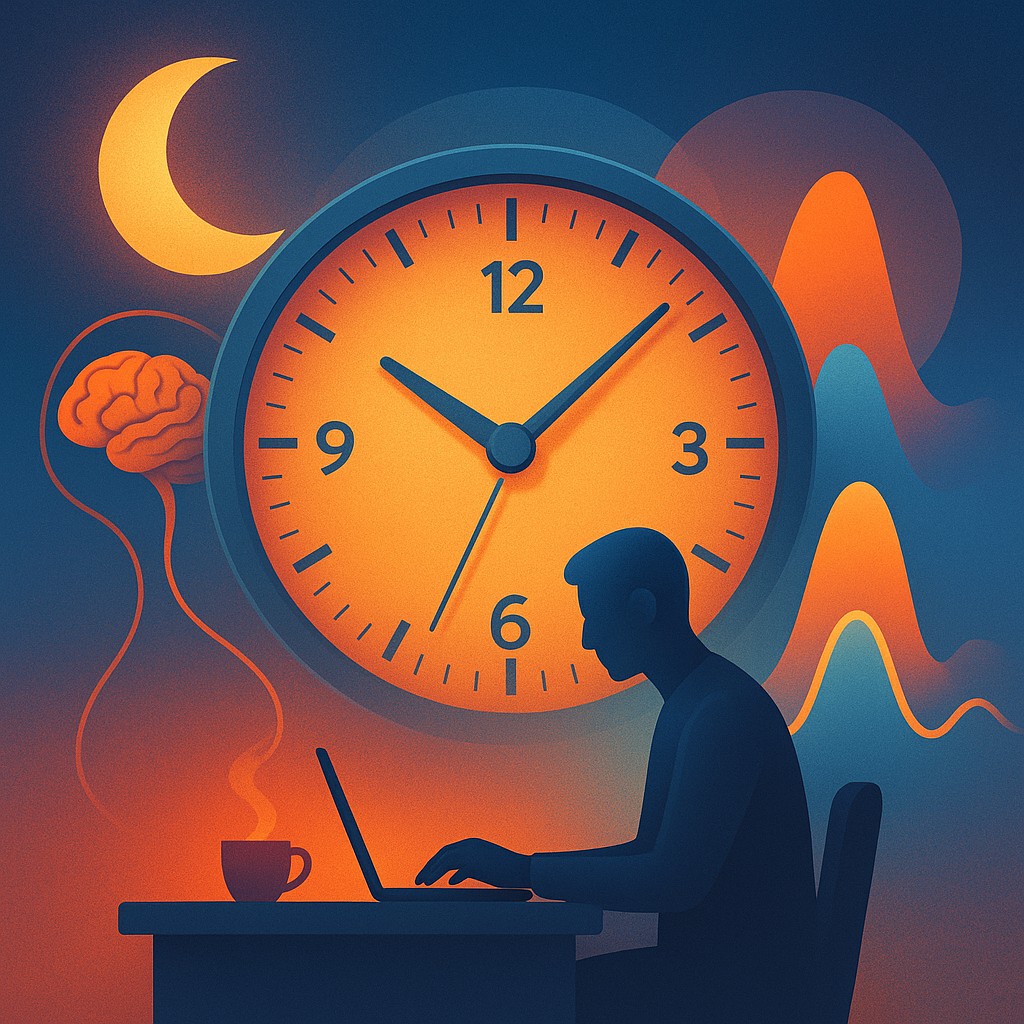
We have all experienced that strange feeling when 3:00 PM hits and the brain suddenly decides to go on an unannounced vacation. You might find yourself staring at a spreadsheet with glazing eyes, wondering why a task that took twenty minutes this morning now feels like climbing a mountain in flip-flops. Usually, we reach for a third cup of coffee or scold ourselves for a lack of "discipline," assuming that productivity is just a matter of gritting our teeth. However, recent neuroscience suggests that your struggle isn't a character flaw, but a biological mismatch. You are essentially trying to run high-performance software on a system that has entered its scheduled maintenance mode.
The secret to staying sharp lies in understanding "chronotype alignment." This biological framework shows that our mental abilities are not the same all day. Instead, they rise and fall in predictable waves governed by our internal circadian clocks. These rhythms control everything from the surge of cortisol that wakes us up to the drop in body temperature that prepares us for sleep. When we fight these internal tides, we experience mental fatigue, which is the cognitive equivalent of driving with the emergency brake on. By learning to map your specific biological profile, you can stop treating work like an uphill battle and start working with your nervous system’s natural energy.
The Genetic Blueprint of Your Internal Clock
While many self-help gurus claim that anyone can join the "5:00 AM club" through sheer willpower, biology tells a different story. Your chronotype, which is your natural tendency to be a morning person, an evening person, or something in between, is largely hard-coded into your DNA. Specifically, variations in genes like the PER2 gene influence the length of your internal clock. Some people have a "faster" clock that makes them jump out of bed at dawn, while others have a "slower" clock that keeps them alert long after the sun goes down. This isn't a lifestyle choice; it is a physical reality as fundamental as your height or eye color.
This internal clock regulates when your body releases hormones, particularly the relationship between cortisol (the stress and alertness hormone) and melatonin (the sleep hormone). In the morning, a healthy system experiences a "cortisol awakening response," which primes the brain for logical thinking and analytical work. As the day goes on, this alertness naturally fades, leading to the well-documented post-lunch slump. For a "Lark" (a morning person), this peak happens early and disappears by late afternoon. For an "Owl" (an evening person), the peak is delayed, often not arriving until mid-afternoon or even early evening. Understanding that you cannot "will" your PER2 gene into a different setting is the first step toward working smarter rather than harder.
The Three Phases of Daily Mental Flow
Regardless of your specific type, most people move through three distinct phases of mental readiness every twenty-four hours: the peak, the trough, and the recovery. During the peak, your brain is best at "inhibitory control," which is the ability to ignore distractions and stay focused on a single, difficult task. This is the perfect time for writing complex code, analyzing financial data, or making big strategic decisions. Because your brain is better at filtering out "noise" during this time, you complete tasks with fewer errors and much less mental strain.
The trough is the opposite of the peak. This period, usually in the early-to-mid afternoon, is when your body temperature drops slightly and the brain’s processing speed slows down. Trying to do "deep work" during this slump is the main cause of mental exhaustion. Finally, there is the recovery phase. Interestingly, during this period, our focus is lower than during the peak, but our mood is often better. This "looser" mental state is actually superior for creative problem-solving and brainstorming. Because your brain is less "strict" about filtering out random thoughts, you are more likely to make the unique connections required for innovation.
Mapping Your Tasks to Your Biology
To make the most of your internal rhythm, you must organize your to-do list based on how much mental effort each task requires. We often build our schedules around deadlines or the newest email in our inbox, but it is more efficient to match the difficulty of the task to the readiness of the brain. If you spend your peak morning hours answering routine emails, you are essentially wasting high-quality brain fuel on a low-priority activity. By the time you get to the "real" work in the afternoon, your tank is empty.
The following table provides a guide for how to distribute different types of work based on your biological highs and lows.
| Mental State |
Task Type |
Examples of Ideal Activities |
| Peak (High Alertness) |
Analytical & Deep Work |
Complex coding, technical writing, auditing, strategic planning. |
| Trough (Low Energy) |
Routine & Basic Tasks |
Sorting emails, filing expenses, scheduling, data entry. |
| Recovery (Creative Flow) |
Ideas & Exploration |
Brainstorming, sketching, visioning, collaborative planning. |
By moving your most demanding "Peak" tasks to your natural window of alertness, you create a "synchrony effect." Research in schools and offices has shown that when the difficulty of a task matches a person's biological peak, their scores on intelligence and memory tests rise significantly. It is not that the person became smarter; they were simply able to use their existing brainpower without the friction of fatigue.
Overcoming the "Social Jetlag" Obstacle
One of the biggest challenges to following your rhythm is "social jetlag," the gap between what our bodies want and what society demands. Most offices and schools favor a "Lark" schedule, starting at 8:00 AM and putting "Owls" at a permanent disadvantage. When an evening person is forced to do heavy analytical work early in the morning, they are essentially living in a state of permanent jetlag, even if they never leave home. This leads to a "sleep debt" and chronic exhaustion that a weekend lie-in cannot fix.
While you might not be able to quit your job to follow your clock, you can "nudge" your rhythm or adjust your schedule. Exposure to light is the most powerful tool for shifting your clock. Getting bright sunlight in your eyes as soon as you wake up can help a night owl shift their peak earlier. Meanwhile, avoiding blue light from screens in the evening can keep your clock from drifting even later. In a professional setting, this might mean asking for "asynchronous" work blocks, where you protect your peak hours from meetings, whether those hours happen at 9:00 AM or 4:00 PM.
The Myth of Constant Productivity
There is a persistent myth that high achievers are productive every hour of the day. This is physically impossible. The human brain consumes about 20 percent of the body's total energy, even though it only makes up 2 percent of its weight. It is a hungry organ that needs periods of low activity to clear out chemical waste products like adenosine. When we try to "power through" the afternoon slump, we aren't being disciplined; we are being inefficient.
True productivity is not about the number of hours you work, but the quality of focus within those hours. A morning person who works four hours early on might produce more high-quality work than an evening person who struggles for eight hours during a morning shift. Once you accept that your energy is a limited, rhythmic resource, you can stop blaming your willpower and start fixing your environment. This shifts the conversation from "Why am I so lazy?" to "How can I protect my best hours for the things that actually matter?"
Embracing Your Natural Rhythm
Aligning with your chronotype is ultimately about self-awareness. It requires you to pay attention to your body’s signals, noting when you feel "sharp" and when you feel "blurry." It asks you to stop measuring yourself against a generic, standard workday and start building a life that respects your genetics. When you save your hardest mental work for your biological peaks, you don't just become more productive; you become more resilient, less stressed, and more likely to enjoy what you do.
Imagine a life where you no longer fight your own biology, but instead ride its waves like a skilled surfer. You handle complex challenges when your mind is a steel trap, you breeze through boring chores when your energy is low, and you let your imagination soar when your brain is in its creative recovery phase. This isn't just a dream of efficiency; it is a sustainable way of living that honors the human brain. Start today by tracking your energy levels, and give yourself permission to step away from the desk when your biological clock says it's time for a break.