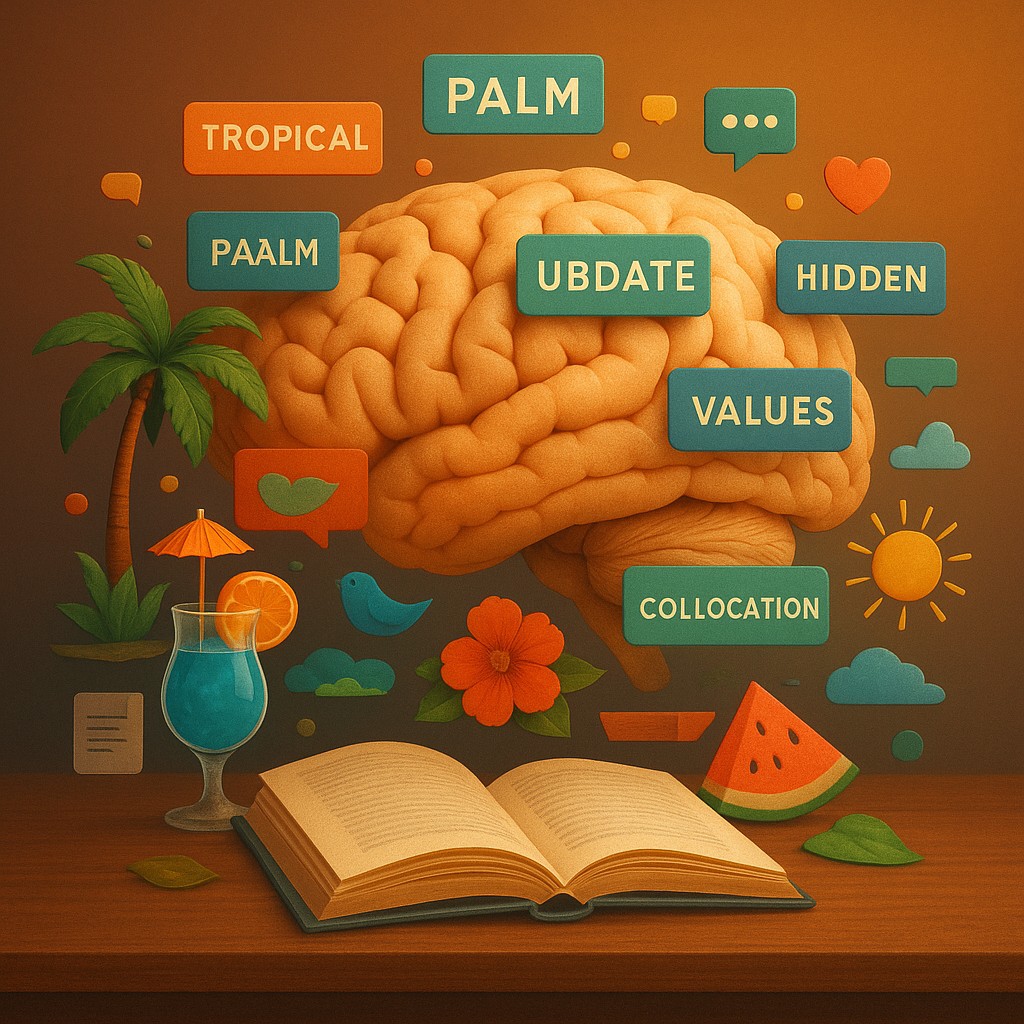
Think of your brain as a high-speed librarian who has been working for years without a break. Every time you hear a word, this librarian does not just hand you a dry dictionary definition. Instead, they present you with a messy, colorful collage of every place you have ever seen that word used before. If you hear the word "tropical," you do not just think of high temperatures and humidity. You likely visualize palm trees, blue water, and perhaps a fruity drink with a little paper umbrella. This happens because our brains are designed to spot patterns. In the world of language, certain words are simply best friends that refuse to go anywhere without each other.
Scientists who study this phenomenon are called corpus linguists, and they have discovered that the "company a word keeps" is far more important than the literal meaning of the word itself. By feeding millions of books, news articles, and social media posts into powerful computers, these researchers can map out the hidden architecture of our thoughts. They are not looking for what people say they believe, but rather for the unconscious habits of language that reveal what we actually value, fear, or ignore. When certain words cling to each other with statistical regularity, it is called a "collocation." These pairings are the secret keys to understanding the cultural biases hidden in plain sight.
The Mathematical Luck of Language Partners
When we talk about words appearing together, we are not just talking about accidental neighbors. In any given sentence, words might end up next to each other purely by chance because they are common, like how "the" and "and" are constantly bumping into each other in the hallway. However, corpus linguistics focuses on pairings that occur much more frequently than the laws of probability should allow. If you have a bowl of alphabet soup, you expect to see random letters floating around. But if you constantly see the letters Q and U stuck together, you know there is a rule or a design at play.
This is where "Mutual Information" scores come into the picture. Software programs like Sketch Engine or AntConc analyze billions of words to see if the presence of Word A predicts the presence of Word B. For instance, the word "rancid" technically means spoiled or smelling bad, but in the English language, it has a very exclusive relationship with the word "butter." You rarely hear about "rancid milk" or "rancid meat," even though those things certainly spoil. Our language has bonded "rancid" to "butter" so tightly that the two have become a package deal. When this happens across an entire culture, it creates a "semantic prosody," which is a fancy way of saying that a neutral word takes on a positive or negative vibe simply because of the crowd it hangs out with.
Decoding the Hidden Portraits of People
The real power of collocation analysis is not found in butter or soup, but in how we describe human beings. This is where the data gets uncomfortable and illuminating. If a researcher looks at the collocations for the word "spinster" versus "bachelor," the bias of history becomes undeniable. In historical data sets, "spinster" frequently appears with words like "frustrated," "lonely," or "bitter." Meanwhile, "bachelor" is more likely to find itself surrounded by "eligible," "dashing," or "carefree." Even though both words technically just mean "an unmarried person," the company they keep tells a story of societal judgment and double standards.
This goes beyond gender. Imagine a computer program scanning twenty years of news coverage regarding two different neighborhoods. In one neighborhood, the words "innovative" or "up-and-coming" might frequently appear next to descriptions of new businesses. In another neighborhood, a similar business might be paired with words like "resilient" or "surprising." The data shows that we do not view these two areas as equals. One is expected to succeed, while the success of the other is treated as an anomaly. By identifying these clusters, linguists can prove that a writer is biased without the writer even knowing it. It is the linguistic equivalent of a "tell" in a game of poker.
The Invisible Tint of Our Social Lenses
To understand how these word pairings shape our reality, it is helpful to look at how they compare across different sectors of life. We often think of adjectives as neutral tools, but they are actually heavily loaded with cultural assumptions. When we see a pattern in a corpus (a massive body of text used for research), we are seeing the collective unconscious of a society. The table below illustrates how seemingly similar concepts can be framed entirely differently through the power of collocation.
| Target Word |
Common Positive Collocations |
Common Negative/Bias Collocations |
What this Reveals |
| Ambition |
Driven, visionary, leadership |
Aggressive, ruthless, calculating |
Often used positively for men, but negatively for women. |
| Migrant |
Economic, seasonal, skilled |
Illegal, flood, swarm, wave |
Using water metaphors suggests a natural disaster rather than people. |
| Teenager |
Youthful, talented, aspiring |
Rowdy, troubled, delinquent |
Reflects a societal fear of youth rather than an appreciation for it. |
| Elderly |
Wise, respected, seasoned |
Frail, burden, declining |
Shows a bias toward seeing aging as a purely physical decay. |
By examining these pairings, we see that "ambition" is not a static concept. Its meaning shifts depending on who it is attached to. These collocations act like an invisible tint on a pair of glasses. If you have been reading the word "migrant" next to the word "flood" for your entire life, you will unconsciously begin to associate human movement with a lack of control and a threat to property. You did not choose to think this way, but the "company" the words kept has trained your brain to expect a specific narrative.
Breaking the Cycle of Language Habits
One of the most common myths about language is that if we look a word up in the dictionary, we have understood it. But dictionaries are like maps of a city, while collocations are the actual traffic patterns. You can know where a road is, but until you see where the cars are actually going, you do not understand the city. Some people fear that analyzing language with computers makes it cold or mechanical, but it actually makes it more human. It allows us to see the cracks in our objectivity and gives us the tools to fix them.
A common misconception is that these biases are the result of "bad people" trying to brainwash the public. In reality, collocations are usually the result of lazy writing and cultural momentum. Writers often reach for clichés because they are easy and familiar. If every movie script describes a "brooding" hero and a "sultry" heroine, these collocations become the path of least resistance. The danger is that these paths eventually become ruts. However, once we use corpus linguistics to shine a light on these patterns, we gain the agency to choose new neighbors for our words. We can consciously decide to pair "elderly" with "active" or "migrants" with "contribution."
The Mirror of the Digital World
In the modern era, this study has become more urgent because of Artificial Intelligence. Large Language Models, the brains behind AI chatbots, are trained on massive collections of human text. If the data we feed them is full of biased collocations, the AI will inherit those biases as if they were facts. If an AI sees "doctor" grouped with "he" and "nurse" grouped with "she" a million times, it will provide results that reinforce those stereotypes. Understanding collocation is no longer just an academic exercise for linguists; it is a safety manual for building the future of technology.
We can actually measure the mathematical "distance" between words to see how a society is changing. In recent years, researchers have noticed that the collocations for "mental health" have shifted. In the mid-twentieth century, the term was often paired with "asylum" or "shame." Today, you are much more likely to see it paired with "awareness," "support," or "wellness." This is data-driven proof that our cultural stigma is dissolving. We are literally rewriting the neighborhood of that word. As the neighbors change, the term "mental health" starts to feel like a much safer place to visit.
Finding the Power in Your Own Patterns
Now that you know how the game is played, you will likely start seeing collocations everywhere. You will notice it in news headlines, in the way people are described in business meetings, and even in the way you talk about yourself. When you find yourself reaching for a common word pairing, stop and ask: "Is this word here because it’s true, or because it’s a habitual roommate?" By questioning these invisible bonds, you become a more critical consumer of information and a more intentional communicator.
Language is not a fixed monument carved in stone. It is a living, breathing ecosystem that changes based on how we use it. Every time you consciously pair a word with a new, more accurate neighbor, you are contributing to a subtle shift in the global conversation. You have the power to break old linguistic habits and build new bridges. Your words are the architects of your reality. By choosing their company wisely, you can design a world that is more thoughtful, more precise, and infinitely more inclusive. Embrace the data, trust the patterns, and never underestimate the impact of the friends your words keep.