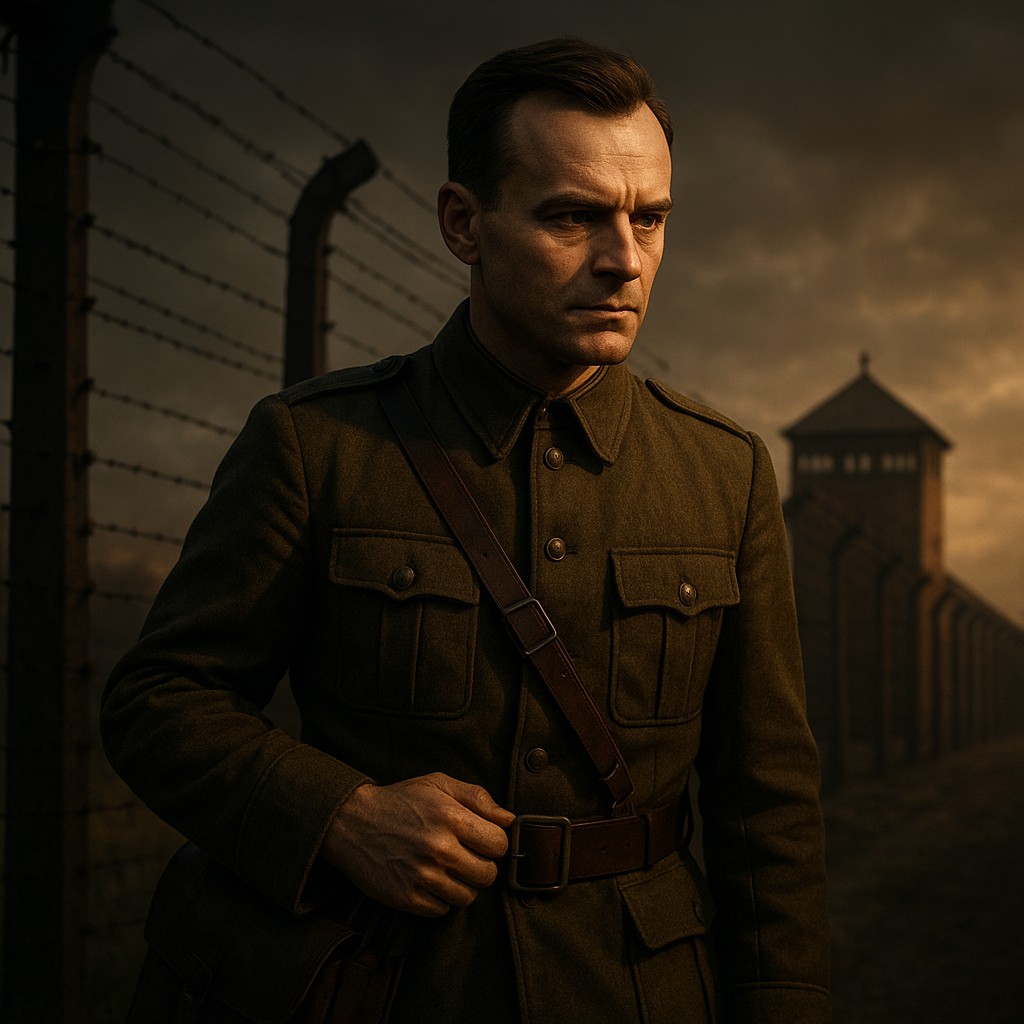
Picture, for a moment, a man who decides to get himself arrested on purpose. Not because he is careless or wants to die, but because he wants to enter a place no sane person tries to enter: Auschwitz. He wants to see what is happening inside, organize resistance, and tell the outside world the truth. It reads like a thriller a publisher would call "too unrealistic." Except it happened.
Witold Pilecki’s story sits where courage, planning, and moral stubbornness meet. He was not a superhero. He was a Polish cavalry officer with a clear mind, a strong sense of duty, and nerves that held under extreme pressure. His life forces a hard question: what would you do if you saw evil on an industrial scale and ordinary bravery was not enough?
You might know him from the short version: "the man who volunteered for Auschwitz." That is true, but it is like calling a whole novel "someone takes a trip." To understand Pilecki, you need the full arc: the world he came from, the mission he chose, what he learned, how he tried to move governments to act, and why his story ends not with a parade, but with a bullet from the postwar communist state.
A soldier shaped by a stolen homeland
Witold Pilecki was born in 1901, when Poland did not exist as a free country. It had been carved up by neighboring empires, and many Poles kept their language and identity alive in private. For Pilecki, patriotism was not a slogan, it was something you practiced quietly to avoid punishment.
As a young man he fought in the conflicts that helped Poland reappear after World War I, including the Polish-Soviet War from 1919 to 1921. Those battles taught two lessons that shaped his later choices. First, a country can disappear from maps but live on in what people do. Second, freedom is not won once - it must be defended again and again, sometimes with a rifle, sometimes with a secret meeting or forged papers.
Between the wars, Pilecki lived like a citizen-soldier. He managed an estate, raised a family, and served as a reserve officer. That normal life matters because it undercuts a common myth: that only a born warrior can do brave things. Pilecki’s heroism was a choice, a steady response to a world that kept asking impossible things of him.
Poland collapses, and a resistance network rises
In 1939 Nazi Germany invaded Poland, and the Soviet Union attacked from the east soon after. Poland was crushed between two totalitarian powers, each with its own system of terror. Pilecki fought in the defense, and when the country fell he joined the underground rather than accept defeat.
He became part of the Polish resistance and later linked with the Home Army, or Armia Krajowa, one of the largest underground movements in occupied Europe. The resistance did more than sabotage and gun battles, though those happened. It also handled intelligence, ran secret schools, kept morale up, and built a shadow state that tried to preserve Polish institutions. If you picture resistance only as dramatic action scenes, you miss the reality: it was also paperwork, passwords, waiting, and the constant fear of betrayal.
Early in this underground period an idea took shape: someone needed to go into Auschwitz. By 1940 Auschwitz was already a place of brutal imprisonment and mass murder. People outside heard rumors, but solid information was scarce and the scale hard to believe. Pilecki volunteered, knowing he might never come out.
Walking into Auschwitz on purpose
Pilecki let himself be arrested during a Warsaw roundup in September 1940. He entered Auschwitz under the false name Tomasz Serafiński and was registered as prisoner number 4859. That may sound like a spy movie touch, but it was practical: an alias protected his family and resistance contacts and gave him space to work.
Auschwitz then meant starvation, forced labor, torture, and arbitrary killing. Later it became the central symbol of the Holocaust, with industrialized murder on a massive scale. Pilecki’s first months were about survival, but not survival alone. He watched, learned routines, found potential allies, and began building a secret organization inside the camp.
His underground group was called the ZOW, short for the Union of Military Organization. Its goals were clear: help prisoners survive, share information, keep morale, and prepare for an uprising if outside forces could help. That last goal is crucial. Resistance inside a camp is not the same as resistance in a city. Prisoners had almost no weapons, little food, and were surrounded by guards and fences. Heroic impulses were not enough. Plans had to be realistic, and Auschwitz taught that in the hardest way.
What resistance looked like in a place built to crush it
Pilecki’s network smuggled information out, organized mutual aid, and tried to reduce the chaos the camp system created on purpose. They shared food when possible, helped sick prisoners avoid selections, and built small circles of trust. They also gathered intelligence: names, numbers, conditions, guard behavior, and evidence of killings. That detail mattered because people outside found it hard to believe such a system could exist in modern Europe.
Here are a few practical tools underground prisoners used, which sound ordinary until you remember where they were used:
- Compartmentalized cells so if one person was caught, they could not betray everyone, meaning each cell knew only what it needed to know.
- Secret messaging through civilians or sympathetic workers when any contact was possible.
- Informal mutual aid to keep people alive long enough to be witnesses, not just victims.
- Intelligence gathering that focused on specifics, not just horror stories, because specific facts travel better and convince skeptics.
One misconception is that Pilecki’s mission was a lone act of heroism. In truth it was collaborative by necessity. He led, but many prisoners risked their lives to keep the network going. This is not a story of one man saving the day. It is a story of one man helping build solidarity in a place designed to destroy it.
Getting the truth out: the reports and the world’s slow response
Pilecki managed to send reports from Auschwitz to the Polish underground and, through it, to the Polish government-in-exile and Allied contacts. These reports described camp conditions, killings, and the urgent need for action. They were among the earliest detailed accounts from inside Auschwitz.
It is tempting to think that once the Allies knew, they acted immediately. That did not happen. Information did get out, but turning it into action was slow, tangled in politics, and fought over by strategists. Leaders weighed military priorities, doubted some reports because the scale seemed unbelievable, and feared that diverting resources would hurt the broader war effort. The world did not respond with the urgency the victims deserved.
This is where myths grow. Some say "no one knew" about Auschwitz, while others insist "everyone knew everything." The reality is between those extremes. Many pieces of information circulated, but they competed with wartime propaganda, disbelief, and the difficulty of imagining systematic mass murder. Pilecki’s reports were efforts to force clarity into a fog of doubt and distance.
A quick timeline of key moments
| Year |
Event |
Why it matters |
| 1901 |
Pilecki is born |
He grows up in a Poland erased from the map, which shapes his identity |
| 1939 |
Germany and USSR invade Poland |
Resistance becomes necessary, not optional |
| 1940 |
Pilecki infiltrates Auschwitz |
He enters to build a network and report the truth |
| 1940-1943 |
Organizes ZOW and sends reports |
Early, credible intelligence from inside the camp reaches the outside world |
| 1943 |
Escapes Auschwitz |
He brings firsthand testimony and presses for action |
| 1944 |
Warsaw Uprising (Pilecki fights) |
He keeps fighting in both armed and civic ways |
| 1945-1948 |
Opposes communist takeover, arrested |
Postwar Poland punishes many wartime resisters |
| 1948 |
Executed by communist authorities |
His story is suppressed for decades |
Escape, renewed fighting, and a grim postwar twist
In April 1943, after almost three years in Auschwitz, Pilecki escaped with fellow prisoners. It was not a cinematic dash to freedom so much as a carefully planned break that still relied on luck. Once free, he wrote a fuller report and pushed the resistance and the Allies to consider striking the camp or supporting an uprising. The obstacles were huge: Auschwitz was well guarded, far from outside help, and any attack risked killing the prisoners it aimed to free.
Pilecki later fought in the Warsaw Uprising of 1944, the large and doomed attempt by Polish resistance to free the capital before the Soviets arrived. The uprising ended in disaster, with the city destroyed and massive civilian suffering. Afterward, Pilecki was captured by the Germans again and became a prisoner of war. If you notice a pattern of "this man cannot catch a break," that is the correct impression.
After the war Poland did not become the free country many had hoped for. A Soviet-backed communist government took power, and many wartime underground members were treated as enemies. Pilecki returned to Poland and secretly gathered intelligence on the new regime’s repression. In 1947 he was arrested by communist security services, brutally interrogated, and put on trial in a staged process. In 1948 he was executed.
That ending is the hardest to take: a man who fought Nazi Germany is killed by the authorities of his "liberated" homeland. But it fits the tragic reality of postwar Eastern Europe. Totalitarianism did not always disappear; sometimes it changed uniforms.
What to remember, and what not to romanticize
Pilecki’s story is inspiring, but do not turn it into a tidy moral fable. One danger is to treat him as a lone legend above ordinary human fear. He was afraid, hungry, and surrounded by death. He made strategic choices under extreme pressure. The power of his story is not that he was unbreakable, but that he kept choosing responsibility when there was no reward.
Another mistake is to say his reports "proved everything" and leaders ignored them only out of malice. The truth is more complex and more useful. Governments often struggle to act on moral emergencies when those emergencies do not fit existing priorities or when action seems militarily costly. That does not excuse inaction, but it explains why the "right thing" can be delayed even when good people are in charge. Pilecki’s frustration is part of the story: he was trying to make the unimaginable undeniable.
A third myth is that resistance in Auschwitz could easily have become a successful uprising if only outsiders had helped. Plans existed, but the camp was built to prevent exactly that. Prisoners were weak, weapons were scarce, and the SS had overwhelming force. Pilecki knew this, which is why he pushed for outside coordination, not a romantic last stand.
The deeper lesson behind the headline
If you want a short way to sum up Pilecki’s work, try this: he fought with evidence as much as with weapons. Volunteering for Auschwitz was not only an act of courage, it was an intelligence mission meant to cut through denial. His underground work inside the camp was more than defiance; it was an attempt to keep human connection and agency alive where the system wanted to turn people into numbers and ash.
His life also shows that history is not a straight line from darkness to light. He lived long enough to see one tyranny fall and another take its place. Yet his choices still mattered because they preserved truth, dignity, and a record later generations could not honestly ignore.
How his story resurfaced, and why people still talk about him
For decades after his execution, Pilecki’s name was suppressed in communist Poland. Official histories praised some wartime actions and erased others, especially those tied to the independent underground. After communism fell, historians and the public slowly recovered his papers, reports, and biography, restoring him to a more fitting place in World War II and Holocaust history.
Today Pilecki is remembered in Poland and increasingly around the world as a symbol of moral courage and civic duty. But remembering him is not about putting up a statue and walking away satisfied. The real value is educational: his story forces people to face how oppression works, how hard it is for information to travel, and how individual choices can create pockets of resistance even when victory is unlikely.
If you think, "I could never do that," you are probably right in the literal sense. Most people will never face a choice like volunteering for Auschwitz. The more useful question is smaller: when reality is uncomfortable and the stakes are human, do you look away or do you take on some responsibility?
Pilecki’s life does not ask you to be fearless. It asks you to be honest, persistent, and brave in proportion to your situation. That is a challenge for every era, including ours.