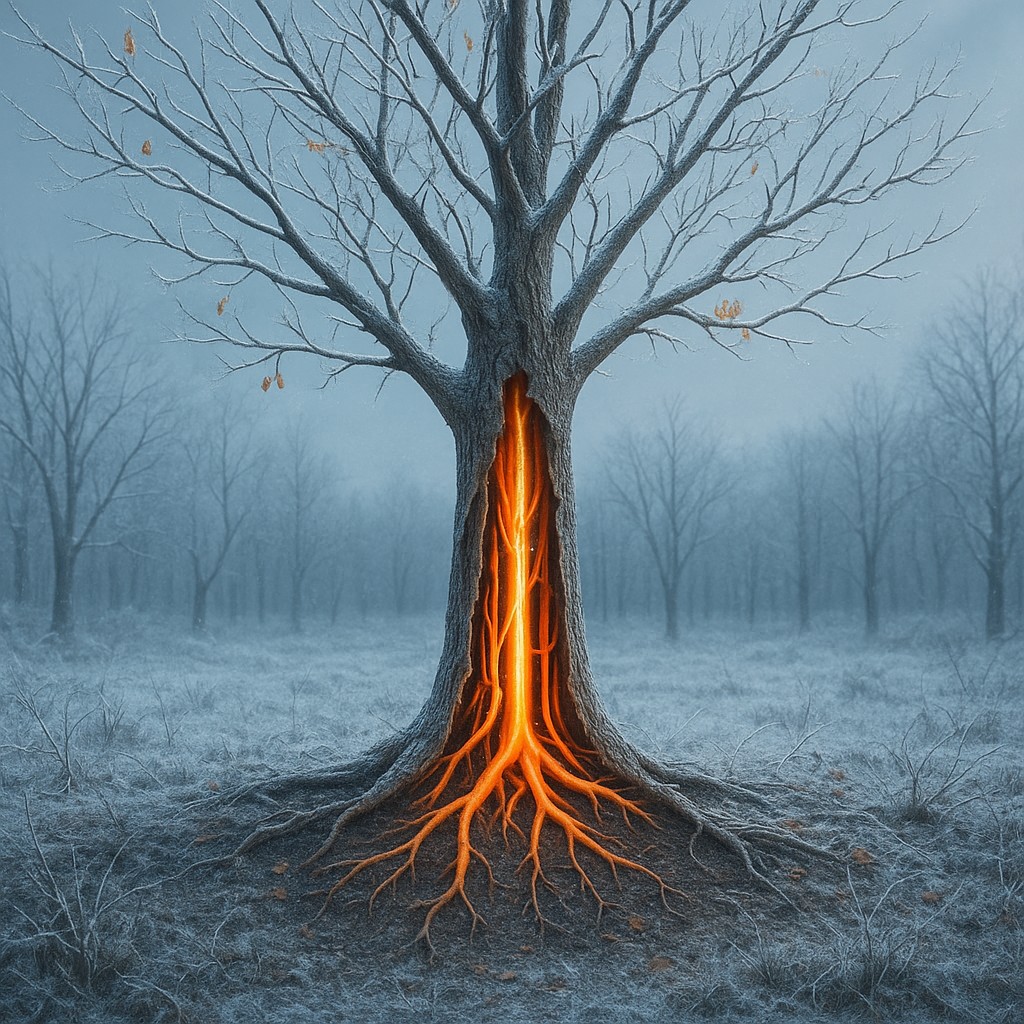
When the first autumn frost bites the air, we often think of the forest as a victim of the cold. We see brittle leaves falling, branches turning to skeletons, and the ground hardening like iron. It looks like a landscape of passive endurance, as if the trees are simply huddling against the wind like commuters waiting for a bus. However, what is actually happening inside those trunks is a masterclass in strategy. Instead of fighting the freeze, trees actively dismantle their own internal plumbing to prevent a total mechanical collapse.
Imagine you owned a cabin in a remote area where temperatures regularly hit forty below. You wouldn't leave the water running and just hope the heater stayed on. If you were smart, you would shut off the main valve and drain the lines, accepting that you won't have running water until the thaw. Trees do something very similar, but with a surprising twist: they don't just drain the pipes; they intentionally break them. By letting air into their systems, they create a safety barrier that keeps the entire organism from literally shredding itself from the inside out.
The High-Pressure Drama of Living Straws
To understand why a tree would purposefully break its own internal systems, we first have to recognize the high stakes of water transport. Trees do not have a heart to pump fluids. Instead, they rely on a process called transpiration, which is essentially a giant physics trick powered by the sun. As water evaporates from microscopic pores in the leaves, it creates a vacuum that pulls on the water molecules below. Because water molecules are "sticky" and cling to one another through hydrogen bonding, they form a continuous, unbroken chain stretching from the deepest root to the highest leaf.
This chain is under immense tension. In a tall redwood or a sturdy oak, the water column is stretched like a rubber band pulled to its limit. The tissue responsible for this is the xylem, a network of tiny, tube-like cells that act as the tree’s plumbing. Under normal summer conditions, this system is an engineering marvel, moving hundreds of gallons of water a day without a single moving part. But this high-tension system has a fatal flaw: it is incredibly fragile. If that continuous chain of water ever snaps, the "straw" loses its suction and the flow stops instantly.
The Treacherous Physics of Frozen Water
Winter poses a double threat to this elegant system. The first is expansion. Water is one of the few substances that expands when it freezes. In a cramped space like a xylem vessel, that expansion is devastating. If the water inside the tree freezes solid while the pipes are full, the pressure can rupture the cell walls. This is the botanical version of a pipe bursting in your basement, but with no way to call a plumber. If too many of these vessels burst, the tree loses its ability to move nutrients and water, leading to a slow death in the spring.
The second threat is more subtle: dissolved gases. All water contains a small amount of air. When water turns to ice, it can no longer hold those gases, and the air is forced out to form tiny bubbles. In the high-tension environment of a tree's plumbing, these bubbles are like a ticking time bomb. When the ice thaws, the bubbles don't always dissolve back into the water. Instead, they can expand and join together, snapping the water chain. This is known as "cavitation," and it creates a vascular embolism-a blockage of air that makes the pipe useless.
Failure as a Survival Tactic
In a brilliant display of the logic that says "if you can't beat them, join them," many cold-climate trees don't try to prevent these air blocks. Instead, they lean into them. As temperatures drop, trees like oaks and maples essentially allow their plumbing to fail on purpose. They let gas bubbles fill the xylem, creating a deliberate break in the water column. This intentional blockage effectively shuts down the tree's hydraulic system for the season.
By letting the pipes fill with air, the tree solves several problems at once. First, it avoids the massive pressure of expanding ice. Second, it enforces a state of dormancy. Because the water columns are broken, the tree can no longer pull moisture from the soil. This is actually a lifesaver because the soil is frozen solid. If a tree tried to maintain its water tension during the winter, the leaves would keep losing moisture to the dry air while the roots remained unable to replace it. This would lead to "winter burn" or desiccation, where the tree essentially freeze-dries to death. By breaking the circuit, the tree locks its remaining moisture inside its core.
Comparing Winter Strategies
Different trees have evolved different ways to handle this shutdown. Some are "risk-takers" with large, efficient pipes that fail easily, while others are "conservatives" with smaller, tougher plumbing.
| Tree Strategy |
Plumbing Type |
Winter Response |
Spring Recovery |
| Ring-Porous (e.g., Oak) |
Large, wide vessels for massive water flow. |
Nearly 100% of pipes "break" in winter. |
Must grow a whole new layer of wood before leaves can open. |
| Diffuse-Porous (e.g., Birch) |
Medium-sized vessels scattered through the wood. |
Partial blockage; some pipes stay functional or are easier to fix. |
Uses "root pressure" to push water up and dissolve air bubbles. |
| Tracheids (e.g., Pine/Spruce) |
Tiny, narrow cells rather than long pipes. |
Highly resistant to air blocks due to small size. |
Most pipes stay functional; can start photosynthesis earlier. |
The Real Reason Leaves Must Fall
This plumbing shutdown explains why deciduous trees drop their leaves. A leaf is essentially a high-maintenance water evaporator. Even in winter, a leaf has tiny openings called stomata that let gas in and out. If a tree kept its leaves while its internal pipes were broken, the dry winter wind would suck every drop of moisture out of its body. Without a working system to pull more water from the ground, the tree would be dead within weeks.
The autumn colors we enjoy are the result of the tree sealing its exits. Before the plumbing shuts down, the tree pulls valuable nutrients like nitrogen and phosphorus out of the leaves and stores them in the trunk. It then grows a specialized layer of corky cells at the base of the leaf stem called the abscission zone. This acts as a surgical seal. Once the leaf falls, the tree becomes a closed system-a vault of moisture protected from the thirsty winter air. Only when the plumbing is repaired or replaced in the spring can the tree afford to sprout new leaves.
The Physics of the Spring Reboot
Once winter ends, the tree faces a new challenge: how do you restart a broken hydraulic system? You can't just turn on the tap when the pipes are full of air. For many trees, the solution is brute force. Species like birch and maple use "root pressure." In early spring, the roots pump minerals into the xylem, which draws water from the soil. This creates a positive pressure that literally pushes air bubbles back into the liquid. This is the process that gives us maple syrup; the "sap run" is actually the tree pressurized and bleeding from the internal effort of fixing its plumbing.
Other trees, like the mighty oak, don't even try to fix the old pipes. Their vessels are so large that once they break, they stay broken. Instead, the oak waits until the very last moment of spring and uses its stored energy to grow a brand-new ring of wood. This fresh layer of xylem is pristine and bubble-free. This is why oaks are often the last to get their leaves; they aren't being lazy, they are busy building a new plumbing system from scratch before they dare to start the water engine.
The Architecture of Resilience
Nature rarely finds a perfect solution; instead, it finds ones that work under pressure. The sight of a bare, frozen forest might look like a retreat, but it is actually a display of mechanical sophistication. Each tree is an architect of its own survival, knowing exactly when to let go, when to break its own rules, and when to start over.
The next time you walk through the winter woods, think about the silent, air-filled pipes within the trunks. Consider the strategic genius of a life form that knows that sometimes, the only way to survive the pressure is to let the system break. By understanding these invisible mechanics, we can find a deeper appreciation for a natural world that doesn't just endure the winter, but uses the laws of physics to navigate it safely.