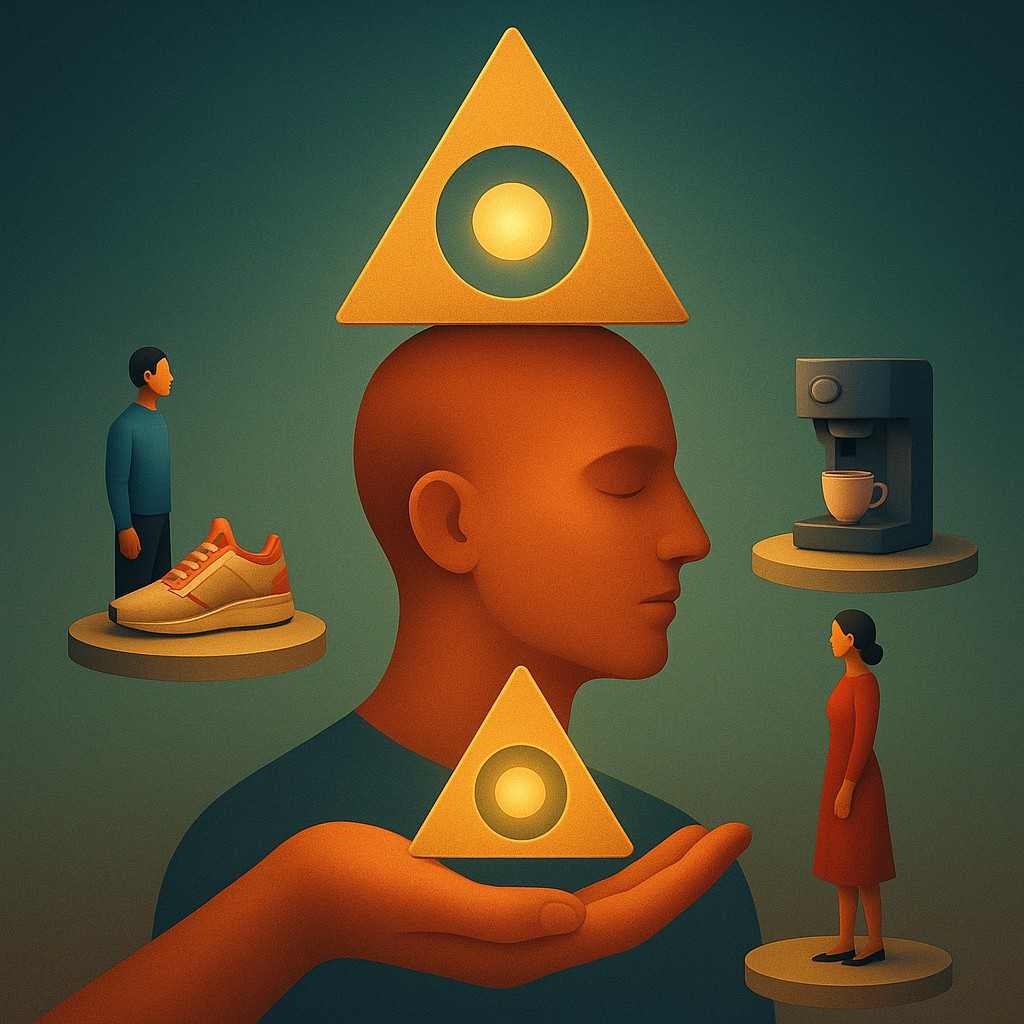
Think about the last time you felt a desperate need for something new. Maybe it was a specific brand of sneakers, a high-end espresso machine, or the sudden, urgent sense that you needed to overhaul your entire career to mirror a tech mogul you follow online. We like to believe our desires are deeply personal, bubbling up from our souls like a pure mountain spring. We tell ourselves we want that vintage car or that promotion because of its value or because it fits our unique identity. But if we look closer, we find that our wants are rarely original. Instead, they are often just reflections of what we see other people wanting.
This subtle but powerful force is called mimetic desire, a concept developed by the French thinker René Girard. The word "mimetic" comes from the Greek mimesis, which means imitation. Girard argued that humans do not naturally know what to want. Unlike biological needs like hunger or thirst, which are hardwired into our DNA, our higher-level desires are learned by watching others. We look to people Girard called "models" to show us what is worth chasing. Whether we are scrolling through a social media feed or watching a colleague get praised for a goal, we are always scanning our environment for clues about what our next big ambition should be.
The Triangle of Human Wanting
To understand how this works, we have to move past the idea that desire is a straight line between a person and an object. In the traditional view, you see a beautiful watch and decide you want it because it is shiny and keeps good time. Girard suggested that desire is actually a triangle. He proposed three points for every desire: the Subject (you), the Object (the thing), and the Model (the person you are imitating). You do not want the watch for the watch itself; you want it because you see someone you admire or relate to wearing it. The model lends a certain "glamour" or "status" to the object, making it look like the key to becoming a better version of yourself.
This triangular relationship explains why advertising works so well, even when we claim to be immune to it. A car commercial rarely spends a full minute discussing engine physics or safety ratings. Instead, it shows someone who looks like the person you want to become, driving through a beautiful landscape with effortless cool. The car is just the bridge. By getting the object, we subconsciously hope to gain the qualities of the model. We are not just buying a product; we are trying to "borrow" the lifestyle and status of the person who pointed us toward it.
This happens at every level, from playgrounds to boardrooms. A toddler might ignore a pile of bright blocks until another child picks one up. Suddenly, that specific block is the only one that matters, leading to an immediate tug-of-war. In the professional world, a job title might seem prestigious simply because three of your smartest peers are competing for it. The intensity of our focus is often less about the job's actual value and more about the fact that people we respect have validated it with their attention.
Close Neighbors and Distant Idols
Not all models are the same. Girard split them into two groups: external mediators and internal mediators. External mediators are people far removed from our daily lives. These are celebrities, historical figures, or legendary founders we can never actually meet or challenge. When you admire a famous artist and try to copy their work ethic, there is no risk of a fight because you are not competing for the same space. These models are generally safe; they inspire us to grow without creating the friction of a direct rivalry.
Internal mediators, however, are the people in our immediate circles: friends, siblings, coworkers, or neighbors. These are our peers. Because we live in the same "world" as them, our desire to have what they have can quickly turn into a competition. If your neighbor buys a luxury SUV, you might feel a sudden urge to upgrade your own car - not because your current one is broken, but because your neighbor has signaled that an SUV is a symbol of success in your community. This is where mimetic desire gets risky. Because you and your model are looking at the same limited pool of resources or status, you can easily become rivals.
| Type of Model |
Social Distance |
Risk of Conflict |
Impact on Behavior |
| External Mediator |
High (Celebrities, Icons) |
Low |
Provides inspiration and broad life goals. |
| Internal Mediator |
Low (Friends, Peers, Siblings) |
High |
Drives intense competition and "keeping up with the Joneses." |
| Digital Mediator |
Medium (Influencers) |
Variable |
Creates a "fake peer" relationship that fuels constant comparison. |
The tension with internal models often leads to "mimetic rivalry." When two people start wanting the exact same thing just because the other wants it, they stop focusing on the object and start focusing on each other. The goal shifts from "getting the thing" to "beating the person." This is the root of office feuds, family arguments, and even international conflicts. The closer we are to someone, the more likely we are to copy their desires, and the more likely we are to end up fighting over the same patch of grass, even if there is plenty of grass elsewhere.
The Exhaustion of the Digital Mirror
In the modern age, social media has poured gasoline on mimetic desire. Before the internet, your pool of models was small, limited to your local neighborhood and the occasional movie star. Today, we see thousands of potential models every time we unlock our phones. We are no longer just comparing ourselves to our neighbors; we are comparing our mundane Tuesday mornings to the "highlight reels" of the most successful people on Earth. This creates constant "mimetic noise," where we are hit with endless signals about what we should eat, where we should travel, and how we should spend our time.
This constant stream of imitation often leads to "herd behavior." You might notice that everyone on your feed is suddenly obsessed with the same hobby, like baking bread, or the same fashion style. These trends spread fast because humans are social creatures who seek safety in numbers. However, following the herd usually comes at a cost. When we chase goals just because everyone else is, we often end up exhausted and unfulfilled. We might win the prize, only to realize it was someone else’s dream all along.
The danger of the digital landscape is that it blurs the line between distant idols and our actual peers. We feel like we "know" influencers because we see their private lives, which tricks our brains into treating them like neighbors. This makes envy sharper and the urge to copy more frantic. We get caught in a loop of wanting what we see on a screen, which was likely a copy of something that person saw on another screen. This cycle can lead to a "mimetic crisis," where entire communities obsess over the same narrow version of success, leading to burnout and a loss of creativity.
Breaking the Cycle of Imitation
The good news is that simply noticing mimetic desire is the first step toward taking control. You cannot fully escape this part of being human - it is how we learn languages, manners, and skills. However, you can be more intentional about which models you choose to follow. Instead of blindly accepting whatever desires are floating around your social circle, you can step back and ask if a goal truly fits your values. This is the difference between "thin" desires (those we catch from others like a cold) and "thick" desires (those rooted in our unique talents and long-term purpose).
One strategy is to build a "mimetic barrier" by looking for inspiration in many different places. If you only follow people in your exact job or age group, you will likely fall into intense rivalry. If you instead look for ideas from different fields, age groups, or cultures, you reduce the pressure to compete. You might learn a work ethic from an athlete, a sense of wonder from a scientist, and a life philosophy from an ancient writer. By mixing these influences, you create a unique path that belongs to you alone.
Another tool is to focus on "non-rivalrous" goals. Rivalrous goals are things only one person can have at a time, like a specific promotion. Non-rivalrous goals are things like knowledge, friendship, or personal skill, which do not shrink when others have them. When you focus on growing your own skills or helping others, the pressure to compare yourself to others fades. You stop looking sideways at what your peers are doing and start looking forward at who you are becoming. By understanding how desire works, you gain the power to stop being a mirror of your environment and start being the architect of your own life.
Self-awareness isn't about getting rid of all your desires; it's about sorting through them. When you find the real reason behind your ambitions, you might discover that your biggest stresses are just the ghosts of someone else’s expectations. Letting go of these borrowed goals isn't a loss - it is a huge relief. As you prioritize your genuine needs over social noise, you will find more energy and a clearer sense of direction. Trust your own curiosity, and remember that the best path is the one you choose because it speaks to you, not because it echoes everyone else.