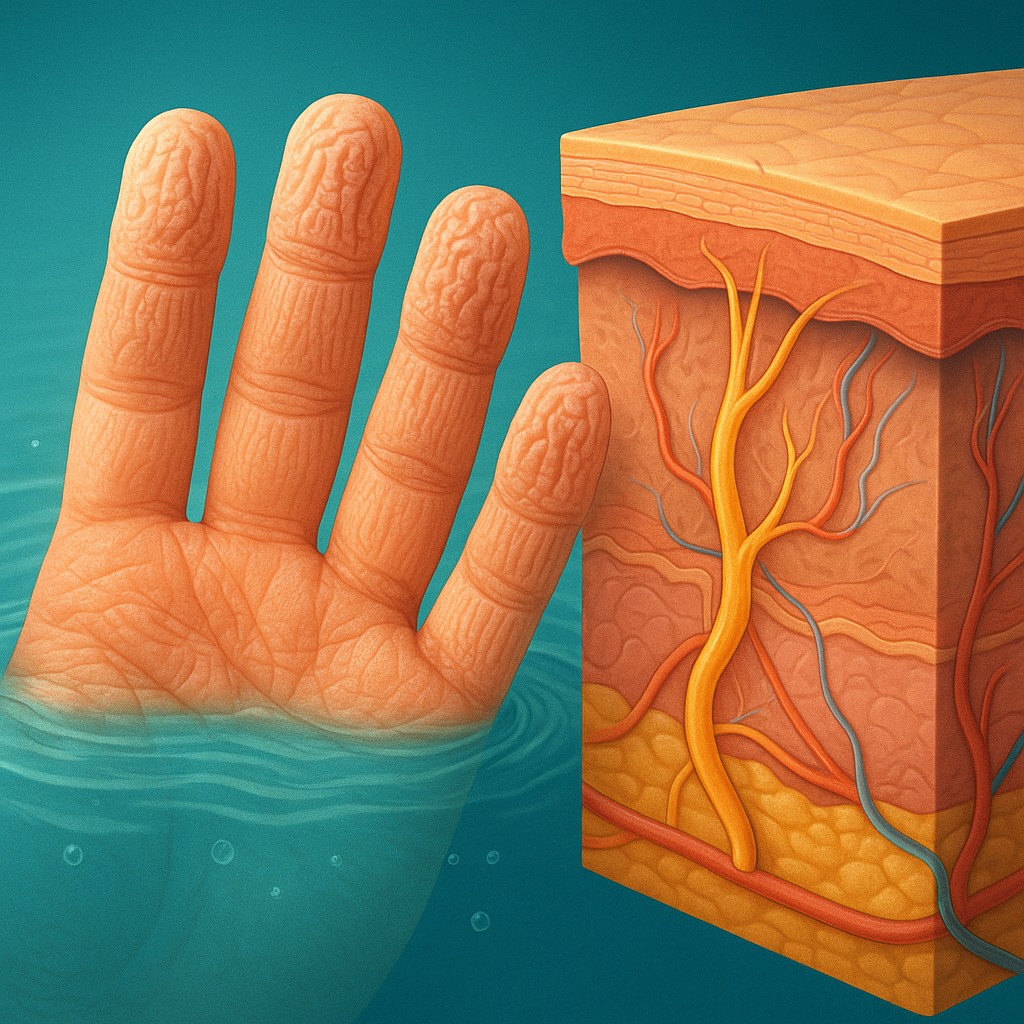
If you have ever spent a long afternoon lounging in a swimming pool or soaked in a hot bath until the water turned lukewarm, you are intimately familiar with "pruning." Your once smooth, supple fingertips transform into something resembling a sun-dried raisin or a topographical map. For decades, the common wisdom passed down from parents to children was that your skin was simply acting like a kitchen sponge. The story was simple: you are made of water, the tub is full of water, and after enough time, your skin just soaks up the excess until it swells and buckles into those characteristic ridges.
It is a perfectly logical explanation, except for the fact that it is completely wrong. If the "sponge" theory were true, every part of your body would shrivel up equally, leaving you looking like a humanoid prune from head to toe. Instead, this phenomenon happens almost exclusively on our hands and feet. Even more intriguing is the fact that if a person has specific types of nerve damage in their arms, their fingers stay perfectly smooth no matter how long they soak. This reveals a startling truth: pruning is not a passive accident of physics, but a sophisticated, active command sent from your brain to your hands and feet.
The Biological Command Center Behind the Ridges
To understand why our skin transforms in water, we have to look past the surface layers and into the sympathetic nervous system. This is the same system that controls your heart rate, your breathing, and your "fight or flight" response. When you submerge your hands in water, the nervous system eventually decides that you have been wet long enough for things to get slippery. It then sends a specific signal to the tiny blood vessels, known as glomus bodies, tucked deep beneath the skin of your fingertips and toes.
Once these vessels receive the signal, they undergo vasoconstriction, which is a technical way of saying they tighten and shrink. As the blood vessels pull inward, they create a vacuum-like effect on the tissue above them. Because the skin on our finger pads is anchored to deeper layers in specific spots, the shrinking interior pulls the surface down with it, creating deep, recessed channels. It is an active, energy-consuming process. Your body is essentially "remodeling" its own exterior in real-time to adapt to a changing environment. This explains why the process takes five to ten minutes to kick in; your brain is waiting to make sure the wetness is a permanent condition before it begins the mechanical shift.
A Natural Design Inspired by High-Performance Tires
Evolution is rarely a frivolous decorator, and the specific pattern of these wrinkles is far from random. If you look closely at your pruned fingers, you will notice the ridges tend to radiate outward from the center of the fingertip. This pattern is remarkably similar to the treads on a rain tire or the grooves on a high-performance running shoe. The primary enemy of a good grip is "hydroplaning," where a thin layer of water gets trapped between two surfaces, acting as a lubricant that causes you to slide.
By creating these deep channels, your nervous system is providing a drainage route. When you press a wrinkled finger against a wet stone or a submerged piece of fruit, the water is squeezed out through the "valleys" of the wrinkle. This allows the "peaks" of your skin to make direct, high-friction contact with the object. Without these grooves, the water would have nowhere to go, and you would be left fumbling. Researchers have actually put this to the test by having participants move wet marbles from one container to another. Consistently, those with wrinkled fingers performed the task significantly faster than those with smooth, dry hands.
Comparing Passive Swelling and Active Pruning
To truly grasp how unique this biological reflex is, it helps to compare it to how other materials interact with water. Most things in nature react to moisture through simple absorption, but the human body’s response is a distinct outlier.
| Feature |
Passive Absorption (Sponge Theory) |
Active Vasoconstriction (Nervous System) |
| Primary Cause |
Physical pressure pulling water into skin cells. |
Nervous system shrinking blood vessels. |
| Energy Required |
None; it is a passive physical reaction. |
High; requires active signaling and muscle contraction. |
| Location |
Everywhere the material touches water. |
Only on specialized areas like fingers and toes. |
| Nerve Dependency |
Would happen even if nerves were severed. |
Will not occur if the local nerves are damaged. |
| Evolutionary Purpose |
None; usually a structural weakness. |
Enhanced grip for gathering and movement in wet areas. |
The Ancestral Context of the Wet Grip
Why did we develop this specific trait while other mammals did not? The answer likely lies in the lifestyle of our early ancestors. Before we had grocery stores and paved roads, survival depended on the ability to forage in diverse environments. Imagine an early human trying to harvest nutritious roots from a muddy riverbank or trying to catch a slippery fish in a shallow stream. In these scenarios, a "rain tire" grip would have provided a massive competitive advantage. Those who could maintain their hold on wet, slippery objects were more likely to eat, survive, and pass those "wrinkly" genes down to the next generation.
Interestingly, this trait is also found in macaques, suggesting that the "wet grip" has been part of the primate toolkit for millions of years. It tells us that our ancestors spent a significant amount of time interacting with damp vegetation and aquatic environments. We are, in a sense, biologically programmed to be "all-terrain" foragers. The fact that pruning also occurs on our toes suggests an added benefit for walking. Crossing wet, mossy rocks near a shoreline is a recipe for a broken bone unless your feet can "tread" the surface effectively. Our toes wrinkle to ensure that even when the ground is slick, our steps remain sure.
The Chemistry of Salt and the Timing of the Fold
One of the most frequent questions regarding this phenomenon is why we do not prune quite as quickly when we are swimming in the ocean compared to a backyard pool or a bathtub. This is where the old theory of osmosis actually plays a small, supporting role. While the nervous system is the "driver" of the wrinkling, the external environment can influence the speed and intensity of the reaction. Saltwater contains much more salt than freshwater. When you are in the ocean, the difference in salt concentration between your body and the sea is much smaller.
In freshwater, the lack of salt creates a different sensory input for the skin's receptors. The body notes the lack of minerals and the high hydration level, which may trigger the "grip reflex" more urgently. In contrast, saltwater is closer to our own internal chemistry, which can sometimes delay the signal. However, regardless of the salt level, the nervous system remains the boss. If you stay in the ocean long enough, your brain will eventually decide that the benefits of a better grip outweigh the metabolic cost of shrinking those blood vessels, and the ridges will appear anyway.
Why We Stop Pruning and the Return to Normal
As soon as you step out of the water and dry off, your body begins to reverse the process. The nervous system senses that the hazard of a slippery environment has passed. The blood vessels in your fingertips begin to relax and open up, flooding the area with warm blood and "inflating" the skin back to its original, smooth state. This happens relatively quickly, usually within ten to twenty minutes, because maintaining tight blood vessels requires constant work from the muscles surrounding them. Your body is efficient; it does not want to spend energy on a high-grip mode if you are just sitting on a dry couch.
This return to normalcy is just as important as the pruning itself. While wrinkled skin is great for gripping wet things, it is actually less durable and more prone to tearing than smooth skin. Constant pruning would leave our fingertips vulnerable to blisters and scrapes. Our bodies have found the perfect middle ground: a temporary, on-demand structural change that only activates when the environment absolutely demands it. It is a masterpiece of biological engineering that most of us overlook every single time we take a shower.
The Body as an Intelligent Machine
The next time you look down at your hands after a long soak and see those deep grooves, take a moment to appreciate the silent conversation happening between your skin and your brain. You are not just "getting soggy." You are witnessing a high-speed survival mechanism that has been refined over millions of years of evolution. Your nervous system is constantly scanning your surroundings, making split-second decisions to improve your physical performance without you ever having to think about it.
This shift in perspective, from seeing pruning as a flaw of absorbent skin to seeing it as a feature of an advanced nervous system, changes how we think about our own biology. We are not just passive inhabitants of our bodies; we are the pilots of incredibly complex machines designed to interact with the world in the most efficient way possible. Whether you are grabbing a slippery shampoo bottle or imagining your ancestors snatching a meal from a rushing river, those wrinkles are a reminder of your incredible capacity to adapt, survive, and get a grip on whatever life throws your way.