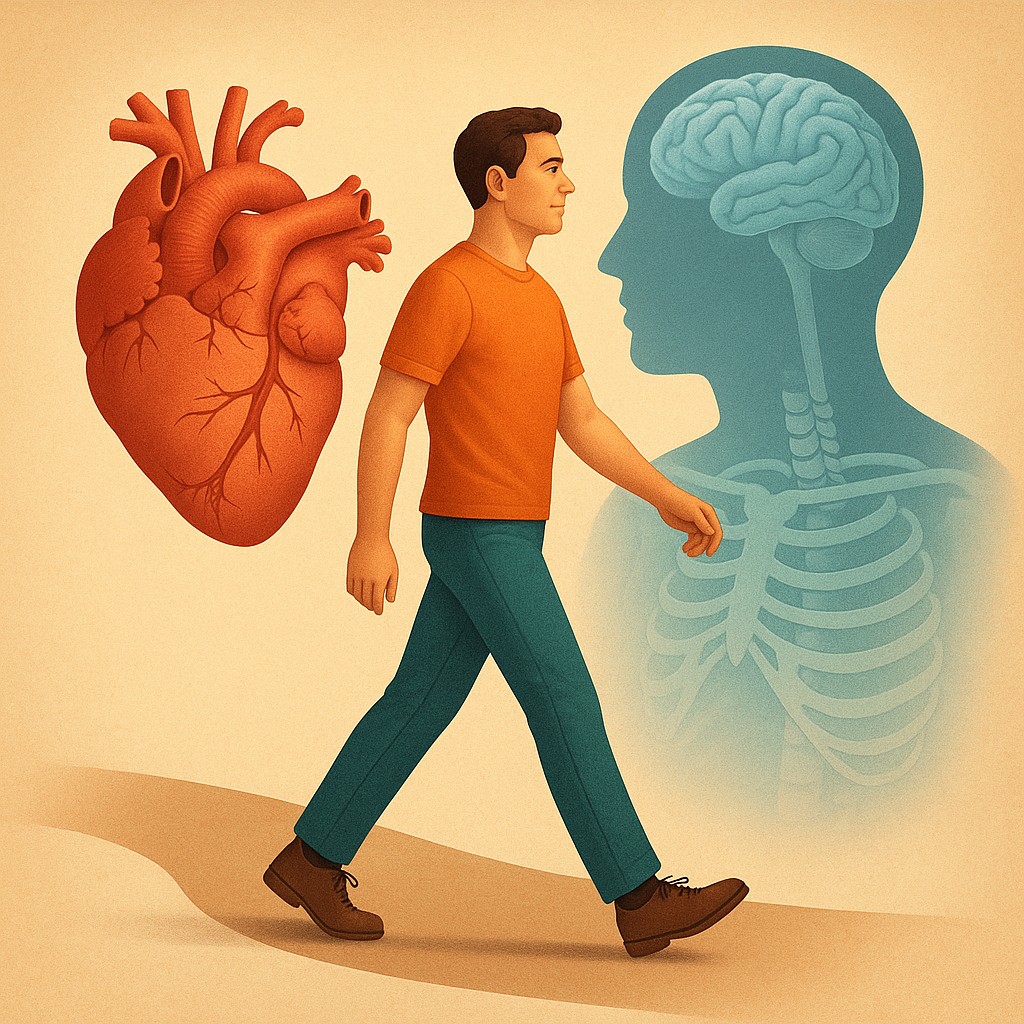
We often treat exercise as a grueling ritual involving heavy weights, neon spandex, and the kind of gasping for air that belongs in a Victorian tragedy. We have been conditioned to believe that if it does not hurt, it isn't working, and if it isn't complicated, it isn't effective. Yet, tucked away in our evolutionary toolkit is a prehistoric superpower we often overlook because it seems too simple to be "real" fitness. It is the humble act of putting one foot in front of the other, a skill our ancestors perfected over millions of years while trekking across the savannah.
Walking is quite literally what humans were designed to do. It remains one of the most underrated tools for a healthy metabolism, mental clarity, and a long life. When you walk, you engage a sophisticated internal system of muscles, bones, and blood vessels that does not require a gym membership or a pricey pre-workout drink. It is the ultimate low-cost, high-reward investment. Understanding how walking reshapes your body is the first step toward reclaiming the vitality that modern, sedentary life has slowly begun to erode.
The Physical Shift of a Daily Hour
If you commit to walking for one hour every day, you are doing more than just burning a few calories; you are upgrading your entire biological operating system. Within the first few days, your heart becomes more efficient at pumping blood, and your lungs get better at pulling oxygen from the air. Your body starts to manage blood sugar with much more skill because walking makes your cells more sensitive to insulin. This means that instead of your blood sugar spiking and crashing like a shaky stock market, it stays on a stable path, protecting your energy levels and long-term health.
Over the course of a month, the changes become structural. Your joints, especially your knees and hips, receive a fresh supply of synovial fluid - a natural lubricant that keeps everything moving smoothly. Many people worry that walking more will wear out their joints, but the opposite is usually true: movement helps deliver nutrients to cartilage, which does not have its own blood supply. At the same time, your brain begins to produce more "brain-derived neurotrophic factor," or BDNF. Think of this as "Miracle-Gro" for your brain; it helps repair neural connections and may even help grow new ones, leading to better memory and sharper focus.
As the months go by, the habit of these sixty-minute sessions becomes a powerful shield against chronic illness. Research suggests that consistent, brisk walking can significantly reduce the risk of heart disease, type 2 diabetes, and certain types of cancer. You also begin to see a shift in your body composition. While walking might not build the massive muscles of a weightlifter, it is an exceptional tool for burning fat while keeping lean muscle. Because walking is a low-stress exercise, it does not spike your cortisol (stress hormone) levels the way high-intensity workouts might. This makes it easier for your body to recover and stay in a fat-burning state without feeling constantly starving.
Comparing One Long Trek vs. Multiple Short Bursts
People often wonder whether it is better to take one long "power walk" or several shorter "fitness snacks" throughout the day. Fortunately, science offers reassuring answers depending on your specific goals. If your main objective is heart health and endurance, a single, steady hour allows your heart rate to stay in the "Zone 2" sweet spot - a moderate pace that builds your aerobic base. This teaches your body to become incredibly efficient at using fat for fuel and improves your overall stamina. There is also a mental benefit to the long walk: the rhythm becomes meditative, allowing your mind to solve problems that seem impossible while staring at a screen.
However, if your goal is to manage blood sugar and undo the damage of a desk job, multiple short walks may actually be better. When you walk for ten or fifteen minutes after a meal, you are effectively "mopping up" the sugar entering your bloodstream before it can cause a massive insulin spike. These frequent breaks also keep your metabolism from falling asleep. When we sit for hours, an enzyme called lipoprotein lipase, which breaks down fats in the blood, drops to very low levels. Periodic walking wakes up this enzyme and keeps your fat metabolism humming all day.
Ultimately, the best approach is the one that fits your schedule. If your morning is chaotic but your evening is free, go for a sixty-minute sunset stroll. If your day is a minefield of meetings, three twenty-minute walks or even six ten-minute walks provide nearly identical benefits. The total amount of movement is what matters most for general health, while the timing is a strategic tool for managing energy slumps.
| Comparison Factor |
Single One-Hour Walk |
Multiple Short Walks (e.g., 6 x 10 mins) |
| Endurance |
High - builds a stronger aerobic base. |
Moderate - less time at a steady heart rate. |
| Blood Sugar |
Good - improves overall insulin response. |
Excellent - prevents spikes after meals. |
| Weight Control |
High - higher calorie burn per session. |
Moderate - boosts metabolism periodically. |
| Mental Benefits |
Meditative - great for deep thinking. |
Refreshing - provides frequent brain breaks. |
| Joint Stiffness |
May feel tired by the end. |
Prevents "desk-chair stiffness." |
| Lifestyle |
Requires a dedicated block of time. |
Easy to fit into a busy schedule. |
Bringing Movement Into the Modern Workspace
The rise of the "under-desk treadmill" or walking pad has changed how many people view the workday. The concept is simple: instead of sitting in a chair that tightens your hips and rounds your shoulders, you walk at a slow, steady pace while you type, join video calls, or answer emails. From a health perspective, a walking pad is a game-changer. It allows you to rack up thousands of steps without ever leaving your desk, turning a sedentary eight-hour block into a dynamic, active period. It removes the struggle of "finding time" to exercise because the movement happens alongside your work.
However, using a walking pad effectively takes a bit of practice. It is generally best to keep the speed low, usually between 1.0 and 2.5 miles per hour. If you go too fast, your body sways too much, making it hard to type or focus. Most people find that "passive" tasks, like reading reports or listening to meetings, are perfect for walking. More "active" mental tasks, like writing complex code or intense brainstorming, might be better handled while standing still or sitting, as the brain sometimes struggles to balance high-level logic with physical coordination.
Physical transition is also important. If you switch from sitting for eight hours to walking for eight hours overnight, your heels, calves, and lower back will likely ache. Treat it like a new piece of gym equipment. Start with thirty minutes in the morning and thirty in the afternoon, gradually increasing your time as your muscles get stronger. When used correctly, a walking pad does more than burn calories; it keeps your energy high, prevents the 3:00 PM slump, and ensures you finish the workday feeling energized rather than drained.
Overcoming Obstacles and Common Myths
One of the biggest myths about walking is that it "doesn't count" if you aren't sweating through your shirt. This is a leftover from a culture of "no pain, no gain" that often does more harm than good. In reality, brisk walking - where you can still talk but would struggle to sing - is the gold standard for long-term health. It puts very little stress on the nervous system, meaning you can do it every day without burning out. Unlike running, which involves high-impact forces that can be tough on knees, walking is accessible to almost everyone regardless of their fitness level.
Another common concern is that walking is boring. If you see it as a chore to check off a list, it can feel repetitive. The trick is to pair walking with an activity you genuinely enjoy. This could be catching up on a podcast, listening to a book, or calling a friend. This "habit stacking" makes the walk something to look forward to. If you use a walking pad at home, you can even save a favorite TV show to watch only while you are moving.
Finally, do not get caught in the "10,000 steps" trap as if it were a magic number. That figure actually started as a Japanese marketing slogan for a pedometer in the 1960s. While it is a great goal, science shows that health benefits remain strong at around 7,000 to 8,000 steps for most people. If you currently only take 2,000 steps, reaching 5,000 is a massive win. The goal is not a perfect number, but simply moving more today than you did yesterday. Focus on the habit rather than the data, and your body will reward the effort.
Stepping Toward a Better Life
Starting a daily walking habit is perhaps the kindest thing you can do for your future self. It is a commitment to a life where you move with ease, think clearly, and have the energy to engage with the world. Whether you march through a park for an hour, take laps around your office, or clock miles on a walking pad while clearing your inbox, the result is the same: you are honoring the way your body was built. Let go of the need for intensity and embrace the power of consistency. The road to health is not a sprint, but a long, beautiful walk that begins with the simple decision to stand up and move.