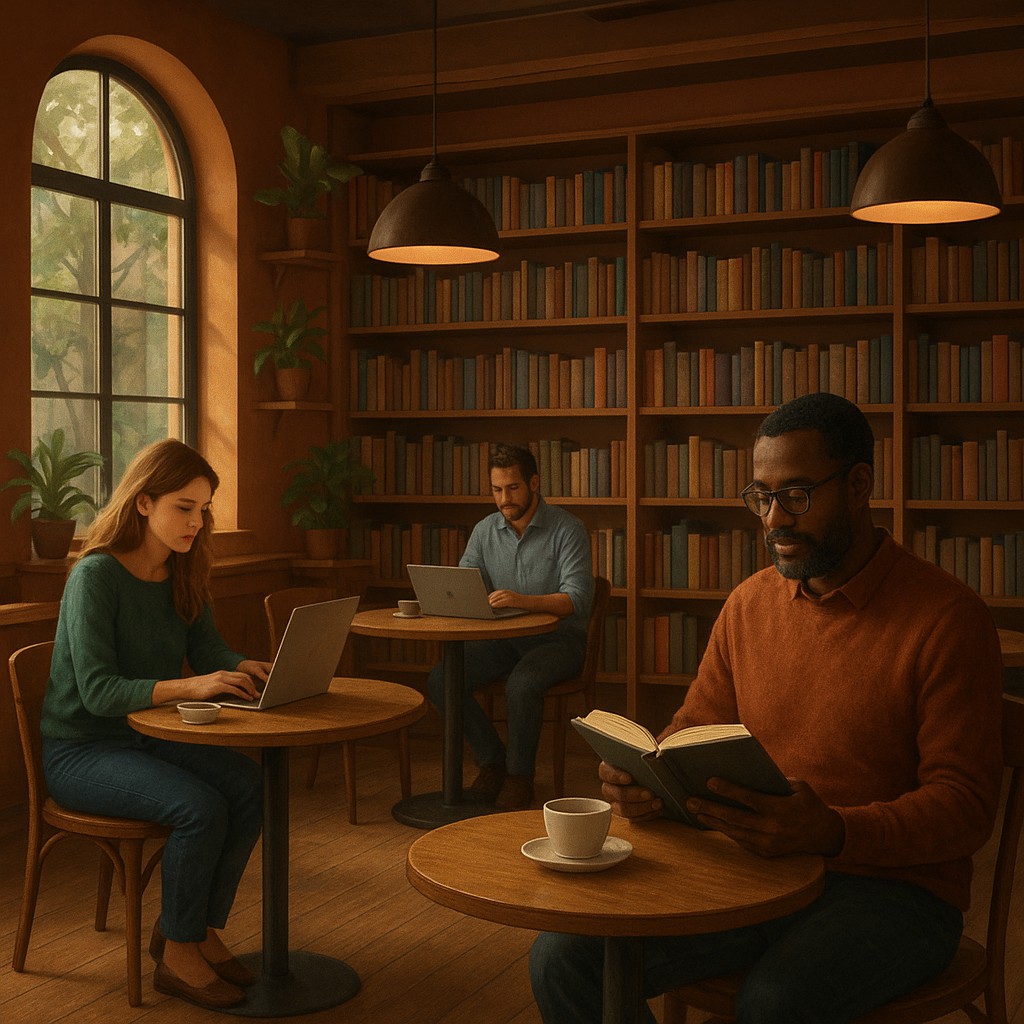
Imagine your typical Tuesday. For most of us, life follows a predictable, rhythmic swing like a pendulum. You wake up in your "first place," the home, where you handle chores, sleep, and your private life. Then, you head to your "second place," the office or workspace, where your identity is defined by how much you get done, your deadlines, and the company hierarchy. While these two pillars of existence are necessary for survival and shelter, a life lived only between the two often feels strangely hollow. If you have ever felt "urban loneliness" despite being surrounded by millions of people, you are likely missing the most vital ingredient of a social life: the third place.
The concept of the third place was popularized by sociologist Ray Oldenburg. He argued that for a society to be healthy, people need neutral ground where they can gather, put aside their status, and simply exist together. These are the neighborhood pubs, the quiet corners of public libraries, the park benches where elderly chess players meet, and the local coffee shops where the barista knows your name but not your job title. In these spaces, the pressure of being a "provider" at home or a "performer" at work fades away. You are just a person among people, participating in the informal public life that bridges the gap between the private individual and the massive, impersonal state.
The Architecture of Believing and Belonging
To understand why a bookstore feels different than a boardroom, we have to look at the specific traits that make a space a true third place. It is not just about having four walls and a roof; it is about the "social temperature" of the environment. A third place must be neutral ground. This means no one has to act as the host, and everyone feels they have an equal right to be there. There is no social anxiety about staying too long, and you aren't weighed down by the duties of hospitality that come with inviting someone into your home. It is a place where you can come and go as you please, and if you choose to stay, the atmosphere acts as a "leveler."
Leveling is perhaps the most magical quality of these settings. In a third place, your bank account, political power, or career success are pushed into the background. You might find a high-powered attorney chatting about a local sports team with a college student or a retired plumber. Because the environment does not reward or demand professional ego, people are free to engage in the most important activity of a third place: conversation. In these halls of casual chatter, the main "food" served is talk. It is often witty, lighthearted, and spontaneous. It serves as a playground for the mind where the only requirements for entry are a bit of kindness and a willingness to listen.
The Surprising Strength of Casual Acquaintances
We often prioritize our "strong ties" - the deep bonds we have with family and best friends - as the only relationships that truly matter for our well-being. However, sociology tells a different story through the lens of "weak ties." Weak ties are the people you recognize at the dog park, the regular you see at the cafe every Thursday, or the librarian who recommends a specific book because they know what you like. While these people might not be the ones you call during a medical emergency, they are statistically more likely to provide you with new information, different perspectives, and a sense of belonging to a group.
The "Strength of Weak Ties," a concept famously pioneered by Mark Granovetter, explains that our close friends usually move in the same circles we do. This means they know the same people and have the same information. Weak ties act as bridges to other social groups. They are the ones who tell you about a job opening at a company you have never heard of or introduce you to a hobby you didn't know existed. In a third place, you grow an entire ecosystem of these weak ties. This network acts as a social safety net, making the world feel smaller, friendlier, and easier to navigate. When you lose these spaces, your world physically shrinks to the size of your living room and your computer screen.
Navigating the Physical and Social Landscape
Not every public space counts as a third place. It is helpful to distinguish between a "commercial space" and a "communal space." To help clarify what makes a location a true anchor for the community, consider the following comparison:
| Characteristic |
Home & Work (1st & 2nd) |
The Ideal Third Place |
| Primary Purpose |
Survival, family, and production |
Social connection and relaxation |
| Social Hierarchy |
High (Parent/Child, Boss/Employee) |
Level (Everyone is an equal) |
| Conversation |
Task-oriented and functional |
Playful, spontaneous, and central |
| Accessibility |
Restricted (Invite only or badge in) |
Open, easy to access, and inviting |
| Mood |
Serious, private, or stressful |
Bright, cheerful, and low-pressure |
| Relationship Type |
Deeply emotional or transactional |
Casual, varied, and "weak ties" |
As seen in the table, moving from the first or second place to the third involves a total change in the social "vibe." A library is a classic example because it is one of the few remaining places where you can stay for hours without being expected to spend money. However, even businesses like cafes can serve this function if they prioritize "dwell time" (how long you stay) over "turnover" (how fast they can get you out). If a business encourages you to stay, provides comfortable seating, and builds an environment where regulars feel recognized, they are providing a public service that goes far beyond the coffee they sell.
Why Pixels Cannot Replace People
In the modern era, many have argued that the internet has become our new third place. We have Discord servers, Facebook groups, and Reddit forums where we can discuss our niche interests with people from across the globe. While these digital hangouts are excellent for sharing info, they often fail to provide the full benefits of being physically present. "Biological synchronization" happens when humans are in the same room. Our brains pick up on tiny facial expressions, body language, and the shared senses of the environment. This physical presence lowers stress hormones, like cortisol, in a way that looking at a blue-light screen simply cannot.
Furthermore, online spaces are often built on "algorithms of interest." This means we only interact with people who already agree with us or share our specific background. A physical third place is naturally messy and diverse. You might find yourself sitting next to someone from a different generation or a different political side. Because you are sharing a physical space and perhaps a smile or a small comment about the weather, you are forced to see their humanity. This "forced" politeness is the glue that prevents a society from breaking into isolated, angry groups. Moving only between your home and a digital forum results in a "thin" social life, whereas a physical third place provides a "thick" experience of community.
The Ripple Effect of a Healthy Neighborhood
When a community invests in its third places, it isn't just making the neighborhood prettier; it is building "social capital." Social capital is the collective value of all social networks and the natural desire we get from those networks to do things for each other. In neighborhoods with strong third places, people are more likely to trust their neighbors. This trust leads to lower crime rates, better local political involvement, and a faster recovery after a crisis. If a neighborhood is hit by a storm or a power outage, the people who have spent time together in the local park or pub are the ones who know which elderly neighbor needs a check-in, or who has a generator they can share.
Collective mental health is also directly tied to these spaces. Isolation is a quiet epidemic, and the third place acts as a natural preventative medicine. Knowing that there is a place you can go where "everybody knows your name" (as the old TV theme song says) provides a sense of emotional security. It protects you from the feeling of being a nameless gear in a giant machine. When we lose these anchors, we see a rise in anxiety and a drop in local pride. Therefore, urban planning that focuses on walkable neighborhoods, public squares, and accessible community centers is actually a form of public health infrastructure.
Correcting the Myths of Social Life
A common mistake is thinking that introverts do not need third places. In reality, introverts often thrive in these settings because third places allow for "low-stakes" social interaction. An introvert can sit in a busy cafe with a book, enjoying the "ambient belonging" of being around people without the pressure of a one-on-one conversation. It is a way to feel connected to the world without the exhaustion of a formal party. Another myth is that third places must be expensive or fancy. On the contrary, the best third places are often a bit "shabby" or "homely." If a place is too perfect or expensive, it feels exclusive and loses its power to level everyone out. The most effective social anchors are usually the ones where the chairs don't match and the coffee is cheap.
Finally, some people believe that the decline of the third place is an unavoidable result of technology and "progress." While it is true that car-dependent suburbs and online shopping have made it harder to keep these spaces, their disappearance is not a done deal. Many cities are rediscovering the value of "placemaking." This involves designing public spaces that encourage people to linger rather than just pass through. By choosing to support local independent businesses and spending time in public parks or libraries, we can actively repair the social fabric of our own lives.
Finding Your Own Anchor
The next time you feel the urge to hide in your living room and scroll through a social media feed, consider heading out to find your own third place instead. It might be a community garden, a local comic book shop, or even a specific bench at the waterfront where the regulars gather at sunset. Look for a place that feels like a "home away from home," where you feel at ease and where the world's demands feel just a little bit farther away. Your presence in these spaces is not just a personal choice; it is a contribution to the strength and energy of your entire community.
Embracing the third place is about more than just finding a good spot for a latte; it is about reclaiming the human right to be a social creature in a physical world. By stepping out of the rigid boundaries of the home and the office, you open yourself up to the delightful surprises of life. You may find a new friend, discover a new idea, or simply find comfort in the quiet pulse of people living life together. Go find your space, stay a little longer than usual, and remember that the strongest communities are built one casual conversation at a time.