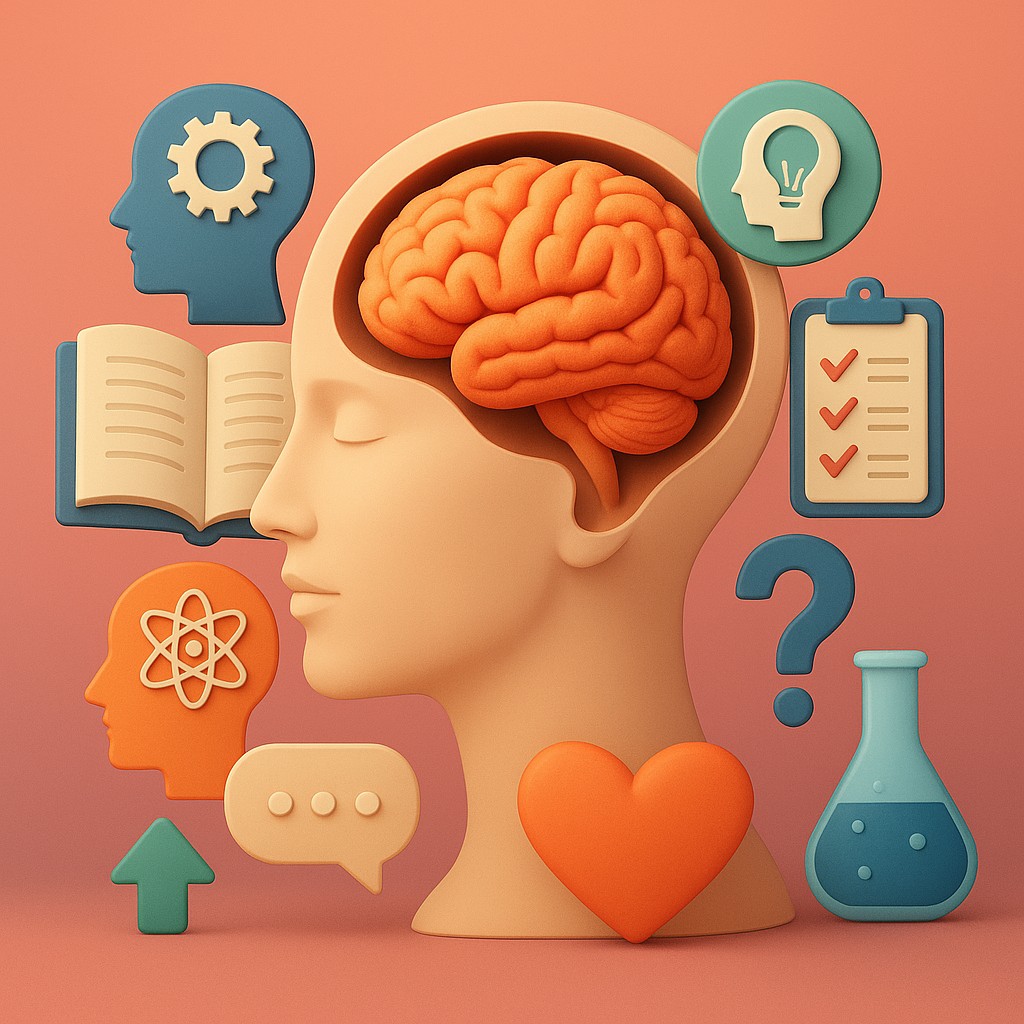
Why psychology matters to your coffee, your relationships, and your future self
Psychology is the friendly, nosy science that studies why people do what they do, think what they think, and feel what they feel. It explains why your favorite song can make you cry, why texting "k" feels passive-aggressive, and why that meeting left you buzzing for hours. Far from being abstract, psychology offers practical tools to improve learning, manage stress, resolve conflict, and make better decisions. Think of it as a curiosity-powered toolkit for living smarter, kinder, and with fewer awkward social moments.
Most of us use psychological principles every day without realizing it - when we form impressions of strangers, when we try to motivate a colleague, or when we remember where we left our keys. Knowing the science behind these moments gives you leverage: you can change habits more reliably, choose healthier relationships, and spot misleading arguments faster. Psychology also matters at social and societal levels, from designing schools and workplaces to shaping public health campaigns. That mix of personal usefulness and public impact is why psychology is worth learning, even if you never take a formal class.
If you think psychology is just about therapy or reading minds, you are not alone, but you are about to be delightfully corrected. Psychology is a broad, evidence-based field that combines lab experiments, brain scans, surveys, and thoughtful theory. In this introductory tour you will meet the major ideas, learn how scientists study behavior and mind, and pick up practical exercises to apply right away. My promise: by the end you will see everyday life with a sharper, kinder lens and have concrete ways to practice what you learn.
A friendly map of psychology’s major ideas and schools
Psychology grew from philosophy and biology into many specialties, which sometimes argue with each other like siblings at a family dinner. Major schools include behaviorism, which focuses on observable actions and rewards; cognitive psychology, which studies thinking and information processing; biological psychology, which links behavior to brain and body; psychodynamic thought, which explores unconscious motives and early relationships; and humanistic psychology, which emphasizes growth and meaning. Each school highlights something useful - behaviorists give concrete techniques for change, cognitive psychologists help improve learning and decision-making, and biological approaches connect mental states to physiological mechanisms.
Rather than treating these schools as competing truth claims, think of them as complementary tools for understanding a complex human. For instance, depression can be approached as a biological imbalance, a pattern of negative thinking, a reaction to life events, and a developmental product of early attachment all at once. Modern psychologists often combine insights, using medication, cognitive therapy, and social support depending on the problem. That pragmatic blending is why the field keeps advancing: it borrows the best ideas and tests them rigorously.
Schools of thought also shaped how research is done and what questions are asked. Behaviorists pushed careful experimental control, cognitive psychologists introduced rigorous models of information flow, and neuroscientists brought imaging tools that let us watch brains in action. Learning these perspectives equips you to read studies critically, understand their limitations, and appreciate how different methods give different kinds of answers. It also helps you choose interventions in your own life that match the problem you want to solve.
How the major approaches stack up - a quick comparison
| Approach |
Focus |
Typical methods |
Useful for |
| Behaviorism |
Observable behaviors and learning |
Experiments, conditioning |
Habit change, training, behavior modification |
| Cognitive |
Thought, memory, problem-solving |
Lab tasks, reaction times, models |
Improving learning, decision-making, therapy (CBT) |
| Biological |
Brain, genes, neurotransmitters |
Neuroimaging, pharmacology, electrophysiology |
Understanding mental disorders, neurorehab |
| Psychodynamic |
Unconscious motives, early experiences |
Case studies, clinical interviews |
Insight-oriented therapy, personality issues |
| Humanistic |
Growth, meaning, choice |
Qualitative studies, therapy sessions |
Well-being, motivation, self-actualization |
| Social |
Influence of others and groups |
Surveys, experiments, observations |
Persuasion, prejudice, group dynamics |
This table condenses decades of debate into a practical cheat-sheet. No single row holds the whole truth, but together they illuminate how psychologists approach questions from different angles. Use this as a starting compass when you read a study or choose an approach for a personal problem.
How psychologists study the mind without being mind readers
Psychology is empirical - it relies on observation, measurement, and careful reasoning rather than guessing. Experimental methods manipulate one variable and measure another to infer cause and effect, while correlational studies look for relationships without claiming causation. Observational and naturalistic studies capture behavior in real-world settings, and case studies dig deep into single instances for rich insight. Longitudinal studies follow people over time to reveal development and change, while twin and adoption studies untangle genetic and environmental influences.
Good research balances internal validity - how confident we are about cause and effect in a study - with external validity, or how well results generalize. Randomized controlled trials are the gold standard for testing interventions, but they are not always ethical or practical. That is why psychologists use a pluralistic toolbox: multiple methods across studies build convergent evidence, making conclusions stronger. As a consumer of psychological claims, look for replication, sample diversity, clear measurement, and openness about limitations.
Statistics are the language of psychological evidence, but you do not need to be a math wizard to interpret a study sensibly. Focus on effect sizes, real-world relevance, and whether findings have been replicated. Beware of single flashy studies, especially if they rely on small samples or p-hacking - selective reporting of results. A healthy skepticism helps you separate robust findings from trendy but shaky headlines.
Your brain in plain English - the biological basics you need
At a basic level, the brain is a network of neurons that communicate with electrical and chemical signals. Neurons connect through synapses where neurotransmitters - chemicals like dopamine, serotonin, and glutamate - pass messages that influence mood, attention, and movement. Brain regions specialize: the prefrontal cortex helps with planning and impulse control, the hippocampus supports memory formation, and the amygdala tags experiences with emotional significance. These parts work together dynamically, not like rigid modules, so behavior emerges from complex interactions.
Neuroplasticity - the brain's ability to reorganize with experience - is one of psychology's most hopeful findings. New learning, therapy, or practice can change neural pathways, improving skills and resilience. That said, biology is not destiny; genes predispose but environments and choices shape outcomes significantly. When people hear "your brain did this," remember it means a history of experiences, habits, and biology combined to produce the moment you are in.
Modern tools like fMRI and EEG let researchers observe brain activity correlated with tasks and emotions, but these methods have limits. Imaging shows patterns of activity, not precise causes, and interpretation requires caution. The key takeaway is not to over-interpret scans, but to appreciate that mental states have biological correlates and that interventions can work at both psychological and biological levels.
Thinking, learning, and memory - cognitive psychology made useful
Cognitive psychology studies the mental processes behind attention, perception, memory, problem-solving, and language. Attention is finite, so multitasking often means rapid switching with performance costs rather than true simultaneous processing. Perception is active: your brain interprets sensory input using prior knowledge, which explains optical illusions and confirmation bias. Memory is not a video recorder; it is reconstructive - you encode, store, and retrieve information, and each retrieval is an opportunity for distortion.
Practical consequences flow from cognitive principles. Effective learning uses spaced repetition, testing yourself, and varied practice rather than massed cramming. To remember something, encode it meaningfully and retrieve it often. Problem-solving benefits from breaking tasks into subgoals and re-framing stumper problems. Cognitive biases, such as availability bias and anchoring, are mental shortcuts that help but sometimes mislead; being aware of them can improve decision-making.
Cognitive behavioral therapy (CBT) is an example of applying cognitive science in therapy: it helps people spot unhelpful thoughts, test them against reality, and build healthier thinking patterns. Understanding your cognitive architecture - its strengths and limits - turns vague self-improvement goals into targeted strategies that actually work.
Growing up and growing older - a lifespan view of development
Developmental psychology explores how people change from infancy through old age, focusing on cognitive, emotional, and social growth. Early attachment relationships shape expectations about others and influence later intimacy and trust, but attachment patterns are not immutable. Critical and sensitive periods matter for certain skills - language acquisition is much easier in early childhood - yet plasticity allows learning later in life. Nature and nurture interact constantly, so genes set potentials while environments influence expression.
Adolescence is a period of rapid brain and social change, often producing risk-taking as the reward system matures faster than control systems. Midlife and later years bring their own developmental tasks, such as consolidating identity and finding meaning, which many people do successfully. Aging includes cognitive shifts that are variable; while some processing speed may slow, knowledge and emotional regulation often improve. A lifespan perspective helps you set realistic expectations for growth and change at each stage.
Developmental research relies on longitudinal and cross-sectional methods to separate age effects from cohort effects. That means watching people over time gives richer information than single snapshots, and policies or interventions should account for the timing and context of development.
Personality and individual differences - the science of what makes people unique
Personality psychology studies stable patterns of thought, feeling, and behavior that make individuals distinct. One widely used model is the Big Five traits - openness, conscientiousness, extraversion, agreeableness, and neuroticism - which reliably describe individual differences across cultures. Personality traits predict many life outcomes: conscientiousness correlates with academic and job success, while high neuroticism can relate to emotional difficulties. Traits are not fate, but they offer useful predictors and starting points for personal development.
Personality assessments range from self-report questionnaires to behavioral observations, each with strengths and pitfalls. Self-reports are efficient but subject to bias; informant reports add perspective. Interventions to change personality are possible but often gradual; targeted behavior change, therapy, and sustained practice can shift patterns over time. Appreciating personality differences also improves relationships by encouraging empathy and tailored communication.
Beyond traits, individual differences include intelligence, temperament, values, and interests, which together shape personal paths. Recognizing this complexity helps avoid simplistic labels and encourages nuanced understanding of why people act differently in the same situation.
Mental health and therapy - evidence, stigma, and where to get help
Mental health covers a broad range of experiences, from mild distress to severe disorders like major depression, anxiety disorders, bipolar disorder, and schizophrenia. Modern mental health practice uses a biopsychosocial model that considers biological factors, psychological processes, and social context. Evidence-based treatments include psychotherapies such as CBT, interpersonal therapy, and family therapy, as well as medications when appropriate. Combined approaches often work best, and stepping into treatment is a sign of strength, not weakness.
Stigma remains a barrier to care; myths that mental illness is a moral failing or purely a character flaw are inaccurate and harmful. Many conditions are treatable, and early help generally improves outcomes. If you or a loved one experience persistent changes in mood, thinking, or functioning, practical steps include talking to a trusted person, seeking a professional evaluation, and using crisis resources when safety is at risk. Therapy and medication can reduce symptoms and restore functioning, allowing people to reclaim meaningful lives.
Prevention and promotion of mental health matter as much as treatment. Building social support, managing stress through sleep and exercise, and learning coping skills reduce the risk of problems escalating. Public policies that reduce inequality, improve access to care, and normalize help-seeking make a big population-level difference.
Common myths and mistakes about psychology - what to stop believing
Although psychology is evidence-based, popular culture often spreads misconceptions that stick. A few persistent myths worth debunking include the following:
- You only use 10 percent of your brain: Brain imaging shows activity across most regions even at rest, so this claim is false and misleading.
- Mental disorders are just personality weaknesses: Many disorders have biological, psychological, and social roots; they are not moral failings.
- Labels like "introvert" or "addicted" explain everything: Labels can be helpful shorthand, but they oversimplify dynamic processes and contexts.
- Past events determine everything: Early experiences matter but do not irrevocably seal your fate; change and growth are possible.
- Psychology is just common sense: Some findings seem intuitive only after they are discovered; rigorous methods often reveal counterintuitive truths.
Calling out myths helps you spot poor advice and choose strategies that actually work. Healthy skepticism, combined with habit of checking evidence, keeps you from being swayed by catchy but incorrect claims.
Small experiments to try - apply psychology to your life this week
Psychology is most powerful when tested through small, controlled experiments on yourself. Try these beginner-friendly experiments and observe what changes:
- Improve sleep by setting a fixed wake-up time and reducing screen use an hour before bed; track mood and focus for two weeks.
- Boost learning with spaced repetition: study material briefly across several days instead of one long session, and self-test each time.
- Practice a tiny habit for four weeks, such as two minutes of morning stretching, to build momentum and study behavior maintenance.
- Use cognitive reappraisal when stressed: write down the automatic thought, generate alternative explanations, and note emotional shifts.
- Social experiment: offer a small, genuine compliment daily and observe effects on relationships and mood.
Design these experiments like a mini-study: define what you will change, decide how to measure it, try it for a set period, and review results. The scientific habit of testing, recording, and reflecting is itself a psychological skill that produces steady improvement.
How to keep learning - courses, books, and habits that work
If this taste of psychology has whetted your appetite, continue with a mix of structured learning and playful curiosity. Recommended next steps include:
- Introductory textbook or free online courses in psychology for foundational knowledge.
- A few accessible classics: "Thinking, Fast and Slow" by Daniel Kahneman, "Mindset" by Carol Dweck, and "Influence" by Robert Cialdini.
- Podcasts and science communication channels that summarize recent research and practical applications.
- Practice habits: a weekly reflection log, monthly reading goals, and joining a study group or discussion club.
Mix reading with practice: try skills from books and classes in real life, then reflect on outcomes. That loop - learn, apply, evaluate - turns information into expertise, not just trivia.
Parting nudge: use psychology responsibly and with curiosity
Psychology gives you tools to understand and influence behavior, which carries responsibility. Use what you learn to improve well-being, help others, and foster understanding rather than manipulate. Be curious, not cynical; test claims kindly and stay open to surprising findings that challenge intuition. With a mix of scientific thinking, compassionate use, and playful experimentation, you can make better decisions, build healthier relationships, and grow in ways you might not have expected. Keep asking questions, keep practicing, and enjoy how every small insight compounds into a smarter, kinder life.