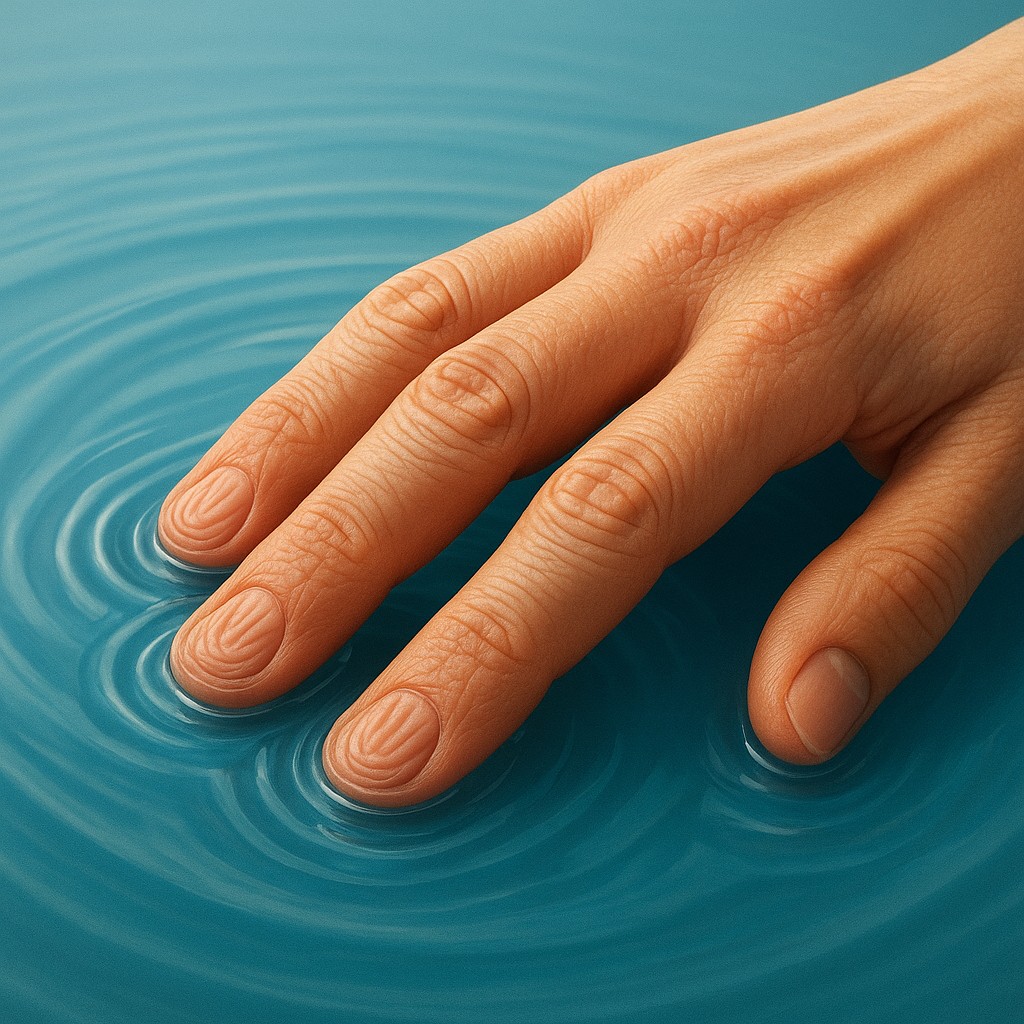
We has all had that moment after a long, relaxing soak in the tub or a workout at the local pool when we look down and see the hands of an eighty-year-old staring back at us. Those deep, distinctive ridges on our fingertips and toes make it look as though our bodies are slowly deflating or even dissolving in the water. For years, the standard explanation taught in grade school was a simple matter of osmosis. We were told our skin acted like a kitchen sponge, soaking up water until the outer layers expanded and buckled into ripples because they had nowhere else to go. It seemed like a perfectly logical physical reaction to being underwater for too long.
However, if you look closer at the "sponge theory," that logic starts to fall apart. If our skin wrinkled simply because it was absorbing water, then every inch of our bodies should look like a golden raisin after a bath. Our bellies, arms, and thighs are covered in skin just as porous as our fingertips, yet they stay smooth while our hands transform. The truth is far more sophisticated and reveals a hidden layer of biological engineering. Rather than being a passive victim of physics, your body is actually making a high-speed adjustment to its environment. Those wrinkles are not a sign of your skin failing, but a sign that your nervous system is working overtime to turn you into a more efficient machine.
The Secret Signal from the Nervous System
To understand why your skin changes shape, we have to look past the surface and into the body’s internal wiring. The discovery that "pruning" was not caused by water absorption came from an unusual source: surgeons treating patients with nerve damage. They noticed that when a patient had a severed nerve in their arm or finger, that specific finger would never wrinkle, no matter how long it stayed in a bucket of water. If the process were just about water soaking in, the condition of the nerves would not matter at all. The fact that a "dead" signal resulted in smooth skin proved that wrinkling is an active command sent by the brain through the autonomic nervous system.
This is the same subconscious system that regulates your heartbeat, your breathing, and your sweat glands. When receptors in the skin or your eyes detect long-term exposure to water, the nervous system sends a "hunker down" signal to the tiny blood vessels tucked beneath your fingertips. These vessels, called glomus bodies, begin to constrict or narrow. As they shrink, the volume of the soft tissue under the skin decreases. Because the tough outer layer of the skin is anchored to the bone and tissue at specific points, this sudden loss of volume underneath forces the surface to collapse inward. This creates the valleys we see, while the anchor points remain as ridges. It is less like a sponge soaking up water and more like a vacuum-sealed bag pulling tight around its contents.
Nature's Rain Tires for the Human Hand
If the brain is putting in the effort to shrink blood vessels and rearrange your skin, there must be a practical reason for it. Evolution rarely keeps traits that consume energy unless they provide a clear survival advantage. In 2013, researchers at Newcastle University decided to test the "grip theory." They asked volunteers to move wet objects, such as marbles and fishing weights, from one container to another through a small opening. They found that people with pruned fingers were significantly faster and more accurate at handling wet objects than those with smooth, dry hands. Interestingly, when the objects were dry, the wrinkles offered no advantage at all.
This suggests that our ancestors, who spent their days foraging in wet riverbeds or trekking through rain forests, developed a biological equivalent to the treads on a car tire. On a high-performance rain tire, the grooves are designed to channel water away from the point where the rubber meets the road. This prevents hydroplaning, which happens when a layer of water gets trapped between the tire and the street, causing a total loss of traction. Your finger wrinkles serve the exact same purpose. When you reach for a wet rock or a slippery fish, the water is forced into the "valleys" of your skin, allowing the "ridges" to make firm, dry contact with the surface. It is a masterful piece of hydraulic engineering that happens automatically without you ever having to think about it.
Comparing the Old Myth and the New Reality
Visualizing the differences between the traditional "osmosis" theory and the modern "vasoconstriction" (vessel-shrinking) model helps us see how our bodies truly interact with the world.
| Feature |
The Old Sponge Theory (Myth) |
The Modern Neural Theory (Fact) |
| Primary Driver |
Passive Osmosis (Water absorption) |
Active Nervous System Response |
| Mechanism |
Skin expands and buckles |
Blood vessels shrink and pull skin tight |
| Control |
External (The water does the work) |
Internal (The brain gives the command) |
| Purpose |
None (Accidental side effect) |
Adaptation (Better grip on wet surfaces) |
| Where it occurs |
Should happen on all skin |
Primarily fingertips, toes, and palms |
| Nerve Dependence |
Happens even if nerves are damaged |
Only happens if the nervous system is intact |
The Efficiency of Subconscious Adaptation
This automatic response shows how much of our survival is managed "under the hood." We often think of our brain's primary job as thinking or feeling, but its most vital role is monitoring the environment and making micro-adjustments to keep us safe. When you step into a cold room, your brain triggers goosebumps to trap a layer of heat; when you step into a pool, it triggers pruning to ensure you don't slip. These are reflexes that bypass our conscious mind entirely. If we had to manually decide to "increase grip" every time we touched something wet, we would likely drop our tools or lose our footing long before the thought even formed.
Recent research also suggests that the pattern of these wrinkles is not random. The folds tend to follow a specific "drainage" layout that is remarkably consistent from person to person. Just as a river delta is shaped by the flow of water, our skin folds are shaped by underlying vascular tunnels. This consistency suggests our DNA contains a blueprint for how to fold the skin for maximum drainage. We are born with a built-in toolkit for navigating a wet world, inherited from ancestors who needed every bit of traction they could get.
Clarifying Common Misconceptions About Skin Health
Because the "pruning" effect looks so much like shriveling, many people worry that spending too long in the water is damaging their skin. While staying in a hot bath for hours can eventually strip away the natural oils that keep your skin moisturized, the wrinkles themselves are not a sign of damage. In fact, if your fingers do not prune after twenty minutes in the water, it might be a sign of a neurological issue rather than "healthy" skin. Medical professionals sometimes use a water-immersion test as a quick way to check if the nervous system is functioning correctly in patients with suspected nerve damage.
Another common myth is that only humans have this ability. While we are the most studied pruners, researchers have observed similar skin patterns in other primates, such as macaques, who also forage in wet environments. This suggests the trait is an old evolutionary "software update" that appeared millions of years ago. It also debunks the idea that our skin is "leaking" salt or fluids into the surrounding water. If the process were about leakage, we would feel exhausted or dehydrated after a swim; instead, the body is simply shifting its internal resources to give you better traction.
A New Way to Look at Your Body's Design
Learning that skin pruning is an active process changes how we see our own biology. We often view ourselves as fragile, but the "rain tire" fingertip shows we are incredibly resilient. Every time you see those ridges appearing on your hands, you are witnessing a real-time hardware transformation. Your brain has recognized a change in your surroundings and deployed a specialized grip system to help you interact with the world.
This realization should inspire a sense of wonder for the silent processes that keep us moving. We are the products of millions of years of field testing, where every feature, from the shape of our ears to the way our blood vessels react to water, has been refined for a specific use. The next time you step out of the shower and notice your hands looking like a topographical map, don't rush for the moisturizer in a panic. Instead, take a moment to appreciate your nervous system. You aren't shriveling up; you are simply getting a better grip on the world.