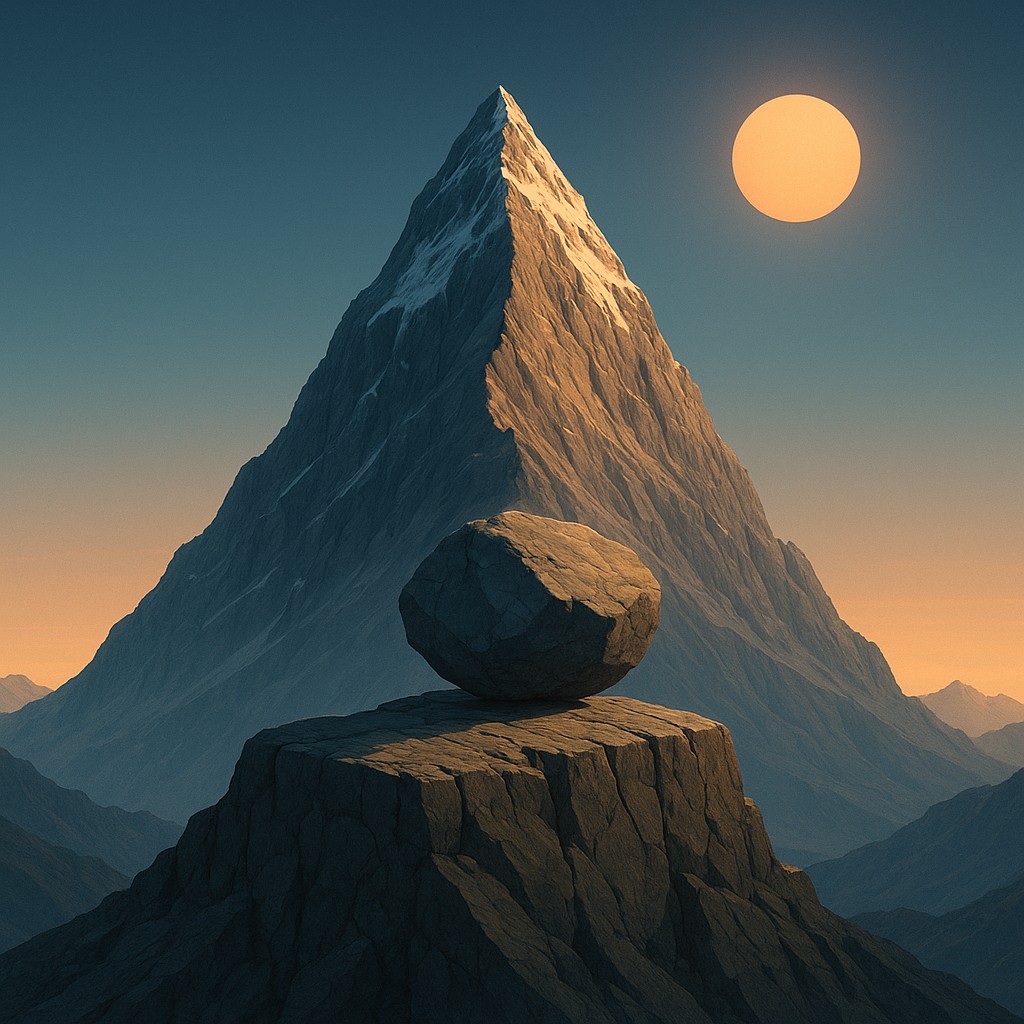
Imagine standing at the base of Mount Everest, staring up at a jagged wall of rock that pierces the very edge of the atmosphere. It feels eternal, a monument of absolute permanence that has stood since the beginning of time and will remain until the end. We tend to think of mountains as the ultimate symbols of stability, but in the eyes of physics, they are actually dynamic participants in a high-stakes wrestling match. On one side, you have the tectonic forces of the Earth, shoving massive plates of crust together with enough power to wrinkle the surface of the world. On the other side, you have gravity, a relentless accountant that keeps track of every single gram of granite and limestone being hoisted into the sky.
For a long time, the common assumption was that mountains keep growing as long as the tectonic plates keep pushing. If the Indian plate continues to ram into the Eurasian plate at a few centimeters a year, shouldn't Everest eventually reach the height of a commercial jetliner, or perhaps even poke into the vacuum of space? As it turns out, nature has a very strict building code. There is a "ceiling" to how high a mountain can climb, and it isn't set by the wind or the cold. Instead, the limit is dictated by the fundamental strength of the rock itself. When a mountain gets too tall, it essentially begins to commit geological suicide, crushing its own foundation under the sheer magnitude of its weight.
The Invisible Limit of Bedrock Strength
To understand why a mountain cannot grow forever, we have to look at what happens to atoms when they are under extreme pressure. We usually think of rocks like granite or basalt as the definition of "solid." If you hit a piece of granite with a hammer, it chips or shatters because it is brittle. However, the behavior of materials changes drastically when you scale them up to the size of a continent. Deep beneath the base of a massive mountain range, the pressure isn't just coming from a hammer, it is coming from miles and miles of overhead rock pressing down with millions of pounds of force per square inch.
When pressure reaches a certain threshold, even the hardest rock undergoes a transition from a brittle solid to a "plastic" state. This doesn't mean the rock turns into liquid lava immediately, but it does mean it loses its ability to hold a rigid shape. Think of a giant block of cheddar cheese sitting on a table in a warm room. If the block is small, it keeps its sharp corners. But if you were to stack a thousand blocks of cheese on top of one another, the bottom block would eventually lose its structural integrity. It wouldn't shatter, instead, it would slowly bulge outward, unable to support the weight above it. This is exactly what happens at the base of a mountain that has overstayed its welcome in the vertical dimension.
As a peak pushes toward the heavens, the weight of that peak increases exponentially. Eventually, the pressure at the base becomes so intense that the rock reaches its "flow point." At this depth, the heat from the Earth's interior combines with the crushing weight from above to turn the foundation into something resembling thick, slow-moving honey. The mountain stops growing because every inch of new rock added to the top or pushed up from below is balanced by the base spreading out horizontally. The mountain is essentially melting into the crust under its own gravity, creating a natural equilibrium that prevents any Earthly peak from reaching the stars.
Gravity as the Architectural Scale
If the height of a mountain is a battle between weight and structural strength, then the strength of gravity becomes the most important variable in the equation. On Earth, our gravity is relatively strong, which puts a heavy tax on any tall structure. We can calculate the maximum height of a mountain on Earth by looking at the density of rock and the strength of the chemical bonds that hold it together. Most geologists agree that the absolute limit for a mountain on our planet is somewhere around 15 kilometers (about 49,000 feet). Mount Everest, sitting at roughly 8.8 kilometers, is already more than halfway to the theoretical breaking point of the Earth's crust.
This relationship between gravity and height becomes even more obvious when we look at our neighbors in the solar system. Consider Mars, a planet much smaller and less massive than Earth. Because Mars is smaller, its gravitational pull is only about 38 percent of what we experience here. This means a mountain on Mars weighs significantly less than a mountain of the same size would weigh on Earth. Because the mountain is "lighter," the pressure at the base is lower, allowing the rock to remain rigid and brittle at much greater heights before it starts to flow.
This is exactly why Mars is home to Olympus Mons, the largest volcano in the solar system. Olympus Mons stands a staggering 21 kilometers high, nearly two and a half times the height of Everest. On Earth, a mountain that size would be impossible; the base would liquify and sink into the mantle long before it reached such a height. By comparing these two worlds, we can see that the "ceiling" for mountains isn't an arbitrary number, it is a direct reflection of the planet's mass. The smaller the planet, the taller the peaks can be, because gravity isn't pulling quite as hard on the foundation.
| Feature |
Mount Everest (Earth) |
Olympus Mons (Mars) |
| Approximate Height |
8.8 km (5.5 miles) |
21.9 km (13.6 miles) |
| Surface Gravity |
9.8 m/s² (100%) |
3.7 m/s² (38%) |
| Primary Limitation |
Gravity & Base Softening |
Gravity & Crust Thickness |
| Base Diameter |
Part of a massive range |
~600 km (Size of Arizona) |
| Atmospheric Depth |
Reaches the Jet Stream |
Pokes out of the atmosphere |
The Glacial Buzzsaw and Erosional Limits
While the crushing weight of rock is the ultimate physical limit, there are other forces at work that trim the tops of mountains long before they reach their "melting point." One of the most fascinating concepts in geology is the idea of the "glacial buzzsaw." Even if a mountain's base is strong enough to support more height, the environment at high altitudes becomes increasingly hostile. As a mountain grows, it enters colder layers of the atmosphere where glaciers form. These glaciers aren't just static ice caps; they are massive, grinding machines that carve away rock with incredible efficiency.
Geologists have noticed that in many mountain ranges around the world, the peaks seem to level off at a certain altitude, regardless of how fast the tectonic plates are pushing them up. This altitude often corresponds perfectly with the snowline. Above this line, glaciers grow and move, aggressively scouring the mountain and dumping the debris into the valleys below. It is as if nature has a giant pair of hedge trimmers that constantly clips the top of the mountain range. If the tectonic plates push the mountain up by one millimeter, the glaciers might erode it by that same millimeter, creating a "steady state" where the mountain stays the same height despite constant upward movement.
This erosional limit works in tandem with the gravitational limit. While gravity prevents the mountain from becoming a skyscraper that reaches the edge of space, the glacial buzzsaw ensures that most mountains never even get close to that 15-kilometer theoretical maximum. It is a beautiful, if somewhat chaotic, balancing act between the fire of the Earth’s core, the movement of the tectonic plates, the pull of gravity, and the freezing power of the climate.
Floating Peaks and the Sinking Crust
To truly appreciate the physics of a mountain, we have to stop thinking of the Earth's crust as a solid, immovable floor. Instead, think of it as a giant raft floating on a sea of semi-solid mantle, the hot layer beneath the crust. This is a concept known as "isostasy." Just as a heavy person sitting in a small boat will cause the boat to sink lower into the water, a massive mountain range causes the Earth's crust to sink deeper into the mantle. The taller the mountain, the deeper its "roots" must go to provide enough buoyancy to keep it afloat.
For every kilometer a mountain rises above the surface, it often has several kilometers of "root" extending downward into the Earth. When a mountain grows too tall, it isn't just that the base might flow; it is also that the crust underneath it can no longer support the weight without sinking. If you were to somehow place an extra five miles of rock on top of Mount Everest tomorrow, the entire Himalayan range would likely begin to sink deeper into the mantle until a new balance was reached.
This sinking process also contributes to the "melting base" phenomenon. As the mountain's roots are pushed deeper into the Earth by the weight above, they encounter the extreme heat of the inner mantle. This heat softens the rock even further, accelerating the "plastic flow" we discussed earlier. It is a feedback loop: the mountain gets heavier, it sinks lower into the heat, the base becomes softer, and the rock begins to flow outward, ultimately lowering the height of the peak. The Earth is constantly adjusting itself to ensure that no single feature becomes too top-heavy.
The Misconception of Infinite Growth
One of the most common myths about geology is that mountains are static piles of rock that just sit there. In reality, a mountain is more like a very slow fountain. Rock is being pushed up from the bottom by tectonic forces, moving through the middle of the mountain, and being eroded or "flowed" away at the top and base. When we look at Everest, we are seeing a snapshot in time of a process that is moving at the speed of fingernail growth. We see a peak, but the physics sees a temporary accumulation of mass that is constantly trying to flatten itself back out.
Another misconception is that the "highest" mountain is always the one furthest from the center of the Earth. While Everest has the highest elevation relative to sea level, Mount Chimborazo in Ecuador actually sticks out further into space because it sits on the Earth's equatorial bulge. Even more surprising is Mauna Kea in Hawaii. If you measure from the actual base on the ocean floor to the tip of the peak, Mauna Kea is over 10 kilometers tall, making it technically "taller" than Everest. However, because much of Mauna Kea is submerged, the water provides a kind of buoyant support that helps the crust manage the weight, allowing the mountain to exist without crushing its foundation as easily as a land-based mountain might.
Understanding these limits changes the way we look at the landscape. We realize that the shape of our world isn't accidental. The height of the hills, the depth of the valleys, and the soaring peaks of the Himalayas are all precisely tuned by the laws of physics. If our gravity were a little stronger, the world would be much flatter; if it were a little weaker, we might have mountains that dwarf anything we can currently imagine.
The Grand Balance of the World
There is something strangely humbling about the fact that even the mighty mountains have a supervisor. We often view the natural world as a place of unbridled growth and chaos, yet everywhere we look, there are invisible boundaries and elegant equations maintaining order. The mountain doesn't stop growing because it wants to, or because it runs out of material, but because it reaches a point of perfect tension with the planet it sits upon. It is a reminder that in every system, from the smallest atom to the tallest peak, there is a limit to how much stress a foundation can bear.
Next time you see a photo of a snowy peak or stand in the shadow of a great range, remember that you are witnessing a delicate truce. Underneath your feet, the rock is acting like a liquid to keep the world in balance, and above your head, the atmosphere is grinding away at the stone to keep the heights in check. This constant push and pull is what makes the Earth a dynamic, living system. It teaches us that true greatness isn't about growing forever; it is about finding the perfect height where you can stand strong without collapsing under the weight of your own ambition.