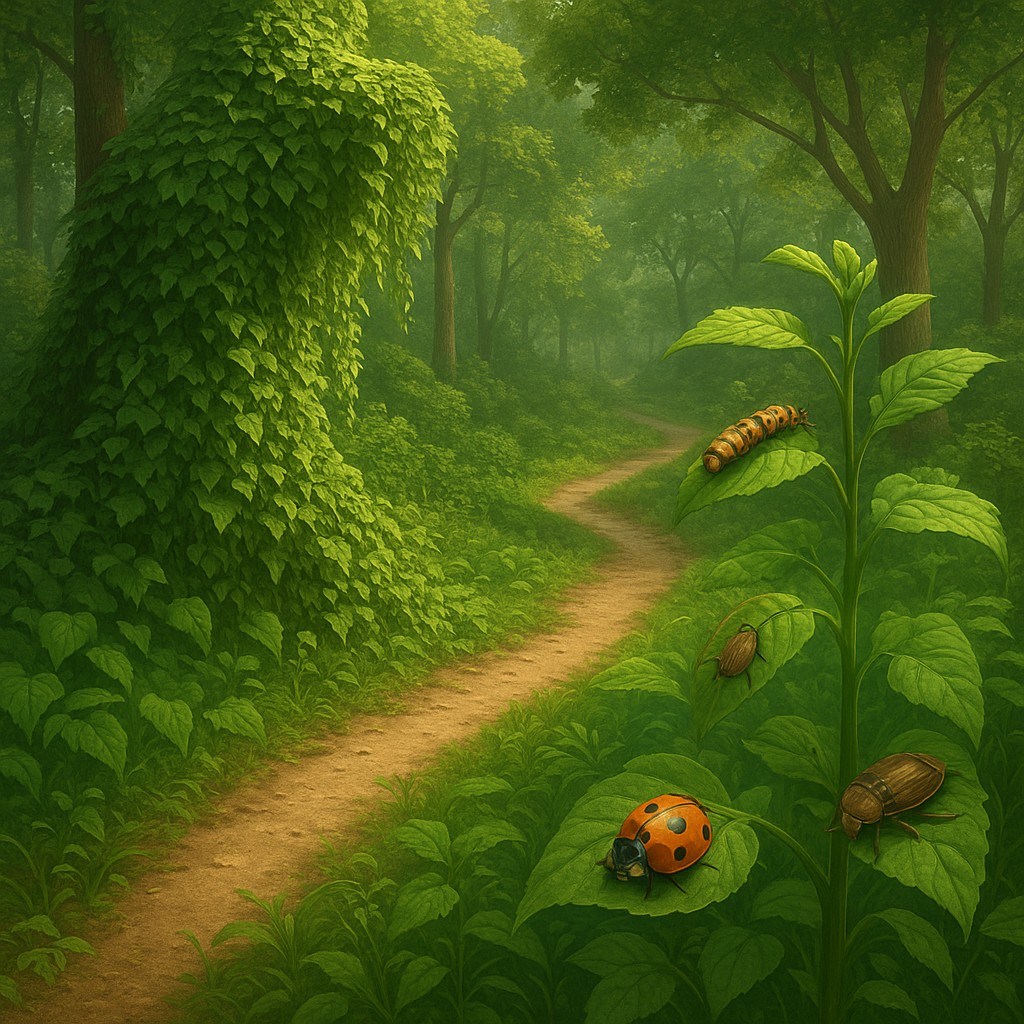
Imagine you are walking through a thick forest in the American Southeast. You might see a stunning wall of green vines draped over every tree, house, and telephone pole in sight. To someone passing by, this plant - known as Kudzu - looks like a biological champion. It appears to be an elite athlete of the plant world, simply stronger, faster, and more aggressive than any local oak or maple. We often assume invasive species succeed because they have "superpowers" or some internal strength that allows them to crush the native competition through sheer force.
However, if you visited Kudzu in its native home of Japan, you would find a very different story. There, it is just another plant growing modestly in the shadows of mountains. It is kept in check by a massive, hidden army of insects, fungi, and specialized diseases. In its own backyard, it isn't a conqueror; it is just a neighbor in a crowded area where everyone owns a pair of hedge clippers. The secret to an invasive species’ success is not that it is a better soldier. Instead, it has accidentally moved to a battlefield where none of its enemies have permission to enter.
The Myth of the Super-Species
The biggest mistake we make about invasive species is the "Big Bad Wolf" theory. We assume the Zebra Mussel or the Burmese Python is simply a more efficient killing machine or a faster grower than our local plants and animals. In reality, most species are strictly average on their home turf. In their native lands, every living thing is part of a complex, ancient system of checks and balances. For every plant that grows a leaf, there is a specific caterpillar that has spent millions of years evolving a way to eat that leaf without getting poisoned. For every fish that lays a thousand eggs, there is a parasite designed to infect them and a predator that knows exactly where to find them.
When a creature is moved to a new continent, it undergoes a radical change - not in its DNA, but in its budget. In its home range, a plant might have to spend 40 percent of its energy growing thick bark, thorns, or complex toxins just to survive local pests. It also has to fight off specialized soil pathogens (tiny germs) that target its roots. This is known as the "Enemy Release Hypothesis." Once the plant is "released" from these enemies, that 40 percent energy tax suddenly vanishes. The plant begins playing the game of life with a massive surplus of resources, which it immediately pours into fast growth and endless reproduction.
This explains why many invasive species actually look and act differently in their new homes than they do back home. Biologists have noted that some invasive plants grow much larger and produce more seeds in the areas they invade. They aren't evolving new traits on the spot; they are simply reinvesting their "defense budget" into "infrastructure and expansion." It is the biological equivalent of a company suddenly having all its taxes, insurance premiums, and security costs wiped out overnight. Of course it is going to take over the market.
The Invisible Network of Ecosystem Friction
To understand why a newcomer can take over so easily, we have to look at ecosystems as systems of "friction." In a stable, native environment, every species feels friction. If a certain beetle starts to overpopulate, the birds that eat that beetle have a feast. Their population grows, and they eventually push the beetle numbers back down. This is a balancing loop that keeps the system stable. Even the most aggressive native species is eventually slowed down by something that wants to eat it, infect it, or compete with it for a specific nutrient.
When a non-native species arrives, it acts like grease in the gears of the ecosystem. It doesn't feel the friction that everyone else does. A local bird might see a bright red invasive berry and avoid it because the bird’s ancestors never learned it was safe to eat. Meanwhile, the local insects that usually eat berries find the chemistry of this new plant unrecognizable or even toxic. This creates a "biological vacuum." The invasive species is essentially invisible to the local "police force" of predators and parasites.
This lack of recognition is a massive tactical advantage. While native plants are struggling to survive the local summer fungus or the yearly aphid outbreak, the invader sits untouched. It is like a runner in a race where everyone else is wearing lead boots, and the invader is the only one in sneakers. Over time, this leads to a monoculture - a situation where one single species dominates the landscape because the evolutionary "brakes" that should stop it simply do not exist in the new environment.
Identifying the Players in World-Changing Invasions
Not every species that moves to a new place becomes an invader. In fact, most die out because they cannot handle the climate or find food. However, the ones that do succeed usually follow a specific pattern of escaping their enemies. Below is a comparison of how different organisms use the lack of local enemies to dominate new environments.
| Species Group |
Native Constraints |
Invasive Opportunity |
Resulting Impact |
| Forest Plants |
Controlled by specialized leaf-eating bugs and soil fungi. |
Local leaf-eaters find the leaves gross; no local fungus attacks the roots. |
Thick tangles that shade out all native seedlings and destroy variety. |
| Freshwater Fish |
Kept in check by specific toothy predators and egg parasites. |
Local predators do not recognize them as food; parasites cannot bypass their immune systems. |
Population explosions that steal food and nesting spots from native fish. |
| Island Birds |
Evolved near ground predators like foxes or snakes. |
Moved to islands with no ground predators; they lose the instinct to protect nests. |
Initial success followed by total collapse when humans bring cats or rats. |
| Crop Pests |
Managed by specific wasps that lay eggs inside the pest. |
They arrive in new countries without their "body-snatcher" wasps. |
Unchecked crop destruction that requires heavy chemical use to stop. |
The High Cost of Biological Ignorance
When we look at the damage caused by these "escaped" species, it is easy to see them as villains. But from a systems perspective, they are just opportunists filling an empty gap. The real problem is that the local ecosystem has no "memory" of how to deal with them. In the animal kingdom, this often shows up as "behavioral naivety." For example, when Brown Tree Snakes were accidentally brought to the island of Guam, the local birds did not fly away. They had evolved for millions of years in a place with no snakes, so they had no fear of the long, slithering shapes climbing toward their nests. They literally sat there and watched their own extinction.
In the plant world, the lack of enemies leads to a phenomenon called "allelopathy," which is essentially chemical warfare. Some invasive plants release toxins into the soil that prevent other plants from growing. In their home range, local soil bacteria have evolved to break these toxins down, making them useless. But in a new country, the soil bacteria are clueless. The toxins stay in the ground like a poisonous cloud, killing off the competition. The invader isn't just winning the race; it is poisoning the track behind it, and there is no "janitor" in the new ecosystem to clean up the mess.
This loss of biodiversity has a massive economic and social impact. We spend billions of dollars every year trying to pull weeds or trap invasive animals. However, physical removal is often like trying to empty the ocean with a teaspoon. As long as the environmental friction is missing, the invader will just keep growing back. If you pull a weed but leave the "tax-free" environment that allowed it to thrive, you are only treating the symptom, not the underlying imbalance.
Recruiting the Enemy of My Enemy
If the problem is that the invader has escaped its enemies, the most logical (and controversial) solution is to go back to the invader’s home and bring its enemies to the new land. This is known as "Classical Biological Control." The idea is to restore the natural friction that was lost during the move. If a certain weed is taking over a wetland, scientists will search for the specific beetle that only eats that weed in its native range. After years of careful testing to ensure the beetle won't eat anything else, they release it into the invaded area.
This is a delicate game of ecological chess. The goal isn't to wipe out the invasive species entirely; that rarely happens. Instead, the goal is to "re-apply the brakes." By introducing a highly specific natural enemy, we force the invasive species to start spending its energy on defense again. If the weed has to spend 30 percent of its energy repairing leaf damage from the beetle, it has 30 percent less energy to produce seeds. Over time, this allows native plants to take back their space, and the ecosystem returns to a balanced state of competition.
Misunderstandings about biological control often come from famous failures, like the introduction of the Cane Toad in Australia. In 그 case, the toad was brought in to eat beetles, but it turned out the toad couldn't even climb the sugarcane where the beetles lived. It ended up eating everything else instead. Modern biological control is much stricter. It focuses on "specialist" enemies that are biologically unable to eat anything other than the target. It’s about finding the precise key for a specific lock, rather than hitting the problem with a sledgehammer.
A New Lens on the Natural World
Learning about the "Enemy Release Hypothesis" changes the way you look at a landscape. A field of pretty purple flowers or a pond full of massive goldfish is no longer just a scene; it is a data point about ecological history and balance. You begin to see that "strength" in nature is often relative and temporary. A species is only a dominant force as long as it is playing in a system that hasn't learned its weaknesses yet.
This perspective shifts our role from "gardeners who pull weeds" to "protectors of ecological friction." It reminds us that every living thing is held in place by a thousand tiny threads of interaction. When we move things around the globe, we aren't just moving an animal or a seed; we are snapping those threads. Understanding these invisible networks allows us to better protect the delicate balance of our own backyards. We can appreciate a complex world where everything, no matter how "strong," has something that keeps it in check. True ecological health isn't the absence of conflict; it is a perfectly balanced stalemate where no one wins too much.