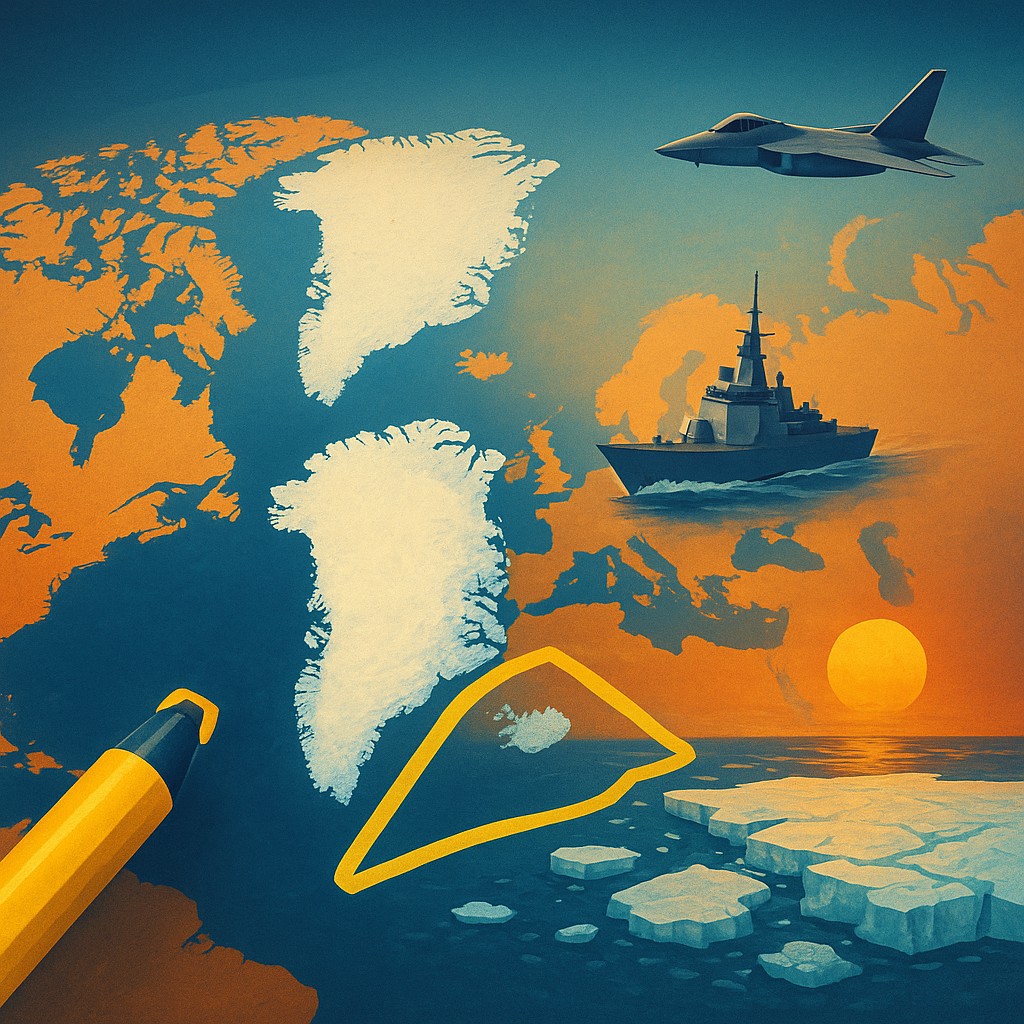
If you look at a map, Greenland can feel like a giant, icy punctuation mark between North America and Europe. Most of it is covered in ice, it has a small population, and it is politically linked to Denmark, not the United States. So when headlines say Washington has suddenly taken an interest in Greenland, it can sound like a strange plot twist, like someone trying to buy a glacier the way you buy a used car.
Greenland is not a random frozen rock. It sits squarely in the Arctic, and the Arctic is changing quickly. Melting sea ice is opening new shipping routes, rivalry among great powers is pushing north, and modern militaries pay close attention to what happens over the pole. Add rare minerals, potential energy resources, and the simple fact that geography still matters, and Greenland looks less like a curiosity and more like a strategic crossroads.
To see why the United States cares, think like a planner juggling three maps at once: a military map for today’s threats, an economic map for tomorrow’s supply chains, and a climate map for the next fifty years. Greenland appears on all three maps, highlighted.
Greenland’s location is a geopolitical superpower all by itself
Greenland’s biggest resource is not buried underground. It is the island’s position between North America and Europe, jutting into the Arctic. If you draw the shortest flight path from many U.S. cities to parts of Europe or Russia, those lines often cut across the polar region. That makes Greenland a natural place for watching, warning, and, if needed, defending.
During the Cold War, the Arctic was basically the ceiling of the world’s most dangerous room. The Soviet Union and the United States built systems to detect bombers and missiles as early as possible. Greenland fit that logic perfectly because it sits near the Greenland-Iceland-UK gap, a key corridor for naval and air movement between the Arctic and the Atlantic. That geography still matters, even though the technology has changed and threats now include hypersonic weapons, space systems, and cyber operations.
It is tempting to think satellites make geography irrelevant. Satellites help, absolutely, but they do not replace everything. Ground-based radar, secure runways, ports, fiber connections, and logistics hubs still anchor power on the ground. Greenland is one of the few places where the United States and its allies can put those anchors far north, without being next door to Russia.
The U.S. already has a foothold: Pituffik Space Base and the Arctic defense network
One of the most concrete American interests in Greenland is already in place. The United States runs a major installation in northwest Greenland called Pituffik Space Base, formerly Thule Air Base. For decades that base has been central to missile warning, space surveillance, and Arctic operations, and it remains a key part of U.S. defense.
Why does a base there matter? Because early warning matters. Detecting a missile launch earlier can buy minutes. Minutes are precious in national security because they let leaders confirm what is happening, avoid mistakes, and respond. Greenland’s latitude makes it a useful spot for sensors that watch the polar approaches, the routes intercontinental missiles could follow, and the space above them.
There is also a practical point that sounds dull until you think about the Arctic itself: operations there are hard. Runways, fuel storage, communications, and search-and-rescue capacity become far more valuable when cold, darkness, and distance are working against you. A base in Greenland gives the U.S. and NATO a place to stage aircraft, support satellites, and keep track of activity in a region where “nearby” can mean a thousand miles.
A common misconception is that the U.S. interest is mainly about building new bases everywhere. In fact, much of the focus is on maintaining and modernizing what already exists, and on keeping the political ties that make those facilities usable. Military planners value reliability more than new toys.
A quick myth check: “The U.S. wants Greenland for a single base”
That is too simple. The base is crucial, but it is part of a bigger picture that includes Arctic navigation, allied defense coordination, and long-term competition with other powers. Think ecosystem, not a single building.
Melting ice is rewriting Arctic maps, and the U.S. does not want to be surprised
Climate change is transforming the Arctic faster than many other regions. Sea ice is shrinking in extent and thickness, and the navigable season is growing. This does not mean the Arctic becomes an easy ocean highway overnight. It remains dangerous, costly, and environmentally sensitive. But the old assumption that the Arctic is basically closed is no longer reliable.
For the United States, Greenland matters in this new reality for three reasons. First, it is a physical hub near emerging sea lanes and air routes. Second, it provides access for scientific monitoring that improves forecasting and safer navigation. Third, it sits at the center of Arctic governance, where rules, norms, and partnerships are being tested.
If shipping and resource exploration increase, you get more coast guard missions, more rescue needs, and more chances for accidents. You also get more opportunities for strategic signaling, like showing the flag, holding exercises, or building dual-use infrastructure. In that environment, countries that can operate reliably in the Arctic gain leverage.
Another misconception is that melting ice automatically means big profits. The Arctic is not a new Panama Canal. Ships need ice-class hulls, insurance can be steep, and ports and repair facilities are sparse. The opportunity is real, but it comes with costs and risks that slow the pace compared with sensational headlines.
Minerals, energy, and supply chains: Greenland as a piece of the resource puzzle
If geopolitics is about where you stand, economics is about what you can build and what you can reliably get. Greenland has attracted attention for its mineral potential, including rare earth elements and other critical minerals used in electronics, batteries, clean energy, and defense systems. The modern economy runs on odd-sounding ingredients, and countries worry about depending on a single supplier.
The United States has focused on critical minerals because many supply chains are concentrated. China, for example, plays a major role in processing rare earths and other materials. Even when minerals are mined elsewhere, processing and refining capacity can be the real bottleneck. Greenland figures in the conversation as a place that might diversify supply over time, especially if projects meet high environmental standards and secure local consent.
Energy resources are part of the story, but they are more complex than “drill and get rich.” Greenland has drawn interest for oil and gas in the past, but political and environmental concerns have pushed policy in different directions. Meanwhile, the global shift to cleaner energy is changing what counts as strategic, making minerals for electrification more important than opening new fossil fuel frontiers.
It is also important to separate potential from production. Greenland’s harsh conditions, limited infrastructure, and high operating costs mean turning a deposit into a working mine can take years or decades. The real strategic value may be optionality - having another possible source when supply shocks happen - rather than immediate tonnage.
Great power competition shows up in the Arctic wearing a parka
The United States is not the only country that sees the Arctic as critical. Russia has vast Arctic territory, has invested heavily in military infrastructure there, and treats the region as central to its defense and economic plans. China calls itself a “near-Arctic state” and has pursued research, shipping interests, and investments around the Arctic, including at times in Greenland.
From Washington’s view, influence is not only about owning land. It is about relationships, investment, infrastructure, and presence. If rivals gain privileged access to ports, airports, telecoms, or mineral projects, that can create security concerns, even if the activity looks civilian. The phrase to watch is dual-use infrastructure, meaning facilities that can support both civilian and military work.
This does not mean every Chinese investment is sinister, or that Greenland is a chessboard with no agency. It means the U.S. sees Greenland as a place where small decisions, like who builds an airport terminal or finances a mine, can have long-term strategic effects. In geopolitics, tomorrow’s leverage often starts as today’s contract.
Here is a helpful way to summarize the main drivers, and the “yes, but” caveats that come with each:
| U.S. interest in Greenland |
What the U.S. hopes to gain |
The built-in constraints and complications |
| Defense and early warning |
Missile warning, space surveillance, Arctic operational reach |
Requires cooperation with Greenland and Denmark, high costs, harsh conditions |
| Arctic shipping and access |
Presence near emerging routes, search-and-rescue capacity |
Routes are seasonal and risky, environmental stakes are high |
| Critical minerals |
Long-term supply diversification for tech and defense |
Projects take time, infrastructure is limited, local politics and environmental concerns are decisive |
| Competition with Russia and China |
Prevent strategic footholds, maintain allied advantage |
Must avoid treating Greenland as an object, diplomacy needs trust and respect |
| Science and climate monitoring |
Better forecasting, environmental understanding, safer operations |
Science is slow and incremental, and it must be done ethically and collaboratively |
Sovereignty, allies, and the awkward truth: Greenland is not a prize to be grabbed
One reason the topic stirs strong feelings is that people fall into an old idea that great powers collect territories. That makes for dramatic headlines, but it misses the modern reality. Greenland is an autonomous territory within the Kingdom of Denmark, with its own government handling many domestic matters. Its people, including Inuit communities with deep ties to the land, have priorities that do not automatically match Washington’s.
The U.S. cannot simply take Greenland, and the serious policy discussion is not about conquest. It is about agreements, investment, and partnerships. In recent years the United States has built a broader diplomatic and economic relationship with Greenland, including reopening a consulate in Nuuk and expanding cooperation in education, business, and environmental work.
A common myth is that the United States “wants to buy Greenland” in the literal way it bought Alaska. That idea has historical echoes, and it grabbed attention when it came up in modern political talk. Even entertaining the notion can anger Greenlanders and Danes, because it treats Greenland like property instead of a society. It also distracts from the real levers of influence today: long-term relationships, credible commitments, and respectful cooperation.
If you want a clearer mental model, think “shared interests and negotiated access,” not “purchase.” The United States cares about Greenland because it needs stable arrangements to operate in the Arctic and to avoid strategic surprises, and those arrangements rest on trust.
What Greenland wants is not an afterthought
It is easy to focus on security and minerals and forget the human layer. Greenland’s leaders must balance economic development, cultural preservation, environmental protection, and health and education services across widely scattered communities. They also face the long arc of decolonization and the question of how much autonomy, or potential independence, Greenland should seek. U.S. policy that ignores these realities is not only disrespectful, it is strategically clumsy.
The environmental and ethical side: security is not the only lens
Greenland is central to the climate story. Its ice sheet is a major factor in global sea level rise. What happens to that ice affects coastal cities thousands of miles away, including in the United States. That makes scientific research and climate monitoring not just a nice-to-have, but a national interest.
At the same time, more activity in the Arctic brings environmental risks. Mining, shipping, and military operations all leave footprints. Greenland’s ecosystems are fragile, and accidents are harder to respond to in remote, icy waters. So any plan to increase activity in Greenland must include careful, transparent work done with local consent.
There is also an ethical issue built into the conversation: Greenland has a history of being used as a strategic asset by outside powers, sometimes with little regard for local impacts. A modern, responsible approach should be explicit about partnership, benefit-sharing, and respecting Indigenous rights and local decision-making. In the long run, legitimacy is a form of power you cannot fake.
Putting it all together without the conspiracy sauce
When people hear “the U.S. wants Greenland,” they sometimes jump to secret plots or sci-fi resource grabs. The real story is more grounded, and frankly more interesting. Greenland is where several slow but powerful trends overlap: Arctic warming, renewed great power competition, fragile supply chains, and the continuing importance of geography for defense.
Use this three-part frame to remember the basics:
- Shield: Greenland helps the U.S. see and defend the Arctic approaches.
- Switchboard: Greenland sits near routes and infrastructure that link the Atlantic and the Arctic.
- Storehouse (with an asterisk): Greenland has mineral potential, but unlocking it is slow and must be done responsibly.
That asterisk matters. Greenland is not a vending machine of rare earths, and it is not an empty map. Real people live there, vote there, and shape their future, and nature sets strict limits on what is possible.
A forward-looking ending: the smartest strategy is partnership, not possession
Greenland’s importance to the United States is not a passing fad. As the Arctic becomes more accessible and more contested, the U.S. will keep caring about what happens on that huge island between continents. The most effective American approach is not treating Greenland like a strategic object. It is treating Greenland as a strategic partner, alongside Denmark and other allies, with shared interests and shared responsibilities.
If this topic grabs your attention, trust that instinct. It shows that world politics is not only about speeches and elections. It is also about ice thickness, radar angles, shipping insurance, local governance, and the quiet power of geography. Understanding Greenland helps you understand how the 21st century works: complex, connected, and full of places that seem remote until you realize they sit at the center of tomorrow’s map.