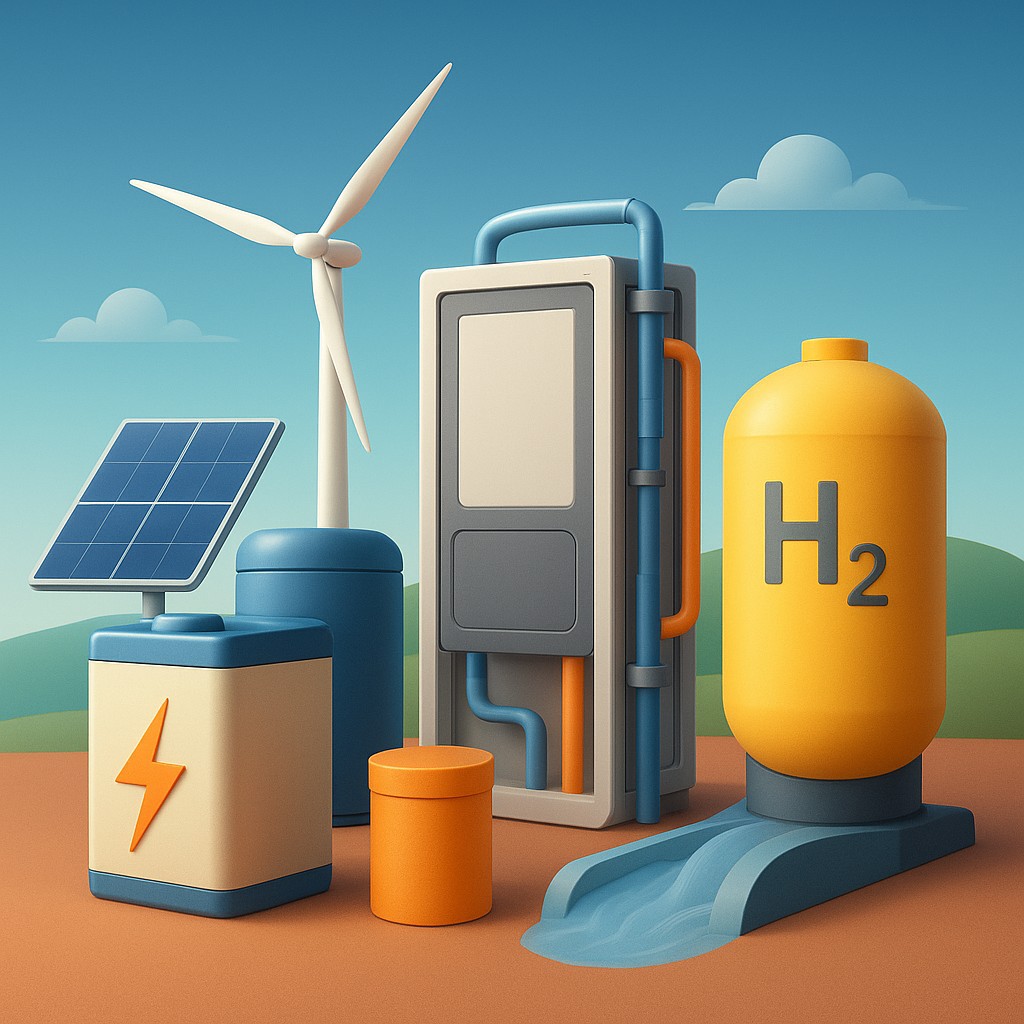
The clean energy revolution has a secret: producing electricity is the easy part. We already know how to turn sunlight, wind, water, and heat into electrons at scale. The real challenge is keeping those electrons useful when we need them - at night, through calm weeks, or during winter demand spikes. The power to decarbonize economies, stabilize grids, and reshape geopolitics will likely depend less on who can build the most turbines or panels, and more on who can store and deliver energy reliably, affordably, and at scale across hours, days, and seasons.
Think of electricity like water in a pipe. You can point a hose at a bucket and fill it quickly, but if you can no longer hold the hose, or you need many buckets at different times, you must have ways to hold, move, and measure that water. Storage is the bucket, the plumbing, and the schedule all at once. The companies, communities, and countries that design the most practical, economical, and durable energy buckets will determine how smoothly and quickly the world shifts to low-carbon power.
Saying storage matters more than generation may sound provocative, but the rest of this piece will walk you through the physics, the economics, the common misconceptions, and the strategies that make storage the real bottleneck. Read on for concrete comparisons, clarifying examples, and where innovation could change everything.
The grid's new problem: intermittency, timing, and mismatch
Electric grids balance supply and demand in real time. Traditional systems relied on dispatchable sources - coal, gas, hydro - that could be turned up or down to match demand. These plants provided steady output, inertia, and predictable capacity. Renewables like wind and solar are variable - output rises and falls with wind speed and sunlight. That variability is manageable if it is paired with flexible resources that soak up surplus generation and release it when generation dips.
Intermittency creates three connected problems. First, short-term variability: clouds or gusts change output minute-to-minute and second-to-second, requiring fast responses to keep frequency stable. Second, diurnal mismatch: solar generates mostly during the day, while demand often peaks in the evening, making evening supply hard to meet without storage. Third, seasonal mismatch: in many climates, renewable generation and energy use peak at different times of year, so you may need to move large amounts of energy across months. Solving the first requires fast-response storage and grid services, the second needs multi-hour storage, and the third calls for seasonal storage on a very different scale.
Storage fills the gaps generation cannot schedule perfectly. It supplies capacity when generation drops, reduces the need for fossil fuel backup, and captures excess renewable power instead of letting it be curtailed. Without storage, grids must oversize generation capacity, accept instability, or keep fossil plants running as insurance - none of which are ideal for cost or emissions goals.
Short-duration needs and long-duration gaps: a spectrum of services
Not all storage needs are the same. Breaking the problem into categories helps match technologies to actual grid services. Short-duration storage handles seconds to hours, long-duration covers hours to days, and seasonal storage addresses weeks to months.
Short-duration services include frequency regulation and smoothing rapid fluctuations. Batteries, flywheels, and fast power electronics excel here because they can inject or absorb power almost instantly. Middle-duration needs - covering evening peaks or a wind lull for several hours - are where lithium-ion batteries and pumped hydro perform well today. Long-duration and seasonal storage are the hardest: imagine preserving summer solar for winter use; that requires storing very large amounts of energy for months in cost-effective ways. Options include hydrogen made by electrolysis, power-to-gas, underground thermal storage, or very large pumped hydro. These solutions are generally less efficient per cycle and more capital intensive, but they offer the scale and duration needed to replace seasonal fossil fuel capacity.
A key point is that cost-effectiveness depends on the service. It is cheap to store a kilowatt-hour for an hour with a lithium battery, but extremely expensive to store that same kilowatt-hour for three months. Efficiency matters, but so does the cost per stored kilowatt-hour for the required duration.
Table: Comparing common grid-scale storage technologies
| Technology |
Best duration |
Round-trip efficiency (typical) |
Cost trend |
Scalability and maturity |
Best use cases |
| Lithium-ion battery |
Minutes to 4-6 hours |
85-95% |
Falling rapidly |
Mature, modular, fast deployment |
Frequency regulation, peak shaving, renewables integration |
| Pumped hydro storage (PHS) |
Hours to days |
70-85% |
Mature, site-limited |
Very large capacity, proven |
Bulk energy shifting, grid capacity, seasonal potential in some geographies |
| Flow batteries (vanadium etc.) |
Hours to many hours |
60-80% |
Improving, higher capex |
Moderate maturity, scalable energy capacity |
Long-duration discharge, cycle life critical |
| Compressed air energy storage (CAES) |
Hours to days |
40-70% |
Site-dependent |
Limited sites, hybrid approaches |
Bulk storage where geology allows |
| Hydrogen (electrolysis + fuel cell/turbine) |
Days to months |
30-50% (today) |
Improving, needs infrastructure |
Nascent for grid power, promising seasonal storage |
Seasonal/season-spanning storage, sector coupling |
| Thermal energy storage (sensible/latent) |
Hours to months |
40-90% depending |
Low cost per unit energy |
High maturity for industrial uses |
District heating, industrial processes, solar thermal storage |
| Flywheels |
Seconds to minutes |
85-95% |
Niche |
Mature but limited energy capacity |
Frequency response, short-term smoothing |
This table simplifies many nuances, but it highlights a central truth: no single technology wins every category. The energy transition will require a portfolio of storage solutions.
Why "build more generation" is not the full answer
A common reaction is to propose simply adding more solar and wind until supply always exceeds demand. That sounds logical, but it runs into economic and physical limits. First, generating surplus power to meet rare peak demands is wasteful and more expensive than storing energy when it is abundant and cheap. Solar and wind face diminishing returns when you try to cover every possible low-wind or low-sun hour by simply oversizing capacity.
Second, grids are constrained by transmission and siting. Building massive generation in favorable locations requires costly transmission to load centers. Storage can sit closer to demand, reducing transmission needs and congestion. Third, the grid needs reliability and controllability. Generation that cannot be dispatched at will cannot provide certain ancillary services that keep the grid stable. Storage provides controllable output and rapid ramp rates, making the whole system more resilient.
Finally, market signals matter. Without storage, generators face curtailment when they produce too much, reducing the incentive to deploy more generation. Storage monetizes that curtailed energy by saving it for higher-value periods, aligning economic incentives with system reliability.
The tricky economics of storage: cost, value, and business models
Evaluating storage is about more than raw price per kilowatt-hour. Three factors determine value: capital expenditure per unit power, capital expenditure per unit energy, and the revenue streams available. Batteries are sold by power rating (how fast they can deliver) and energy capacity (how long they can deliver). For grid operators, the ideal storage asset is cheap per kWh for the duration they need, and can capture multiple revenue streams: energy arbitrage (buy low, sell high), capacity payments for being available during peaks, and ancillary services for frequency and voltage support.
Round-trip efficiency affects how much energy is lost storing and retrieving electricity. Higher efficiency reduces the amount of generation needed to serve the same load, but very efficient options can have higher capital costs. For seasonal storage, efficiency is less decisive than cost per stored unit and durability, because the volumes to be shifted are so large that even low-efficiency-but-cheap storage can be practical.
Another economic consideration is life cycle and materials. Lithium-ion batteries have become much cheaper due to scale, learning, and supply chain development. But their raw material requirements, especially for lithium, cobalt, and nickel, create supply and cost pressures. Technologies that use abundant materials or avoid constrained elements could offer lower long-term systemic risk.
Business models also drive innovation. Behind-the-meter residential batteries pair with solar and time-of-use tariffs; grid-scale developers integrate batteries with renewables; utilities invest in long-duration projects; and new market designs such as capacity markets and ancillary service auctions create revenue certainty. Whoever cracks the best combination of low-cost hardware, favorable regulatory frameworks, and reliable revenue streams stands to reshape electricity markets.
Misconceptions and myths, corrected
Myth 1 - We only need to build more renewable generation, not storage. Reality: Without storage or flexible alternatives, high renewable penetration forces curtailment, reliability challenges, and expensive backup capacity.
Myth 2 - Batteries solve everything. Reality: Lithium-ion is excellent for short to medium durations and fast response, but it is not ideal for seasonal storage or multi-day events in every case. Other technologies will be needed at scale.
Myth 3 - Hydrogen is a magical, lossless storage medium. Reality: Hydrogen is promising for long-duration and seasonal storage, but converting electricity to hydrogen and back involves significant losses today, and infrastructure for production, storage, and reconversion is costly.
Myth 4 - Storage is only about technology. Reality: Storage deployment is shaped by policy, markets, permitting, land use, and social acceptance. The best batteries will fail if they cannot be economically integrated into a market.
Clearing up these misconceptions helps focus attention on realistic portfolios of solutions rather than chasing single silver bullets.
The material and ecological realities of scaling storage
Scaling storage to grid and seasonal needs has environmental and supply chain consequences. Lithium mining, rare earths for magnets, steel for pumped hydro, and large land footprints for some solutions all carry impacts. Responsible scaling requires recycling, material substitution, localization of supply chains, and land-use optimization.
Recycling reduces raw material demand and carbon footprint. For batteries, designing for disassembly and building recycling infrastructure will become critical as large fleets retire. For pumped hydro and underground hydrogen storage, ecological siting and water management matter. Policymakers, engineers, and communities must weigh local impacts against global climate gains.
Geography is another reality. Pumped hydro needs specific topography, underground hydrogen storage requires suitable geology, and thermal storage works best where heat loads exist. That means regions will use different mixes of storage, and interregional transmission will remain important.
Market and policy levers that unlock storage value
Technology alone will not solve the storage bottleneck. Policy and market design can amplify or block deployment. Important levers include:
- Time-of-use and dynamic pricing to provide revenue signals and encourage shifting consumption.
- Capacity markets that pay providers for being available during peak times, favoring dispatchable storage.
- Ancillary service markets that compensate fast-response assets for frequency and voltage support.
- Subsidies, tax credits, or procurement mandates to lower the effective cost of deployment for early-stage long-duration solutions.
- Streamlined permitting for energy storage projects to reduce delays and costs.
- Standards and incentives for circular supply chains, such as battery material recycling targets.
Systems that account for the full value of storage - energy, capacity, and flexibility - will see the fastest and most efficient deployment.
Who wins when storage is solved - power, politics, and profit
Controlling storage is not just a technical achievement, it is strategic power. Companies that build large, cheap storage systems will shape electricity markets, influence grid resilience, and secure long-term revenue streams. Utilities that integrate storage can lower operating costs and offer new services. Countries that master storage technologies gain energy independence, reduce reliance on fuel imports, and increase export potential for technology and know-how.
At a societal level, solving storage reduces emissions, stabilizes energy costs, and enables electrification of transport and heating at scale. It can democratize energy by allowing communities to rely less on centralized generation and more on local storage combined with renewables. For innovators and investors, this is fertile ground: the market for storage is expanding from kilowatt-scale batteries to gigawatt-scale multi-day and seasonal systems.
Practical takeaways and what to watch next
If you want to be smart and useful in this space, here are concrete things to watch and actions you can take. First, follow cost curves and deployment milestones, especially for long-duration technologies like flow batteries, hydrogen electrolysis, and advanced thermal storage. Second, monitor policy developments in capacity markets and incentives for long-duration storage, since these can jumpstart deployment. Third, learn about system-level integration - how storage interacts with transmission, demand response, and grid operations - because the most valuable solutions are system-aware.
For career-minded readers, opportunities exist across engineering, materials science, market design, policy, and project development. For consumers, demand response programs and behind-the-meter storage paired with smart tariffs can cut bills and boost resilience. For investors, diversified exposure to storage portfolios, including early-stage long-duration companies and established battery manufacturers, captures different risk-reward profiles.
Think like a system designer rather than a technology fan. The cheapest path to reliability and decarbonization will mix generation, storage, demand flexibility, and transmission. Betting on just one component is risky; designing integrated solutions is where the real value lies.
Closing push: storage as the lever for a clean future
We started with a bold claim: energy storage matters more than generation. Now you can see why that assertion has weight. Generation technologies are advancing quickly and cheaply, but their value is capped without practical, affordable ways to save and dispatch energy when it is needed. Storage provides the rhythm to the grid, smoothing the music of wind and sun into a steady dance that keeps lights on, hospitals running, and economies humming.
Solving storage is a big technical and social challenge, but it is also the most leverage-rich opportunity in the energy transition. If you are curious, optimistic, and willing to think across materials, markets, and systems, you can join the teams that build the buckets holding our energy future. The next breakthrough - whether in chemistry, geology, economics, or policy - could tip the balance, and the winners will shape climate outcomes for decades. Stay curious, learn the trade-offs, and maybe help build the storage that will change the world.