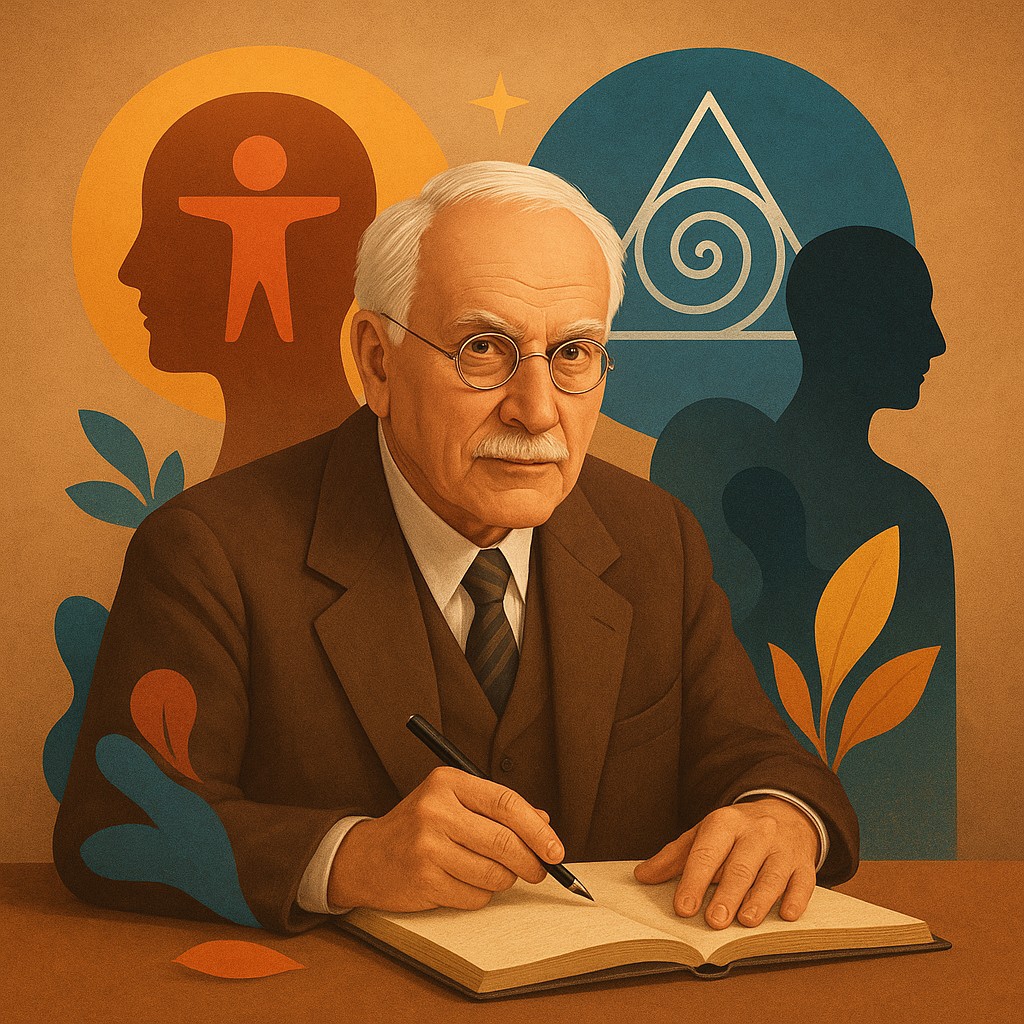
Why Carl Jung still matters: a surprising guide to the psyche that feels alive
Carl Jung feels like the kind of thinker you meet at a dinner party who tells uncanny stories and leaves you with a new way to look at your dreams. He was a Swiss psychiatrist who lived from 1875 to 1961, and his ideas changed how we talk about personality, myth, religion, and creativity. If you have ever wondered why certain symbols repeat across cultures, why some people feel drawn to the mysterious, or why you can be your own worst enemy, Jung gives language and tools that make those experiences feel meaningful and usable.
Jung matters because he fused clinical observation with myth, art, and history in a way that made psychology feel less like mechanics and more like a map of meaning. His work speaks to people who want both practical ways to live better and a deeper sense of what life itself might be asking of them. Whether you are drawn to therapy, creativity, or self-knowledge, Jungian ideas offer stories and exercises that can be worked with, not just memorized.
This Learning Nib will take you from the essentials of Jung's life and methods to the heart of his key concepts, and finally to practical ways you can use his ideas today. Along the way we will dispel common myths, compare Jung to Freud in plain language, and give you simple exercises to begin your own exploration. Think of this as a guided walk through Jung's garden: you will learn the paths and be invited to plant a few seeds.
By the end you should feel smarter about the human mind, more curious about your inner life, and confident enough to try a couple of Jungian practices. No previous psychology degree required, only willingness to be surprised by what you notice about yourself.
The arc of a life that looked both inward and outward
Carl Gustav Jung was born in Kesswil, Switzerland, in 1875, into a family of pastors and scholars. He trained as a psychiatrist and worked at the famous Burghölzli psychiatric hospital in Zurich, where he studied under Eugen Bleuler and began to develop his clinical style. The early years were marked by intense intellectual friendships, most notably with Sigmund Freud, who for a time saw Jung as heir apparent to psychoanalysis. That relationship later fractured, and the break shaped the rest of Jung's work as he moved in directions Freud did not.
Jung's life combined rigorous clinical practice with broad interests in religion, mythology, alchemy, and anthropology. He traveled, studied indigenous cultures, and collected myths and symbols from around the world. These studies led him to propose that humans share a deeper layer of the psyche, which he called the collective unconscious. His clinical method embraced dreams, active imagination, and symbolic interpretation, tools he used both with patients and in his own personal crises.
Jung experienced a prolonged period of inner turmoil in his mid-career, often called his confrontation with the unconscious, which he documented in his "Red Book." This was a private, visionary exploration that yielded much of his mature thinking. In his later years he taught, wrote extensively, and influenced artists, writers, and therapists. He died in 1961, leaving a large body of writing that remains widely read and debated.
Core ideas: the mental architecture that Jung proposed
At the most basic level, Jung divided the mind into layers. The ego is the part of the mind that handles daily consciousness, identity, and the feeling of "I." Underneath the ego lies the personal unconscious, which contains forgotten memories, repressed experiences, and complexes - emotionally charged clusters of ideas. Deeper still is the collective unconscious, a more controversial idea that suggests inherited mental structures shared across humanity. These structures appear as archetypes, which are universal patterns or images such as the Hero, the Mother, the Shadow, the Wise Old Man, and the Anima or Animus.
Archetypes are not ideas in the ordinary sense, but organizing principles that shape how things show up in dreams, myths, and cultural narratives. They are like lenses, coloring our experience and making certain kinds of stories or reactions more likely. For example, when someone encounters a powerful, unexplained fear, Jung might say the Shadow archetype is active, bringing forward traits that the conscious person has disowned. These archetypal patterns help explain why myths from different cultures can feel eerily similar.
Another central concept is individuation, which Jung described as the lifelong process of becoming who you really are. Individuation involves integrating unconscious contents into conscious life, particularly integrating the Shadow and balancing masculine and feminine aspects within the psyche. This is not about becoming perfect, but about developing psychological wholeness and a richer sense of meaning.
Jung also saw psychological life as heavily symbolic. Dreams, creative expression, and fantasies are not random; they are the psyche speaking in images. Understanding those symbols is a key route to change. Jungian therapy therefore often focuses on creative, symbolic exploration rather than on strict symptom removal alone.
The shadow, anima, and archetypes in everyday life
The Shadow represents the parts of ourselves we deny, reject, or deem unacceptable. It can show up as sudden anger, envy, or self-sabotage, and it often appears in projections - when we attribute our own disowned traits to other people. Learning to recognize and integrate the Shadow does not mean indulging bad behavior, but rather understanding the needs and fears behind it so you can make conscious choices. This integration tends to reduce repeated patterns and lead to greater personal freedom.
Anima and Animus are Jung's terms for the inner feminine side of men, and the inner masculine side of women, respectively. These are not the same as cultural gender roles, but deeper psychological figures that influence attraction, relationships, and inner dialogue. A man in tune with his anima might be more emotionally open, creative, and empathetic, while a woman in tune with her animus might be more decisive and assertive. Balance, for Jung, is not equality in a political sense but psychological harmony where neither side dominates nor is wholly repressed.
Archetypes appear in art, film, and personal stories. Think of the wise old man in Yoda, the shadow in Jekyll and Hyde, or the hero's journey in many blockbuster films. When you notice recurring motifs in your dreams or life - a recurring river, an image of falling, repeated encounters with a certain type of person - you are seeing archetypal patterns at work. Jungian work trains you to pay attention and ask, "What is this image asking of me?"
Jungian therapy: tools that mix imagination and reflection
Jungian psychotherapy shares methods with other depth psychologies, yet it has a distinct flavor. Central techniques include dream analysis, active imagination, amplification, and working with complexes. Dream analysis in Jungian practice treats dreams as meaningful communications from the unconscious. Rather than reducing dream elements to single ideas, Jungian analysts explore how images relate to a person's life, feelings, and archetypal themes.
Active imagination is a technique where you consciously dialogue with figures or images from your inner world, allowing scenes to unfold and responding as you would in waking life. It is a disciplined yet creative practice that offers a way to translate unconscious material into conscious understanding. Amplification involves exploring a dream or image by comparing it with myths, religious symbols, and cultural stories to see broader meanings.
Jungian therapy often takes time, because its aim is integration rather than quick fixes. The process can feel like learning a new language for your inner experience. Therapists who work in this tradition emphasize the therapeutic relationship, symbolic work, and the client's active engagement in their own transformation.
Jung and Freud: friends who grew into rivals, briefly clarified
A common question is how Jung differed from Freud. Early on they were close collaborators and respected each other's work. Freud emphasized sexual drives and the role of early childhood conflict in shaping neuroses. Jung agreed that the unconscious was important, but he thought Freud's focus on sexuality was too narrow. Jung proposed a broader, more symbolic unconscious rooted in collective human experience.
The split between them was dramatic, but it is a myth that Jung simply rejected science or became mystical. Jung pursued empirical clinical work, yet he also allowed for religious and symbolic dimensions that Freud questioned. Their debate is less a tidy contest of right and wrong, and more of two different lenses: Freud offered a powerful engine for understanding personal history and drives, while Jung offered a map for meaning, archetype, and spiritual development.
Here is a quick comparison that captures the essentials.
| Topic |
Freud |
Jung |
| Primary focus |
Personal unconscious, sexuality, psychosexual development |
Personal and collective unconscious, archetypes, meaning |
| View of dreams |
Wish fulfillment, expressions of repressed desires |
Symbolic messages from the unconscious, archetypal content |
| Human motives |
Primarily biological drives |
Biological and spiritual, with emphasis on meaning and individuation |
| Method |
Interpretation focused on early history and instincts |
Symbolic exploration, active imagination, myths and cultures |
| Relationship |
Mentor-student turned opponents |
Early collaborators, later divergent paths |
Science, myth, and what Jung gets credit or criticism for
Jung's ideas were groundbreaking but also controversial. Critics argue that many Jungian concepts are hard to test experimentally, and some of his theories lack the empirical rigor expected in modern psychology. Researchers have debated the scientific value of the collective unconscious and archetypes. That said, Jung's influence is clear in personality typologies, creativity research, and therapeutic practices. Concepts like introversion and extraversion, which Jung helped popularize, became central to later psychological models.
It is useful to think of Jung not purely as a scientist in the narrow sense, nor purely as a mystic. He operated at the boundary between observation and interpretation, combining clinical data with cultural study. This made his work fertile for therapists, artists, and philosophers, even if parts of it resist laboratory verification. In short, Jung matters because he offers a coherent framework that helps people make sense of subjective experience, rather than because every claim can be neatly quantified.
Practical exercises you can try this week
Engaging with Jung is best done by doing. Here are simple practices that bring his ideas into daily life. Keep a dream journal for two weeks, writing dreams every morning without censoring. After a few dreams, pick one recurring image and describe what feelings it evokes, then ask how it might relate to your current life. Try active imagination: sit quietly, bring a vivid inner image to mind, and imagine asking it a question - then record whatever arises.
Shadow work exercise: notice a strong negative reaction you have toward another person, and write down the traits you dislike. Now ask where in you those traits might exist, even in small ways. The goal is not to excuse harmful behavior, but to recognize and integrate the disowned part so it stops controlling you through projection. Finally, practice amplification by finding a myth, poem, or film that resonates with your inner image and explore parallels. This widens context and reveals archetypal threads.
Safety note: if deep feelings emerge, consider seeking a trained therapist. Jungian work can surface intense emotions, and it helps to have skilled support.
Misconceptions cleared: what Jung was and was not
One big myth is that Jung was anti-science or wholly mystical. In fact, he conducted careful clinical observations and aimed for psychological rigor, even when he embraced myth and symbolism. Another misconception is that Jung endorsed all aspects of mysticism or occultism; he was curious about spiritual traditions and alchemy as symbolic languages, not necessarily as literal claims. People also sometimes assume Jungian therapy promises instant enlightenment. It does not. It is a steady, sometimes challenging path to greater self-awareness.
Finally, Jung is sometimes reduced to quirky, poetic metaphors. While his language can be lyrical, the concepts have practical application. They are tools for self-understanding and clinical work, and they continue to inspire fields beyond psychotherapy, including literature, art, and cultural studies.
Why learning Jung gives you a richer inner life
Jung offers a bridge between everyday psychology and deeper human meaning. His work helps translate the language of dreams and symbols into insights you can act on. Whether you are struggling with recurring patterns, creative blocks, or spiritual longing, Jungian ideas provide maps and techniques that are usable, not just decorative. They encourage curiosity about the unconscious, patience with development, and respect for the many ways humans find meaning.
Engaging Jung is like learning to read a new form of poetry about yourself: at first it feels strange, then revealing, and finally indispensable. The aim is not to become a perfect person, but to live with more consciousness, depth, and authenticity.
Quick reading list and next steps if you want to go deeper
If you want to read Jung directly, start with The Portable Jung, which collects accessible essays. For a deeper, more personal immersion, the Red Book reveals his visionary period, though it is dense. Modern introductions include "Jung: A Very Short Introduction" for a crisp overview, and "Man and His Symbols" which is Jung's attempt to explain his ideas for a general audience. If you prefer applied practice, look for therapists trained in Jungian or analytic psychology, and consider workshops in dreamwork or active imagination.
Practical next steps: keep the dream journal, try one active imagination session, and notice where you project your complaints onto others. Over time you will see patterns and develop a richer inner vocabulary for tackling them.
Parting nudge: become a curious explorer of your own story
Learning Jung is less like memorizing theories and more like learning to notice. The real adventure is in applying these ideas to your life, whether in small daily practices or through therapy. Approach it with patience, humor, and a willingness to sit with strange images. Your psyche will respond with its own kind of intelligence, often surprising and wise. If you follow that curiosity, you will come away not only with new knowledge, but with new ways of living that feel truer to who you are.