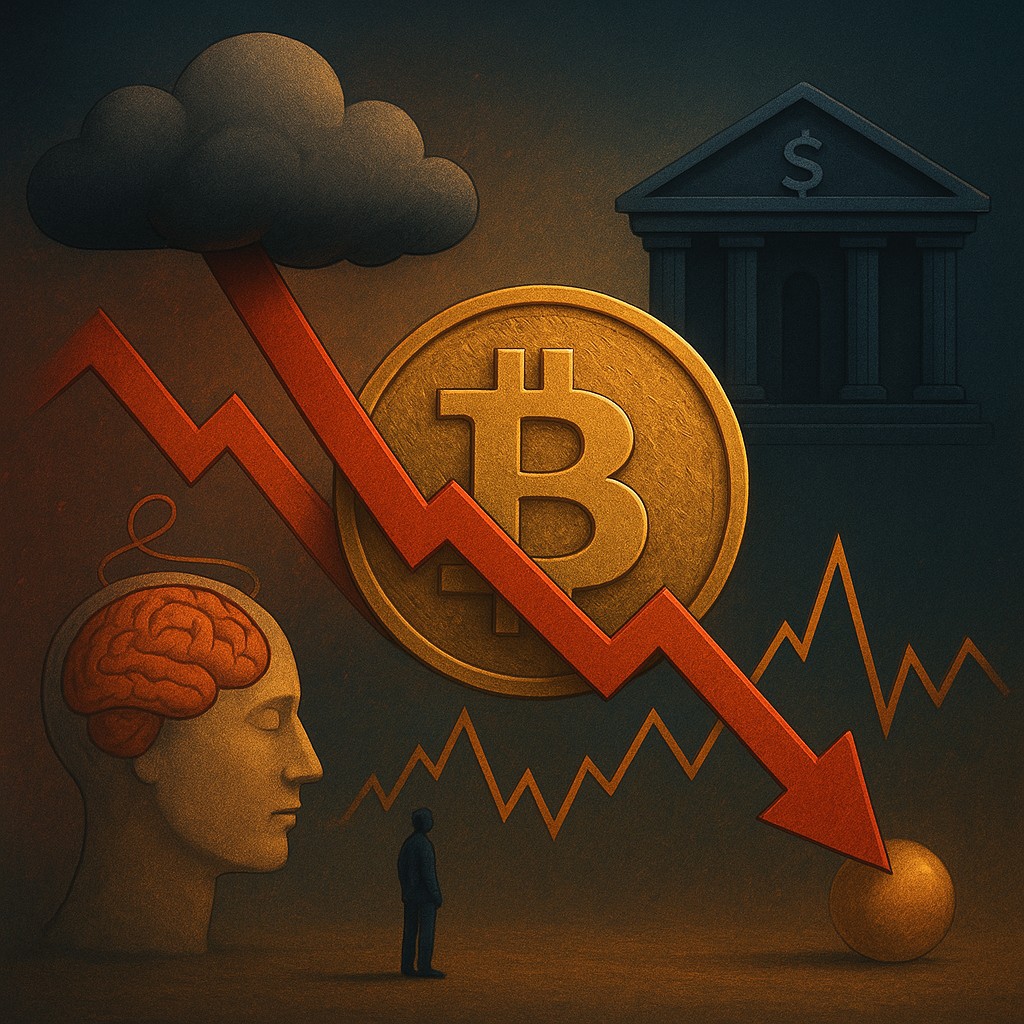
If you have glanced at a financial headline or checked a crypto app lately, you might feel like you are watching a high-speed car chase that suddenly ended in a spectacular, slow-motion skid. Only months ago, Bitcoin was being hailed as "digital gold" and the future of finance. Today, it is behaving like a moody teenager. It is volatile, unpredictable, and currently shedding value faster than a husky sheds fur in the July heat. For those holding onto their digital coins, it feels less like the future of money and more like an expensive roller coaster that forgot how to go up.
Understanding this slump requires looking past the flashing red and green numbers to see how the global economy actually works. Bitcoin does not exist in a vacuum. It is deeply tied to how big banks behave, how the average person feels about their paycheck, and even how wars or elections unfold thousands of miles away. It turns out that when the world gets nervous, "magic internet money" is often the first thing people sell. To make sense of the current dip, we need to untangle the web of high interest rates, psychological panics, and the simple reality of how markets function once the hype dies down.
The Gravity of Interest Rates: How Big Banks Pull the Strings
One of the most powerful forces dragging Bitcoin down has nothing to do with technology and everything to do with the Federal Reserve and other central banks. For a long time, interest rates were near zero. Keeping your money in a traditional savings account was about as profitable as hiding it under a mattress. When money is "cheap" like that, investors get adventurous. They pour cash into risky bets like tech stocks and cryptocurrencies, hunting for the high returns they cannot get at the bank. This wave of "easy money" pushed Bitcoin to staggering heights.
The party came to a halt when inflation spiked. To fight the rising costs of groceries and gas, central banks raised interest rates. Suddenly, you could earn 4% or 5% on your money just by letting it sit in a boring, safe government bond. When "safe" money starts paying well, "risky" assets like Bitcoin lose their appeal. Large institutional investors - the "whales" who move millions at a time - began pulling their cash out of crypto and putting it back into the safety of debt markets. This created massive selling pressure, leaving less "extra" cash around to fuel the speculative fire.
This shift in the cost of borrowing acts like gravity on the entire crypto market. Think of Bitcoin like a kite. When the wind of easy money is blowing hard, the kite soars regardless of its weight. But when interest rates rise, the wind suddenly dies down. The kite doesn't just stop climbing; it begins to tumble back toward the earth. Until investors believe rates will fall again, risky bets will remain less attractive than the guaranteed returns of the traditional banking system.
The Psychological Domino Effect of Market Fear
Markets are not just made of spreadsheets; they are driven by human emotions, which are notoriously fickle. When Bitcoin’s price drops even slightly, it can trigger a psychological chain reaction often called "FUD" - Fear, Uncertainty, and Doubt. This is amplified in the crypto world because Bitcoin is still a young asset without decades of stability to fall back on. When people see their investment lose 10% of its value in a single morning, the instinct to "get out while I still have something left" becomes overwhelming.
This often leads to a "cascade of liquidations." Many professional traders don't just buy Bitcoin with their own cash; they use "leverage," which means they borrow money to bet on the price going up. If the price drops too low, the exchanges they use will automatically sell their Bitcoin to pay back the loan. This forced selling pushes the price even lower, which triggers another round of automatic sales for other traders. It is like a row of dominoes: one small tap at the front can flatten the entire line in seconds, even if the underlying technology is still working perfectly.
Furthermore, the "narrative" used to justify owning Bitcoin is changing. For years, it was marketed as a "hedge against inflation," meaning it was supposed to gain value when the dollar weakened. Instead, it has behaved like a "high-beta risk asset" - a fancy way of saying it acts like a tech stock on steroids. When the stock market has a bad day because of recession fears, Bitcoin usually has a worse one. Investors are realizing it is not a digital bunker to hide in during a storm; it is more like a Ferrari that is fast in good weather but dangerous on an icy road.
Mining Mathematics and the Halving Hangover
Every four years, Bitcoin undergoes a pre-programmed event called "the Halving." This is when the reward given to "miners" - the people running the massive computers that secure the network - is cut exactly in half. In the past, this has led to price booms because it reduces the supply of new Bitcoin. However, the most recent halving has caused a "hangover" effect. While the supply is lower, the costs for miners have stayed the same or increased due to high electricity prices, squeezing their profits.
When miners struggle to pay their bills because their income was cut in half, they are often forced to sell the Bitcoin they already own. This adds more supply to the market just as demand is wavering. Many people "bought the rumor" before the halving, expecting the price to skyrocket immediately. When it didn't, those same people started "selling the news" out of disappointment. This reflects a classic market cycle where the anticipation of an event is more powerful than the event itself.
| Market Factor |
Impact on Bitcoin Price |
Sentiment Level |
| High Interest Rates |
Negative: Investors prefer safe bonds. |
Low / Cautious |
| Institutional Inflow |
Positive: ETFs allow big banks to buy. |
Moderate |
| Regulatory Pressure |
Negative: Governments want more control. |
High Anxiety |
| Network Security |
Neutral: Computing power remains high. |
High Confidence |
| Retail Hype |
Negative: Fewer people are buying from fear of missing out. |
Boredom / Fear |
As the table suggests, the technical health of the network is actually quite strong, but the economic environment is working against it. The "hash rate," which measures the computing power securing the network, is near all-time highs. This tells us the Bitcoin "machine" isn't broken; it is just that the world is currently placing a lower price tag on what that machine produces. There is a disconnect between value (what the thing is worth in the long run) and price (what someone will pay for it today).
The Shadow of Regulation and the Search for Legitimacy
Bitcoin also struggles under the looming shadow of government regulation. For a long time, the crypto world was like the Wild West, where taxes and rules were an afterthought. But as Bitcoin became a trillion-dollar asset class, governments stopped ignoring it. From the U.S. Securities and Exchange Commission (SEC) to the European Union, the "suit and tie" world is finally setting boundaries. While regulation is good for long-term stability, the transition is messy and creates uncertainty.
When a major exchange faces a lawsuit or a country bans certain types of mining, it sends shockwaves through the market. Investors hate uncertainty more than they hate bad news. If they don't know if their favorite exchange will be legal in six months, they move their money back to traditional banks. We are also seeing a crackdown on "bad actors." The collapse of platforms like FTX and the legal troubles of famous founders have left a bad taste in the mouths of regular people, making them hesitant to jump back in.
However, there is a silver lining. The introduction of Bitcoin "Spot ETFs" (funds traded on the stock market) in the U.S. was a massive milestone. This allows anyone with a regular brokerage account to buy Bitcoin without worrying about digital keys or "wallets." While this led to an initial price surge, we are now in the "digestion" phase. The market is trying to figure out how much of this institutional money will stay for the long haul. Bitcoin has officially entered its "legitimacy" phase, but maturing comes with growing pains and high volatility.
Lessons from the Chart and the Long-Term Horizon
If you zoom out on a Bitcoin price chart and look at the last ten years instead of the last ten days, the current "crash" looks like a small blip in a larger upward trend. Bitcoin has "died" hundreds of times according to experts and newspapers, yet it keeps ticking along, processing data every ten minutes like clockwork. The current loss in value is a reminder that Bitcoin is still a "monetary experiment" conducted in real time. When you participate, you are betting that the math behind the code is more reliable than the decisions of politicians and bankers.
The current downturn is a healthy, if painful, part of the market cycle. It flushes out the "tourists" who only bought in because of a TikTok video. Markets need these corrections to reset expectations and move assets from "weak hands" to "strong hands." Those who believe in a borderless, decentralized currency often see these price drops as a "sale," while those who were just gambling see it as a catastrophe. Both views are valid depending on your goals and your stomach for risk.
As you follow the news, remember that Bitcoin’s value is driven by two things: its use as a censorship-resistant way to store wealth and the collective belief of its users. Right now, that belief is being tested by a tough global economy. Whether Bitcoin is failing or just taking a breather depends entirely on your timeline. If you are looking at next week, it looks scary. If you are looking at the next decade, this might just be another chapter in the most interesting financial story of our time. Keep a cool head, stay curious, and remember that in finance, the only guarantee is that things will eventually change.