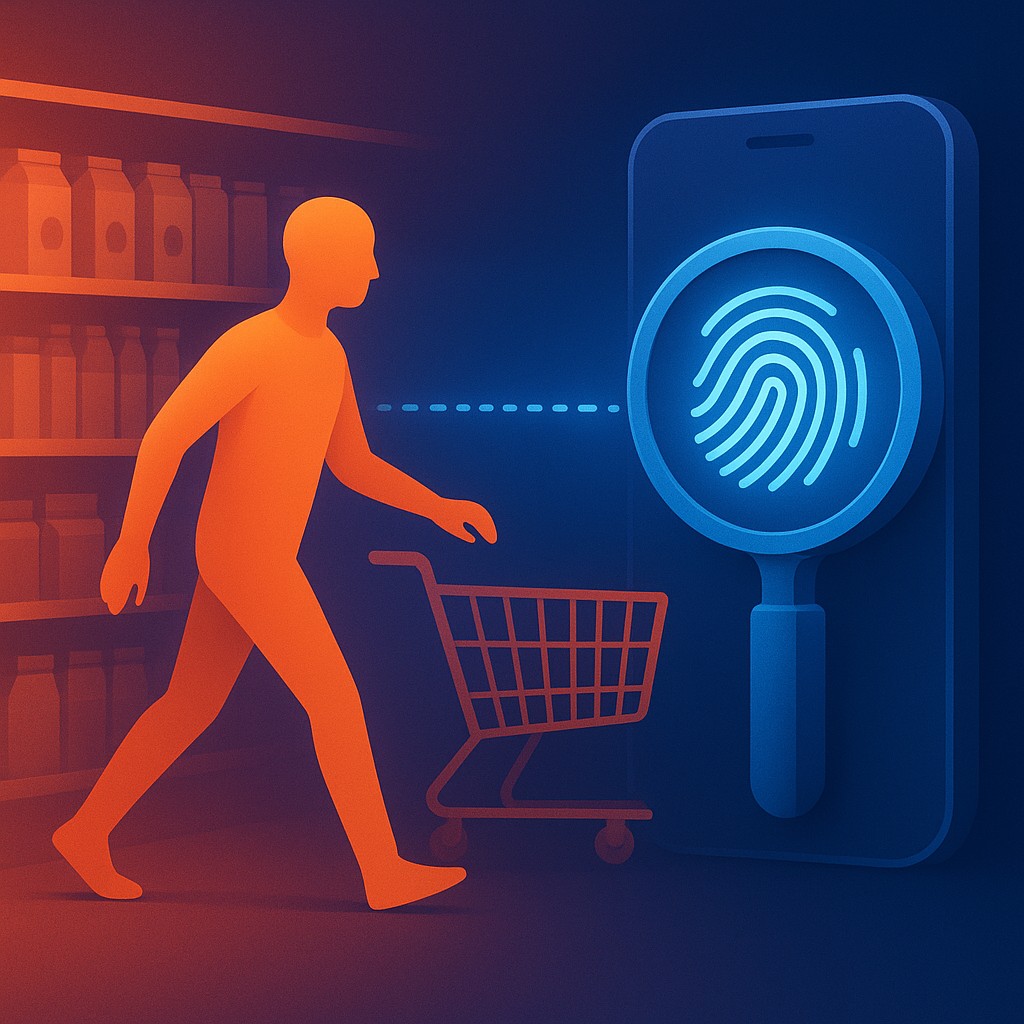
Imagine you are walking through your local grocery store. You know exactly where the milk is, but you still have to navigate crowded aisles, dodge a stray shopping cart, and perhaps pause for a second to choose between whole milk or almond. Even in a familiar place, your physical movement is defined by tiny delays, slight hesitations, and indirect paths. You are a biological being dealing with the friction of the physical world.
Now, imagine a ghost suddenly appeared in the store. It ignored the aisles entirely, flew in a perfectly straight line at eighty miles per hour directly to the dairy fridge, and grabbed the milk in one flawless motion. You would know instantly that this "person" isn’t a person at all.
This is exactly how modern financial technology (fintech) apps are beginning to look at you, or more accurately, at how you interact with your phone. For decades, digital security has been a game of "what you know" (passwords) and "what you have" (security tokens or phones). But we have entered an era where those things are easily stolen, tricked out of users through phishing, or faked. Security engineers have realized that while a hacker might have your password and your phone, they cannot easily copy the unique "you-ness" of your behavior. By measuring the speed, rhythm, and specific path of your navigation, banks are creating a hidden security layer known as velocity friction. It turns out that the way you fumble through a menu is your most unique digital fingerprint.
The Evolution of the Digital Body Double
The shift from static security to behavioral biometrics (identifying people by their habits) represents a major change in how we think about identity. In the early days of the internet, a password was like a secret handshake. If you knew the word, you were the right person. As hackers got better, we added multi-factor authentication, which is like asking to see an ID card after the handshake. However, professional scammers have developed clever social engineering tactics to bypass these. They might call you pretending to be the bank and trick you into reading back the code sent to your phone. At that point, both the "what you know" and "what you have" layers have failed.
Behavioral biometrics, specifically velocity friction, adds a third dimension: "how you do." This is a continuous form of identity checking that doesn't just happen at the login screen; it happens every second you use the app. It relies on the fact that humans are inefficient. We have muscle memory, but we also get distracted. Our thumbs vary in size, and our nervous systems do not fire with the millisecond precision of a computer script. When a fintech app monitors your session, it is looking for a digital body double. If the interactions are too perfect, too fast, or too direct, the system flags the behavior as non-human or a "hostile human," regardless of whether the password was correct.
Measuring the Rhythm of the Human Thumb
To understand how this works, we have to look at the tiny details your smartphone sensors can collect. Every time you touch your screen, you aren't just clicking a button; you are creating a data event. The app can see the exact coordinates of the touch, the pressure applied, the angle of the phone, and the time that passed since your last touch. This is known as "keystroke dynamics" or "gesture profiling." Humans generally have a "flight time" (the time your finger is in the air between taps) and a "dwell time" (how long your finger stays on the screen) that stays within a predictable range.
A professional scammer or an automated script works on a different clock. Scripts move at the speed of the computer processor, which is nearly instant. Even if a script is programmed to include random delays to appear more human, those pauses often lack the natural "jitter" of human biology. Scammers, on the other hand, often work through a checklist. They move through the app with a terrifyingly efficient speed. They don't linger on the home screen to look at their balance; they go straight to the "Transfer Funds" menu, type in a new recipient, and hit send much faster than a typical user who might double-check account numbers or hesitate before sending a large sum of money.
The Invisible Guardrails of Velocity Friction
The term "velocity friction" sounds like a contradiction. Usually, software developers want to remove friction to make an app feel fast and seamless. However, in security, friction is a feature. By monitoring the speed of navigation, the system creates an invisible set of guardrails. If a user tries to add a new person to pay and transfer $5,000 in under twelve seconds, the system recognizes that the speed of this transaction is suspiciously high. It does not necessarily stop the transfer, but it increases the friction by asking for an extra security check, like a face scan or a phone call.
This method is very effective against "Account Takeover" attacks. In these cases, a fraudster has bought a list of leaked passwords and is logging into hundreds of accounts to see which ones have money. Because they are doing this at a large scale, they move with mechanical speed. They don't scroll through your history to see what you bought at the grocery store yesterday; they jump straight to the high-value actions. By measuring the velocity of these movements, fintech platforms can tell the difference between a grandmother checking her pension and a network of automated bots in a server farm halfway across the world.
| Security Layer |
Method of Verification |
Vulnerability |
Role in Modern Fintech |
| Knowledge-Based |
Passwords, PINs, Security Questions |
Phishing, Guessing attacks, Manipulation |
Declining; now used as a basic entry gate. |
| Possession-Based |
SMS Codes, Hardware Keys, Smartphones |
SIM-swapping, Theft, Intercepted messages |
Standard; provides a physical bridge to the user. |
| Behavioral (Biometric) |
Typing rhythm, scroll speed, navigation velocity |
High-stress environments, physical injury |
Rising; provides "silent" and constant monitoring. |
| Environmental |
IP address, GPS location, Time of day |
VPNs, Proxy servers, Travel |
Context-based; helps flag "impossible travel" cases. |
The Physics of a Panic Attack
One of the most fascinating aspects of behavioral biometrics is how it handles human emotion. Security systems are built to detect anomalies (things that are out of the ordinary), and nothing creates an anomaly like a panic attack or a rush. Imagine you are at a train station, your train is leaving in sixty seconds, and you realize you forgot to put money on your travel card. You open your banking app, your hands are shaking slightly, you are tapping the screen aggressively, and you are moving through the menus as fast as your fingers will allow.
In this moment, your velocity spikes. You are moving faster and more erratically than you do on a lazy Sunday morning. To a smart security program, this "panicked human" looks surprisingly similar to a "rushed scammer." This is where the "false alarm" problem happens. The system has to be smart enough to tell the difference between the messy speed of a stressed human and the calculated speed of a computer script. If the system is too sensitive, it locks real users out of their accounts exactly when they need them most. Developers constantly adjust these formulas to find the "Goldilocks zone" where security is tight but the experience stays smooth.
Detecting the Machine Behind the Curtain
While velocity friction is great at catching humans acting like machines, its main target is actual machines. Automated tools like "headless browsers" or script programs are the primary tools of modern fraud. These programs can perfectly simulate a mobile phone environment, making the bank's server think the request is coming from an iPhone in New Jersey. However, they struggle to simulate the physical reality of a human hand holding that phone.
A real human holding a phone is never perfectly still. The motion sensors in your phone pick up tiny tremors, the slight tilt as you shift your grip, and the way the phone leans when you tap the top-left corner versus the bottom-right. A script running on a server has no "grip." It interacts with the app’s internal logic without the physical context of the device. This "sensor silence" is a massive red flag. Even if the script is smart enough to fake motion data, it often fails to match that data with the timing of screen touches. If the phone "tilts" but there is no touch to cause that tilt, the system knows it is looking at a machine behind a curtain.
The Future of the Silent Bodyguard
As we move forward, the traditional "login" might become a thing of the past. We are moving toward a world of "continuous authentication," where the app doesn't just check who you are at the start, but constantly verifies your identity based on every swipe and scroll. This is the ultimate "silent bodyguard." It doesn't interrupt your life with pop-ups or codes unless it notices something is wrong. It allows for a seamless experience for the rightful owner while building an impossible wall of "velocity friction" for anyone else.
This technology also has uses beyond fraud. It can be used to detect the early signs of movement-related illnesses or simply to realize when a person is too tired or distracted to make major financial decisions. The way we move is a window into our mental state. By understanding the physics of our digital interactions, fintech companies aren't just protecting our money; they are beginning to understand the subtle, rhythmic dance of human behavior in a digital world.
The next time you feel slightly annoyed that your banking app is taking an extra second to load, or you feel that a swipe didn't register as fast as you wanted, take a moment to appreciate what is happening. That tiny bit of resistance is often a heartbeat-check from your device, a silent confirmation that the person holding the phone has the messy, beautiful, and slightly slow characteristics of a living human being. In a world of lightning-fast algorithms, your hesitation is your greatest asset. It is the one thing a machine can never truly copy, making your "imperfections" your most powerful shield.