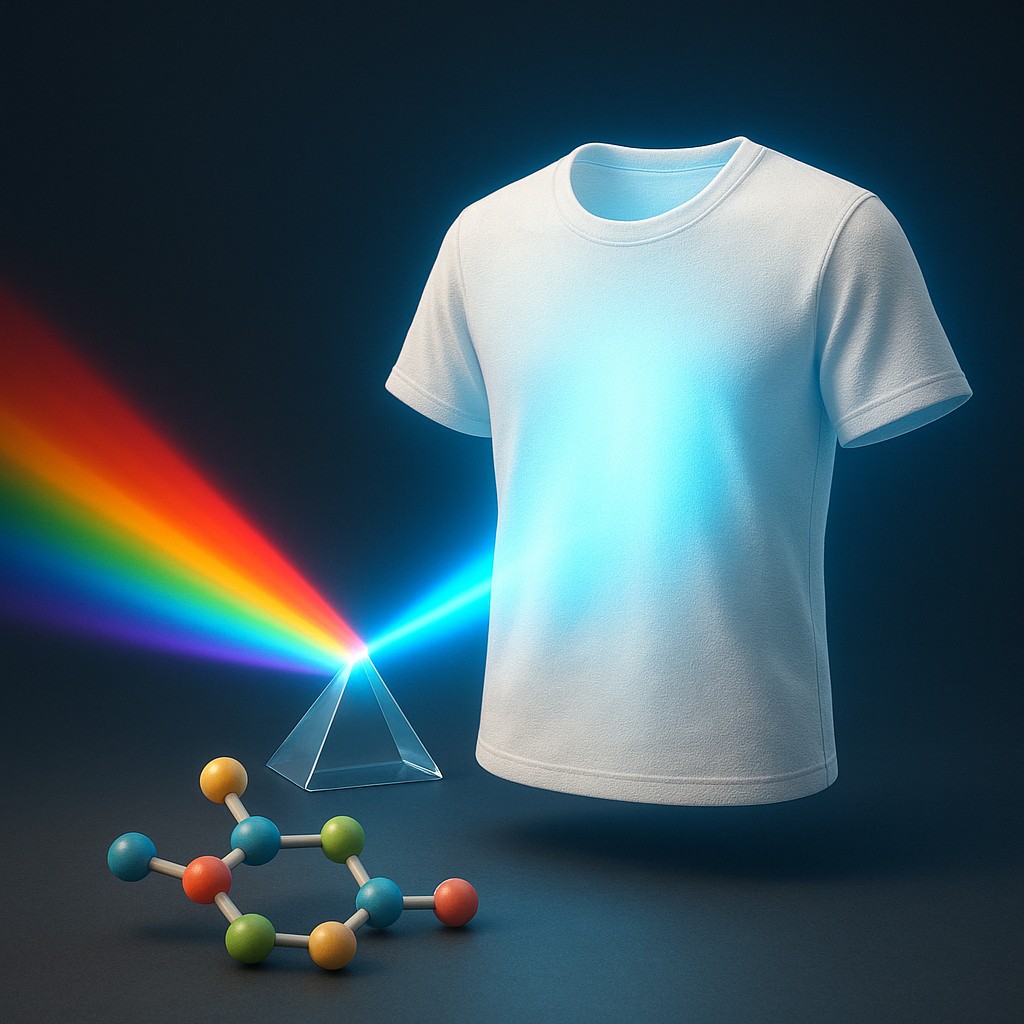
Every time you pull a crisp, snowy-white shirt out of the dryer, you are likely taking part in a silent, high-stakes game of physics and deception. We tend to link that blindingly bright glow with pure cleanliness, assuming our detergent has successfully scrubbed away every microscopic particle of dirt. However, if you were to look at that same shirt under a different light, or perhaps examine it with a spectrometer-a tool that measures the components of light-you would discover a surprising truth. The shirt is not actually as clean as it looks. Its dazzling whiteness is largely the result of a clever chemical trick designed to manipulate how your brain processes color.
In reality, white fabrics tend to age poorly. They slowly drift toward a dull, yellowish tint as they endure the wear and tear of the washing machine and the sun. To solve this visual problem without needing to invent a magical, perfect soap, chemical engineers turned to the electromagnetic spectrum. They realized they did not necessarily need to remove every invisible stain to make a shirt look new; they simply needed to change the way the fabric reflects light back to your eyes. This led to the wide use of optical brighteners, a class of chemicals that act as permanent, glowing makeup for your laundry.
The Problem of Yellowing Fabric
To understand why we need optical brighteners, we first have to understand why white clothes stop looking white in the first place. Most white fabrics are made from natural fibers like cotton, which is not naturally pure white. These fibers often have a slight natural tint, and as they age, they begin to absorb light in the blue part of the visible spectrum. When a material absorbs blue light, the light that reflects back to your eyes is "blue-deficient," which the human brain sees as yellow or dingy. This is a progressive problem: every wash and every day spent in the sun can slightly change the chemical structure of the fibers, making them "thirsty" for more blue light and less pleasing to the eye.
Historically, people tried to combat this by using a technique called "bluing." This involved adding a very small amount of blue dye or pigment to the wash water. The logic was based on the color wheel: since yellow and blue are opposites, adding a touch of blue would cancel out the yellow tint. While this did make the clothes look less yellow, there was a major drawback. By adding a blue pigment, you were actually increasing the total amount of light being absorbed by the fabric. This resulted in a shirt that looked gray or dull rather than bright. The clothes looked "whiter" in terms of shade, but they lost their glow, appearing like a cloudy day instead of a sunny one.
Fluorescence as a Glowing Solution
Optical brighteners, also known as Fluorescent Whitening Agents (FWAs), revolutionized the laundry industry by solving the glow problem. Instead of simply masking yellow with blue pigment, these chemicals use the power of fluorescence. Fluorescence is a physical phenomenon where a substance absorbs light at one wavelength and almost instantly sends it back out at a longer wavelength. In the case of your laundry detergent, these chemicals are designed to absorb invisible ultraviolet (UV) radiation from the sun or overhead lights and "convert" that energy into visible blue light.
When these chemicals latch onto the fibers of your clothing, they act like thousands of tiny, microscopic light bulbs. Because they are actually emitting new light rather than just reflecting what is already there, they increase the total amount of visible light reaching your eyes. This creates an optical illusion of being "whiter than white." Your brain sees the extra blue light coming from the brighteners, which hides the natural yellowing of the fabric, while the added brightness makes the garment look incredibly vivid. This is why a white shirt might seem to "pop" or even glow slightly when you walk into a room with blacklights or strong sunlight.
The Chemistry of Staying Power
One of the most remarkable, and controversial, aspects of optical brighteners is that they are engineered to be stubborn. Most parts of a detergent, such as surfactants that break down oils or enzymes that eat through protein stains, are designed to do their job and then be rinsed away down the drain. If they stayed on the clothes, they would feel greasy or stiff. Optical brighteners are the lone exception to this rule. They are specifically made to have a high "affinity" for fabric fibers, meaning they are designed to stick to your clothes and stay there even after the final rinse cycle is over.
This "substantivity," as chemists call it, is essential for the product to work. If the brighteners washed away, your clothes would look dull the moment you took them out of the machine. By clinging to the threads, they build up over time, ensuring the garment stays bright for as long as possible. However, this means your "clean" clothes are actually coated in a layer of synthetic chemicals that never truly leave. For most people, this is invisible and harmless. But for those with sensitive skin or existing skin conditions, these lingering chemicals can be a source of mysterious irritation, as the fabric is constantly rubbing these fluorescent agents against the skin.
Comparing Traditional Bluing and Modern Brighteners
To better visualize how the technology of "white" has evolved, it helps to compare the two main methods we have used to trick our eyes over the last century. While both aim for the same result, they interact with physics in fundamentally different ways.
| Feature |
Traditional Bluing Agents |
Modern Optical Brighteners |
| Mechanism |
Adding blue pigment to hide yellow. |
Converting UV light into blue light. |
| Total Light |
Decreases (absorbs more light). |
Increases (adds emitted light). |
| Visual Effect |
Neutralizes yellow but looks gray or dim. |
Neutralizes yellow and adds a "glow." |
| Durability |
Usually washes out easily. |
Designed to bond to fibers permanently. |
| Energy Source |
Uses existing visible light. |
Harvests invisible ultraviolet energy. |
| Common Ingredients |
Ultramarine blue or Prussian blue. |
Stilbenes or Coumarins. |
Social and Environmental Trade-offs
The prevalence of these chemicals in our household products speaks to a broader cultural obsession with a specific "Standard of White." Because we have become so used to the hyper-bright white produced by detergents, natural, untreated fabric can look dirty by comparison. This has created a loop where detergent makers must include these chemicals to meet consumer expectations of what "clean" looks like. Interestingly, because these chemicals rely on UV light, a shirt that looks brilliantly white outdoors in the sun might look slightly more yellow indoors under standard lightbulbs, which have very little UV radiation to trigger the glow.
Beyond the look and skin sensitivity, there is also the question of environmental impact. Because optical brighteners are designed to be stable and resistant to breaking down, they do not biodegrade easily. When they eventually wash off or when excess detergent enters the water system, they can stay in the environment for a long time. While they are generally considered to have low toxicity, they are frequently found in wastewater. Environmental scientists even use them as a "tracer" to identify where human sewage is leaking into natural waterways. If a stream starts glowing under a UV lamp, it is a fairly certain sign that laundry water is present.
Seeing Beyond the Glow
Navigating the world of modern cleaning requires a bit of healthy skepticism toward what we see. It is helpful to remember that "white" is not a single, fixed point, but a subjective experience shaped by the light around us and the chemicals on our clothes. If you find that your skin is frequently itchy or irritated after wearing freshly washed clothes, or if you prefer a more natural look, you might consider looking for detergents labeled "Free and Clear." These formulas typically leave out dyes, perfumes, and optical brighteners, prioritizing actual cleanliness over the optical illusion of brightness.
Ultimately, the story of optical brighteners is a testament to human ingenuity. We found a way to bridge the gap between the physics of light and our desire for perfection, using the invisible parts of the sun’s rays to fix a problem we could not solve with soap alone. Whether you appreciate the science of the glow or prefer to keep your chemistry to a minimum, knowing how the trick works allows you to make better choices about the products you bring into your home. The next time you see a shirt that looks "whiter than white," you will know that you aren't just looking at a clean garment, you are looking at a tiny, wearable light show.
The world is full of these hidden mechanisms, where the things we take for granted are actually sophisticated applications of science designed to please our senses. By looking at the science behind the scenes, we transform mundane chores into opportunities for discovery. Whether it is the glow of a white shirt or the scent of a fresh room, there is always a deeper layer of reality waiting to be explored. Approach your daily life with a curious eye, and you will find that even a simple basket of laundry has a fascinating story to tell about the nature of light and the limits of human perception.