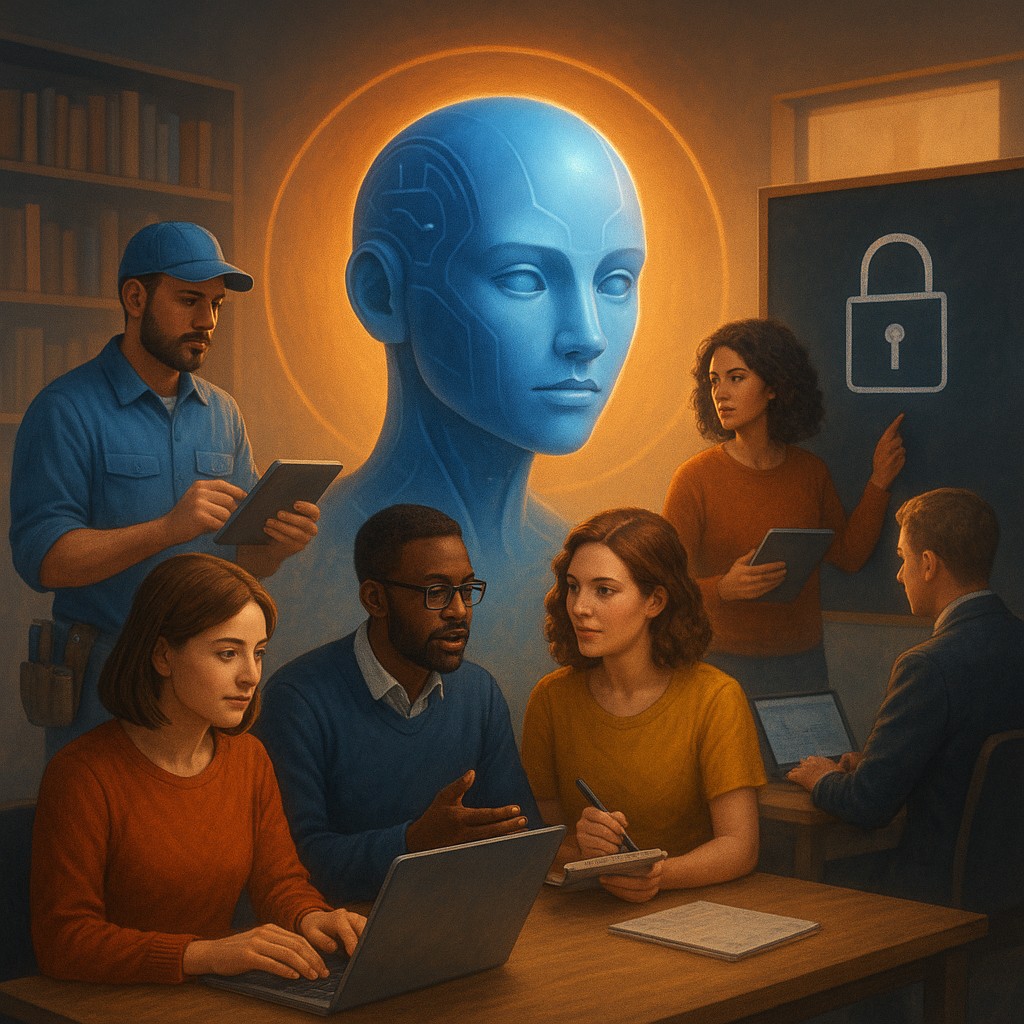
For decades we pictured the future with flying cars and robot butlers. Then the future arrived - not as metal servants but as algorithms that sort our photos, write text, help diagnose diseases, and sometimes even pick the music for doing the dishes. No wonder people keep asking, "But... what will happen to my job?"
The good news is that some jobs hold up well against automation, not because the technology is "stupid," but because human work is not just rule-following. Some roles deal with unpredictable physical situations, require earning trust, calming fears, negotiating conflicting goals, improvising around limits, or taking moral responsibility. In short, where humans are not a bug, they are a feature.
Still, beware the simple idea of a "job 100 percent protected" from AI. In 50 years many professions will still exist, but they will have changed. The real goal is not to find a job "immune to AI," it is to aim for roles where technology becomes a powerful tool in your hands instead of a competitor that replaces you. Below are the kinds of jobs most likely to survive, and why.
Understanding what AI really automates (and what it has trouble with)
AI shines at repeatable, well-defined tasks that generate lots of data: sorting, predicting, optimizing, spotting patterns, and creating variations. If your job is "take an input, apply rules, produce an output," it is probably AI-friendly. That does not mean it will vanish tomorrow, but it will be reshaped with fewer mechanical tasks and more supervision, judgment, and human interaction.
By contrast, AI struggles when you must combine four tricky ingredients: a chaotic physical environment, fuzzy goals, emotional people, and high-stakes consequences. Technology is improving fast, but the real world is full of surprises. A panicked child, a leak behind a wall, a team conflict, a patient who hides the truth, a delayed construction site because of a subcontractor - all those situations require adaptation, not just the statistically most likely answer.
Another often-missed point: even when AI can do something, society does not always accept letting it act alone. Trust, legal responsibility, ethics, and the need for a human face matter a lot. In 50 years we may have powerful systems, but people will still want humans to take responsibility, explain decisions, arbitrate, reassure, and sometimes say, "No, we will not do it that way."
Care and relationship work: when the human is the heart of the service
Health and support professions have a natural protection: they rely on trust and human connection. A doctor, nurse, psychologist, midwife, speech therapist, nursing assistant, special education teacher, or occupational therapist are more than technicians of body or mind. They translate complex situations into understandable choices and walk someone through a vulnerable moment.
AI will help a lot. It will analyze medical images, propose hypotheses, monitor vital signs, optimize hospital schedules, and reduce errors. But when you need to deliver a diagnosis, build buy-in for treatment, understand the fear behind resistance, or choose between "what is possible" and "what is acceptable," human presence stays central. Even if an AI seemed empathetic, people will want to know a human accepts the moral responsibility.
Jobs caring for older adults will also remain essential. In 50 years many countries will have aging populations. You can automate some logistics, but you cannot fully replace looking after someone, spotting subtle signs of decline, adjusting daily life, and preserving dignity. Robots can lift, remind, and monitor, but quality of life is woven through human interaction.
"Real-world" trades: craft, maintenance, emergency work, and construction
Technology prefers clean, predictable environments. Life prefers the opposite. That is great news for skilled manual jobs that operate in varied contexts: electricians, plumbers, heating technicians, maintenance techs, roofers, carpenters, mechanics, site operators, energy retrofit specialists, solar installers, network technicians, and many more.
Why do these jobs hold up? Because every intervention is a unique puzzle. You must diagnose, access the problem, secure the site, improvise, handle regulations, talk to the client, work with imperfect materials, and leave a reliable result. Robots will appear on sites and in factories, but full autonomy in old houses, aging infrastructures, and patchwork installations built over decades is very hard. A robot might know how to tighten a bolt, but someone must know which bolt, in what order, and why the leak persists.
These jobs also gain value because the energy transition and infrastructure resilience will take a long time. Renovating, insulating, repairing, adapting, and securing cannot be shipped overseas and will stay in demand. An algorithm can advise on insulation, but someone still has to install it, check thermal bridges (areas where heat escapes), and make sure the house does not turn into a mold box.
Education, guidance, and transmission: teaching is more than consuming content
People often confuse teaching with reciting a lesson. Teaching is diagnosing what blocks a learner, building motivation, setting a frame, adjusting pace, and managing group dynamics. In 50 years students will have highly personalized AI tutors that can explain a theorem ten ways. That is great. Still, we will need teachers, trainers, educators, coaches, human tutors, and educational leaders.
Why? Because a classroom is a social ecosystem. Someone must keep attention, set rules, protect the vulnerable, spot students falling behind, manage conflicts, and sometimes do the invisible but crucial work of making someone believe they can succeed. Motivation is not a simple on-off switch. It grows from a relationship, clear expectations, a shared culture, and recognition.
Corporate trainers will also remain important because skills will change fast. AI can generate modules, but humans must decide what matters to learn, align learning with strategy, assess behavior, and build workplace culture. Teaching is not only cognitive, it is social: "this is how we work together."
Leadership, arbitration, and responsibility: deciding under uncertainty
A persistent myth says, "When AI is powerful, it will make the decisions." In reality, the stronger the systems get, the more we will need people who can ask the right questions, set goals, and be accountable. Jobs in leadership, crisis management, complex project management, diplomacy, negotiation, and human-centered management should remain, even if the tools change.
Deciding is not just optimizing a metric. It is weighing values: safety versus speed, cost versus quality, innovation versus stability, freedom versus protection. Those trade-offs are political in the noble sense: they involve real people, conflicting interests, compromises, and sometimes morally uncomfortable choices. AI can offer scenarios, but someone must say, "This is what we accept."
Legal and compliance jobs - lawyers, judges, mediators, data protection officers, auditors - will change rather than disappear. AI will speed up document review and spot inconsistencies, but society will still need interpretation, advocacy, fairness, and clearly assigned responsibility. When liberty, reputation, or safety is at stake, "it was the algorithm" is not a sufficient explanation.
Creation, taste, and culture: AI can produce, but humans choose what matters
AI already generates images, music, text, and videos. Does that mean the end of artists? Not so fast. We must separate producing content from making work that matters to a community. In 50 years there will still be authors, designers, directors, architects, game designers, chefs, craftspeople, art directors, and curators. Many will work with generative tools, much like photographers learned to use Photoshop without photography disappearing.
The human role in creation is taste, intention, and context. People do not pay only for something "pretty"; they pay for a vision, a story, an identity. They also want to know who is behind the work, what values they hold, how authentic they are, and whether they take risks. AI can mimic styles, but it does not live through an era, take personal risks, build a reputation, or carry social responsibility.
Cultural and media jobs will be disrupted. Mass production will be automated, and value will shift toward direction, originality, audience building, and trust. Tomorrow’s creator will often act like an orchestra conductor, guiding powerful tools to produce something singular.
Cybersecurity, digital trust, and on-the-ground work: technology creates its own needs
The more we rely on digital systems, the more people we need to secure, audit, fix, and respond to incidents. Cybersecurity is a delicious paradox: each tech advance creates new attack surfaces. In 50 years we will still need defense roles, incident response teams, risk analysts, critical infrastructure security experts, and data governance professionals.
You might think AI will dissolve these roles. In fact, it will make them more strategic. Attackers will use AI too, crafting more convincing scams and finding flaws faster. Defense will rely on people who can think like an adversary, set priorities, communicate clearly during a crisis, and coordinate rapid decisions under pressure.
There is also a very concrete part: much security work happens in the field. Protecting a factory, a hospital, or an electrical grid is not just configuring a firewall. It means understanding operational constraints, people who are rushed, procedures bent "just for today," and designing systems that are robust in real life.
Quick reference table: which job families are most likely to last?
| Job family |
Examples |
Why it resists well |
How AI will mainly change the job |
| Care, support, social work |
nurse, psychologist, home care aide |
trust, moral responsibility, relationships |
helps with diagnosis, monitoring, and cuts administrative tasks |
| Field intervention and trades |
plumber, electrician, maintenance tech |
unpredictable physical world, standards, on-site diagnosis |
helps detect faults, plan work, and provides augmented reality support |
| Education and supervision |
teacher, trainer, educator |
motivation, group management, human follow-up |
personalized tutoring, adaptive content, tool-assisted assessments |
| Leadership and coordination |
project manager, manager, negotiator |
value trade-offs, uncertainty, human politics |
provides scenarios, analytics, and automates reporting |
| Law, mediation, compliance |
lawyer, mediator, DPO |
interpretation, fairness, clear responsibility |
speeds up document research, flags anomalies |
| Creation and artistic direction |
designer, director, architect |
intent, taste, narrative, identity |
speeds prototyping, generates variants, enables co-creation |
| Security and resilience |
cybersecurity, crisis management |
evolving adversaries, high stakes |
assists detection, simulates attacks, speeds response |
Debunking common myths: "manual job" vs "white-collar job" and other traps
Myth one: "Manual jobs are threatened, office jobs are safe." That fit past automation of production lines. But modern AI first targets digital tasks: text, images, spreadsheets, customer support, reporting. As a result, some standardized office jobs are more exposed than many skilled field roles.
Myth two: "Creative jobs are untouchable." They are not. What is protected is not the act of "making a poster" or "writing a text," but the ability to set direction, understand an audience, own a signature style, and deliver coherent work. Creativity as execution can be heavily assisted. Creativity as vision remains rare.
Myth three: "Just pick a job and you will be fine." In reality, security comes more from your transferable skills than from a job title. In a changing world, your best insurance is being the person who knows how to learn, adapt, work with others, and use technology without being replaced by it.
How to choose a durable job: a simple filter you can use
Instead of hunting for a magic list of "10 safe jobs," ask yourself some practical questions. Think of them as a durability detector - they work surprisingly well.
- Does the work involve managing people (emotions, conflicts, motivation, trust)?
- Does the context change often (field work, surprises, unique constraints)?
- Are the stakes high (safety, health, justice, money, reputation)?
- Do you need to explain, convince, teach, or negotiate?
- Does responsibility have to be clearly human (ethical, legal, social)?
If you answer "yes" to several of these, you are likely in an area where AI will be a copilot, not a replacement. If your job has many repetitive tasks, the strategy is not always to flee, but to move up: take on client relations, quality control, coordination, process improvement, or technical specialization.
A realistic and encouraging view for the next 50 years
In 50 years the labor market will not look like a chess game in which AI captures all the human pieces. It will look more like a well-equipped kitchen: some tools will save huge amounts of time, but people will still choose the menu, taste and adjust, plate the food, and create the atmosphere. The most durable jobs will combine expertise, judgment, and human relationships, especially in messy real-world contexts.
The most useful question is not, "Which job can AI not do?" but, "Which job lets me be more human, not less, while using powerful tools?" Build skills in communication, solving concrete problems, taking responsibility, and lifelong learning, and you will not be trying to escape the future. You will be part of shaping it. And honestly, that is exciting.