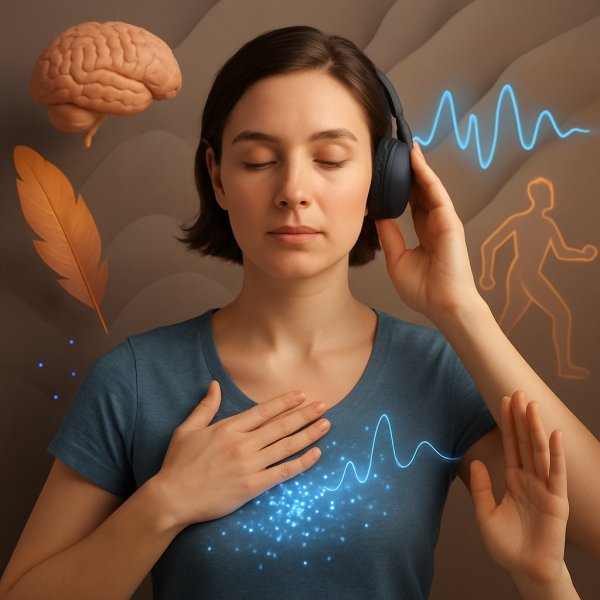
When words stall and the body remembers: why this matters now
Imagine trying to describe a thunderstorm while your shoes are taped to a burning floor. That odd image gives a clue to why trauma often resists talk alone. Trauma is not just a story stored in language; it is a collection of sensations, reflexes, and nervous-system patterns that live in the body. When we rely only on words, we may be naming the storm, but we are not always able to unstick our feet from the heat.
Over the last two decades, clinicians and scientists have started to map where trauma hides - in heartbeat rhythms, muscle bracing, breath patterns, implicit memories, and the brain circuits that predate language. New and revitalized therapies - from yoga to neurofeedback, EMDR to theater-based approaches - aim to speak to those nonverbal systems. They do not replace talk therapy; they expand the dialogue to include the body, the senses, and the brain’s hardware.
If you have ever felt relief from shaking, moving, or performing a small ritual, you already know some of this intuitively. This piece will show how different body-informed methods work, why they can be more effective than words alone, and how to try them safely. Expect science grounded in real-world examples, practical steps you can test, and a few metaphors to help the concepts stick.
Read on if you want a map that links mechanisms to practices - and a toolkit to start releasing stuck patterns that words alone cannot reach.
How trauma gets lodged in body and brain circuitry
Trauma often leaves two kinds of traces: explicit memories we can narrate, and implicit memories held in the nervous system and body. When a frightening event outruns our ability to respond, the brain encodes sensory fragments and bodily states - racing heart, constricted throat, numbness - alongside partial images and smells. Those implicit traces can trigger intense reactions later without conscious awareness, because they live in circuits designed for survival rather than storytelling.
The autonomic nervous system - with its sympathetic, parasympathetic, and social-engagement branches - organizes how we respond to threat. Prolonged or overwhelming stress can bias these circuits toward hypervigilance, freeze, or dissociation. Somatic and neuro-based therapies target those circuits directly, aiming to shift physiological patterns so that the body no longer reflexively re-enact past danger. In short, to change the present you often have to change the body that is wired to expect danger.
Why talking is necessary but sometimes insufficient
Talk therapy is invaluable for meaning-making, reframing, and building insight, and it often lays the groundwork for deeper work. Yet language depends on cognitive systems that can be bypassed during intense arousal, when the brain prioritizes immediate action. Saying "I am safe now" can be helpful, but if your chest is tight, voice shrill, or limbs frozen, the body may not accept that statement because the physiological evidence still says otherwise.
Think of talk therapy as updating the user manual, while somatic approaches update the operating system. Both are important. The operating system - heart rate patterns, muscle tone, vagal brake - needs recalibration for the manual to be fully implemented. This is why integrative approaches that combine words with body-based work often produce deeper and more lasting change.
Yoga and mindful movement - re-teaching the body to flex
Yoga and mindful movement bring attention to breath, posture, interoception, and the flow between effort and release. These practices gently challenge rigid holding patterns and provide repeated, predictable experiences of safety in the body. Over time, breath control and movement can down-regulate sympathetic arousal, strengthen parasympathetic responses, and increase tolerance for bodily sensations that were previously avoided.
Scientific studies show improvements in anxiety, PTSD symptoms, and physiological markers like heart-rate variability after trauma-informed yoga programs. The key is the trauma-informed frame - choice, pacing, and avoidance of re-traumatizing touches or postures - which allows the participant to witness sensations without being overwhelmed. Yoga’s ingredient list is simple - breath, attention, rhythm - but its effect on neural regulation is profound when delivered with safety.
EMDR - using eye movements to reprocess stuck memories
Eye Movement Desensitization and Reprocessing, or EMDR, is a structured, evidence-based therapy that helps reconsolidate traumatic memories. In EMDR, a person recalls a distressing memory while receiving bilateral stimulation - often guided eye movements or alternate taps. The combination appears to reduce the emotional intensity of the memory and allows the brain to integrate it more adaptively.
The exact mechanism is debated, but current models suggest that bilateral stimulation taxes working memory and activates brain networks involved in memory reconsolidation and emotional regulation. EMDR frequently produces rapid reductions in symptoms that can feel surprising compared to gradual talk therapy alone. It directly targets how memories are stored and linked to bodily states, making it a powerful option for people stuck in recurrent flashbacks or intrusive recall.
Neurofeedback - training brain rhythms like a musical instrument
Neurofeedback is a form of biofeedback where individuals learn to shift their brainwave patterns through real-time feedback, usually from EEG signals. Imagine having a mirror that shows your brain’s electrical activity, and learning to change the reflection through practice. Over sessions, people can increase coherence in networks related to focused attention, or decrease overactivity linked to hyperarousal.
Clinical studies show neurofeedback helps with PTSD, anxiety, and sleep problems by stabilizing neural circuits rather than simply talking about them. It is particularly useful when trauma has caused entrenched dysregulation that resists top-down cognitive change. Neurofeedback is not instantaneous; it requires repeated practice, but the changes often persist because they reflect learning at the level of brain rhythms.
Theater and expressive arts - re-scripting the body’s story
Theater-based therapies and expressive arts invite people to inhabit alternative versions of themselves, explore emotions through role-play, and rehearse new responses in a safe container. This embodied rehearsal can alter habitual action patterns, loosen shame-bound postures, and give voice to parts of experience that feel unsayable. The process is social, creative, and often playful, allowing nervous systems to practice safety in relation to others.
Research on drama therapy and psychodrama indicates reduced trauma symptoms, improved emotional regulation, and increased self-efficacy. Theater works because it leverages rehearsal, embodiment, and narrative change simultaneously - your body learns a new movement script while your mind learns a new story about who you can be. For many, the catharsis of giving shape to pain through action is more transformative than describing it.
Comparing strengths, sensations, and research - a quick map
| Therapy |
Primary target |
How it feels in a session |
Mechanism (simple) |
Evidence strength |
| Yoga / Mindful movement |
Breath, posture, interoception |
Slow movement, breath cues, felt-safety |
Enhances vagal tone, tolerance for sensation |
Moderate - growing RCTs |
| EMDR |
Traumatic memory reconsolidation |
Recalling memory with bilateral stimulation |
Working-memory load + memory reprocessing |
Strong for PTSD in many trials |
| Neurofeedback |
Brain rhythm regulation |
Watching feedback, practicing modulation |
Operant conditioning of EEG patterns |
Moderate - promising but variable |
| Theater / Expressive arts |
Embodiment, social rehearsal |
Role-play, enactment, group reflection |
Embodied rehearsal, narrative re-scripting |
Moderate - supportive studies, context-dependent |
Addressing common myths and red flags
Myth 1 - "If it’s body-based it is unscientific." Not true. Many body-based therapies have measurable effects on heart-rate variability, cortisol, and brain imaging. The evidence base is mixed - some therapies are more rigorously studied than others - but physiology is measurable, and that allows scientific testing.
Myth 2 - "You should avoid movement if trauma makes you too reactive." Safety and pacing matter. Trauma-informed versions of yoga or theater avoid coercion and use choice and stabilization skills so people do not get re-traumatized. The problem is not movement itself, but how it is introduced and supported.
Red flag - any practitioner who insists on a one-size-fits-all approach or pushes for rapid exposure without consent. Effective somatic work is collaborative, paced, and trauma-aware. Always check credentials, ask about safety practices, and trust your felt sense if something feels harmful.
Two short stories that illuminate the work
When Mira arrived at an EMDR session, she could not sleep and was replaying a car accident in small, merciless loops. After stabilization work and a few EMDR sets, the images remained, but their charge dropped. The next morning she noticed she could step into a grocery store without feeling dizzy. The memory was still there, but it no longer hijacked her autonomic system, which felt like getting her hands back on the steering wheel.
Carlos joined a community theater group that used drama therapy to explore identity and trauma themes. At first he stayed on the edge, fists clenched, voice low. Over weeks of role-play and small improvisations he discovered a different posture for anger and a new tone for asking for help. The group setting let his nervous system practice feeling seen and contained, and his body slowly stopped bracing in anticipation of rejection.
Practical action plan - try a gentle experimental sequence
Think of this plan as a short laboratory for testing how your body responds when you add action to understanding. Start slow, prioritize safety, and give yourself permission to stop.
- Anchor with a safety check: spend five minutes noticing your feet on the floor, your breath, and one thing in the room you can see. Do this before and after any somatic experiment to monitor change.
- Try a two-minute breath-and-movement exercise: inhale for four counts, exhale for six, and on the exhale soften your shoulders. Repeat with gentle neck rolls for three minutes. Notice any shifts in temperature, tension, or mood.
- Do a guided bilateral stimulation practice - look side to side following a finger or a soft tapping alternately on your hands - for two to three minutes while holding a neutral memory. Notice whether emotional intensity changes without analyzing why.
- Attend one trauma-informed yoga class or 60-minute community drama workshop. Watch how your body and mood differ the next day compared with a talk-based session.
- If symptoms are severe or overwhelming, consult a licensed clinician trained in trauma and one of these modalities. Consider EMDR or neurofeedback with credentialed providers for direct trauma processing.
Short checklist to keep handy:
- Check body safety first - breathe, ground, stop if overwhelmed.
- Start with brief experiments, 2-5 minutes, and observe.
- Seek trauma-informed instructors or clinicians.
- Combine modalities slowly - somatic + talk often works best.
Questions to reflect on and discuss with a therapist
- When you think of a difficult memory, what bodily sensations appear first - heat, tightness, numbness, or something else? How do they change when you move or breathe?
- Which of these modalities - movement, bilateral stimulation, brain-training, or role-play - feels most approachable or intriguing to you, and why?
- What safety supports would you need to try a somatic practice - a trusted professional, a friend on call, shorter sessions, or written consent about boundaries?
Key takeaways for remembering the essentials
- Trauma is stored in body and brain as much as in story, so changing physiology is often necessary for deep healing.
- Talk therapy updates meaning; body-based therapies update the nervous system and make those meanings actionable.
- EMDR targets memory reconsolidation, neurofeedback trains brain rhythms, yoga builds interoceptive regulation, and theater re-scripts embodied behavior.
- Safety, pacing, and trauma-informed guidance are essential across all somatic methods.
- Combining talk and body-based work often yields the most durable results.
Go do one small brave thing today
You do not need to overhaul your life to begin. Pick one two-minute experiment - a breath pattern, a short bilateral stimulation, or a gentle stretch - and notice the difference. Healing from trauma is rarely a single dramatic breakthrough; it is more often a sequence of small corrections that retrain your nervous system to expect safety. Each safe, supported practice is evidence that your body can learn a new habit.
Keep curiosity as your guide, and remember to balance courage with care. If you engage with a professional, ask about trauma-informed practice and pace. You can re-script the body’s memory, and in doing so, change what the future feels like.