Dystopian & Post-Apocalyptic
When the Resonant Core Sang: Memory, Community, and the Night They Drove Back Godzilla
September 20, 2025
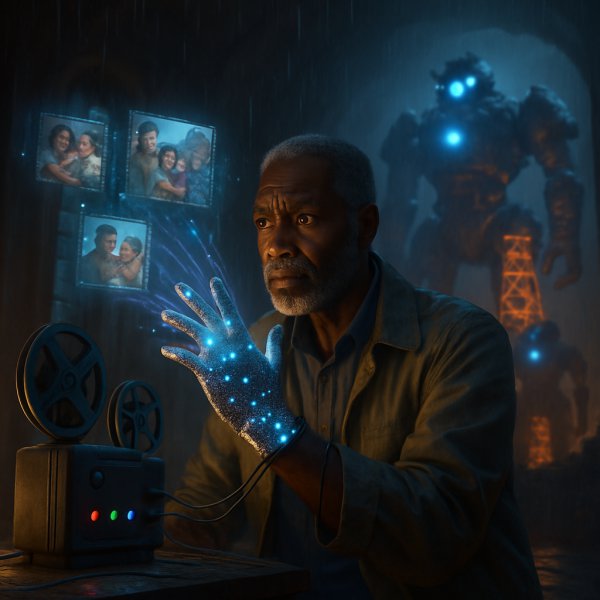
The old Salle des Lucioles still smelled of rain and burnt popcorn, as if the city had coughed up its pleasures and kept the ashes. A strip of salvaged LEDs blinked along the proscenium, coloring cracked plaster in uneasy blues and bruised purples. Hubert sat on a backstage crate, palm warm on a sequined glove, rubbing a finger over the worn disks until they hummed beneath his skin like an unspoken promise he could not sing out loud.
Someone called his name, and the sound ricocheted off pipes and patched curtains. He glanced up at the crowd: faces hooded against the drizzle, a girl with a lamp-bottle clipped to her belt, two old men whispering about "records from the archives." The organizers had hung a poster where paint peeled like dried skin: MICHAEL LOOKALIKE — PRIZE: RESONANT CORE. The letters were hand-stitched in borrowed thread.
The Resonant Core was the inciting spark: a compact compute shard rumored to hold cycles enough to run a neighborhood's life for months. For Hubert it was more than light and speed. He had dreamed of restoring the archive he had coaxed into spare racks: voices, recipes, maps of the flooded sectors — things that kept people from being strangers to one another. And there was the other rumor, whispered in the dark: the Core could be pushed farther, drive a field modulator, focus sound and charge into a blade of purpose. The city needed both memory and defense; the thrum beneath the docks had grown like a throat warming. Hubert had kept that ember folded, afraid to admit that memory alone might not be enough.
Mara, all angles and kindness, touched his shoulder. Her face was lit by the lamps; she smiled with the missing tooth and asked, "You ready to give them something to remember?"
"What if I don't look the part? Or sing it? Or move like him?" Hubert's question landed like a dropped bolt.
Mara glanced at his sequined glove. "You don't have to be the man," she said. "You have to make them remember why it matters."
The line went on. Marco took the stage like a motion picture: hair that defied gravity, skin like polished walnut, moves practiced until they were a memory. He tweaked his wig with a small mirror and took the crowd apart with a perfectly stolen moonwalk. Visible goal: the Core. Hidden fear: a fame that would always be someone else's shadow. He clapped Hubert's shoulder with the easy cruelty of practiced winners. "Play the glove, pal," he whispered.
Hubert could not sing. He could not moonwalk. He could not imitate a voice or make his feet lie. But habit had taught him one thing: code listens where voices fail. Backstage, with the lights arguing overhead, Hubert had been fiddling beneath the glove's cuff. He had soldered a tiny emitter to a salvaged board, tied a strip of LEDs into a miniature matrix, and written a small script that could weave sound and image into a single memory-stream. If people came for Michael, he would give them Michael as a doorway — and walk through that doorway into something else.
When his turn came, Marco had left the crowd bright and greedy. Hubert stepped into the smeared light with his patched suit and fedora; the sequins caught stray rays and winked. He tried a practiced pose and felt the room bend with expectation. The first beat landed awkward; the second lost shape. A voice from the back barked, "You don't look like him, Hubert!" The laugh that followed gnawed at him.
He did not try to be the man. Instead he put a hand to the glove and pressed the emitter's pad to the stage floor. The glove hummed, and beneath the theater's sputter the salvaged LEDs along the proscenium answered like a spine. Hubert's fingers rolled through the script he had written for a thousand solitary nights — not imitation but collage: a loop of neighborhood voices, the boulanger's laugh, a baby's first word, a ferry's horn, and threaded through them, a rhythm borrowed from the songs people had hummed to get through blackout winters. He fed the audio into the lights and the patched speaker under the lip of the stage; the matrix translated sound into light and memory into motion.
On the screen behind him — a ragged sheet rescued from the trash heap — images rose: maps of streets that used to be, recipes written in the margins of grocery slips, the silhouette of a man who once climbed a ladder to fix a rooftop antenna. The projection cracked like a photograph left in the rain and then held. The crowd's whoops softened into something sharp and unprepared: recognition. Mara slid a harmonica between her teeth and let it thread a counter-melody, faint and true. A woman near the front sang a few crooked lines from a children's tune. The theater hung on those small, human notes.
Hubert told a story without opening his mouth to sing the way they expected. He stepped and let the lights do the dancing, spoke through recorded laughter and the hush of a recipe being read aloud, and in that weaving he offered something the polished imitation could not: a reason. "If you want to remember, help me keep it," his final line was not sung but encoded into the projection as a scroll of names — every jar-labeled memory he'd been saving.
The judges whispered. Luc, ex-broadcaster with a cracked pocket watch, sat very still; Yvette, retired costume maker, had tears on the edge of her chin. Marco chewed his lip, the mirror dark in his fist. The official applause was mixed, the generator hiccuped, then steadied — but the crowd rose like one body and, with a momentum Hubert had not engineered, called for the Core.
He had not danced. He had not sung on key. He had used the thing he knew: the light between wires, the shape of a memory when threaded through code. It was a cleverness that looked like honesty. Luc rose, the pocket watch folding shut like a small ship, and announced a new thing: the official prize would stand, but there would be a special award this year — Community Resonance — a people's vote for the thing that kept them human. Marco took the official trophy, glittering and careful; the crowd handed the Resonant Core to Hubert wrapped in canvas.
He held it like a heart.
For all that, Hubert's victory felt like the beginning of a debt rather than its end. He had not told the theater everything. He had salvaged blueprints from a municipal archive: sketches for an acoustic lattice, a pulse modulator that could pattern a field with enough precision to upset an intelligent rhythm. He had imagined a Sentinel: a lean chassis of scrap and intent that would use the Core's cycles to listen and answer, to turn a creature's song back on itself. He had kept that private, afraid of what a weapon made from memory might become. The prize changed the calculus.
Days later, under a sky the color of old bruise-paper, Hubert mounted the Core in a small node. The neighborhood gathered: old dockhands with salt-creased knuckles, a woman who mended radios, Marco bringing a cap and a guilty look, Luc watching like a man who had finally given faith a chance to be measured. They fed the node battery and stories, soldered a ragged antenna, and watched the display pulse awake. Hubert folded his empathy script into the Sentinel's control chain and then — because salvagers and dreamers always cross that thin line — he connected the Core's driver to a lattice of coils he had built to pattern sound and displacement.
When the first alarm came from the harbor — a deep, patient groan that vibrated the lamp-bottles — they took the Sentinel to the quay. Children pressed faces against legs; Mara's harmonica was silent in her hand as if holding breath. The tide spat light on rusted pylons. Hubert keyed transmission and the Core sang through the lattice: listening, matching, returning patterns out of phase. The water answered with a noise that curdled the night and then the sky bent like a torn page as something vast rose from the harbor.
Godzilla was not a rumor then. Scale and muscle and an appetite the size of a neighborhood hoisted itself above the waves, each breath a bell in the square. People screamed; a gull beat its wings like a thrown scrap of paper. The Sentinel's little lights blinked; the Resonant Core hummed like a planet in micro. The machine steadied, but it was small against that shadow. When the creature reared, a slab of back and teeth and ancient hurt, the Sentinel's lattice sent a pulse that made the surface of the water shiver. The creature faltered, then punished the quay with a roar that sent a chorus of broken glass chittering into rain.
This was no longer about archives. This was the thrum underneath made manifest. Hubert had built a net to deflect a rhythm; he had not built an arm to wrestle a god. The Sentinel would do some work, but the city needed a person who could point the pattern and bear its consequences. Hubert stepped forward.
He climbed into the Sentinel rig — a frame bolted out of bedrock and mercy, a pilot's seat surrounded by spools of copper and screens scratched with grease. The Core fitted into the chest like a heart. Through the rig the lattice responded to his hands. His glove, now wired and more than ornament, became a bridge: his touch translated to micro-oscillations, his small intuition folded into the machine's song. He could not sing the creature into sleep. He could, perhaps, map its music and answer it with a pulse sharp enough to prod a beast's attention and soft enough not to tear the quay in half.
Godzilla turned and the ocean cast him in silver. The first exchange was thunder: the creature's tail swept, a tidal fist that flung crates like toys; the Sentinel staggered, cables singing as they strained. Hubert steadied with a breath that tasted of solder and lemon oil. He fed the lattice a counter-hum — not a blast but a woven thing: city frequencies, the boulanger's laugh modulated into a phase that nudged the creature's sensors, a pattern that suggested the world contained other rhythms. He infused it with memories: a child's voice counting shells, the low drone of a ferry's horn, the careful cadence of a recipe being read out loud. The Core amplified, the Sentinel sang, and for a heartbeat the monster's head cocked as if listening.
The battle moved in waves and in details. Godzilla struck the Sentinel and the city threw up sparks like fireworks. Hubert answered with adjustments, feeding the lattice a dynamic pattern that unbalanced the creature's motor centers. It lunged; the Sentinel hooked a coil into the beast's flank and traced a pulse that made the kaiju howl — a sound like a thousand ships turning over. Sparks rained. A lamppost folded like a bent match. Children behind broken glass cheered and sobbed.
At times Hubert was only a hand on a lever, his breath thin in his throat. At others he felt enormous: the Core's cycles braided with the loneliness of his archive and made a new kind of strength. He remembered the rumor he had feared: that the Core could be used to cut. He used it instead to pry open the creature's attention and point it toward the sea, to suggest retreat by playing back the ocean's lullaby distorted into a frequency the creature could not hold. The Sentinel responded with a chorus of harmonics, the city supplied an improvisational orchestra of hammers and whistles and Mara's harmonica thin and steady in a cadence beneath it all. The creature faltered, stumbled back, then charged in a last, terrible answer that bent steel like paper.
There were moments when Hubert imagined the Core burning out in his hands. Sparks licked his arm. The harness bit into his shoulders. His glove, sequins half-melted into solder, flashed as he keyed the lattice for a final modulation: a long, patient inversion of the city's heartbeat that made the beast's rhythm mismatch itself and slide off its own momentum. Godzilla reeled, a colossus re-centering its long dark mind, and then, as if tugged by something gentler than force — shame, perhaps, or a better song — it turned toward the harbor and slipped back into the water. The sea closed around a shape the size of a neighborhood and left the quay reeling and whole enough.
When the waves calmed, the square erupted into a sound that was almost prayer. People swayed, some laughing, some weeping. The Sentinel smoked; the Core warmed like a hand. Hubert sat in the rig with a breath that shook and felt, like a ledger settling, the weight of what they'd done. They had given him the Resonant Core to restore memory. They had watched him thread it into something that could hold a city together and, for a while, hold back a god.
Later, when the generator coughed back to life and folk trailed into rain-blurred streets, Hubert sat on the stage steps and wound a small panel into place. Mara clapped his shoulder and her harmonica lay quiet like a small bone. "You used it for both," she said.
"I had to," Hubert said. "We needed both."
The Sentinel's chest glowed softly as the Core hummed patient and constant. Children came and traced the projected map lines with sticky fingers. An old baker's recipe scrolled across a cracked screen in the archive and someone began to sing the sugar and salt rules under their breath. Marco left a cap on a bench like an apology and later lent a coil to the repair bench. Luc stopped by and held his cracked watch in his palm like a promise. The city stitched itself with small, diligent hands.
On a night when the snow fell like sifted flour, Hubert walked past the Salle des Lucioles. The poster now had a new line stitched under the letters: COMMUNITY RESONANCE — FOR THOSE WHO KEEP MEMORY (AND THE QUIET). He touched the thread with a finger smelling of solder and lemon oil and smiled at how steady his hands had become. The Resonant Core sat warm in a small server wall and in the Sentinel's chest, a small sun against open files and a machine that had answered a long, raw danger.
He had not become anyone else's shadow to win the prize. He had taken the thing he knew — the language of code and light — and turned it into a bridge and, when the city called, a shield. He wondered what song would come next: a lullaby for a neighborhood that would sleep easier now, or a new line of code to stitch memory and vigilance together for whatever else the water might send. For now, the map projected slowly faded into the square and the lines looked like veins of light across a city that had remembered itself.
Dystopian & Post-Apocalyptic