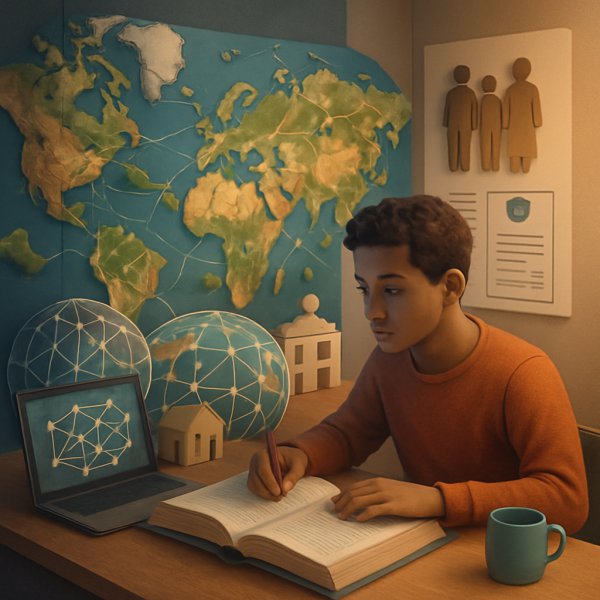
Imagine waking up and borders have vanished: a morning in a world without countries
Picture pouring coffee, glancing out the window, and realizing the map on your wall is blank. No flags, no boundary lines, just rivers, mountains, and cities connected by roads, fiber, and flights. Surprising as it sounds, this thought experiment helps us see which parts of daily life depend on territorial states and which do not. In this piece we will walk from concrete images to systemic consequences, mix in real cases, and leave you with practical ways to think and act. Prepare for some curious what-if questions, a few small challenges, and a table that makes the economics clearer.
How we got here in five sentences: a tiny history that matters
States arose to solve problems: organized defense, tax collection, public order, and large-scale coordination. Over centuries, rulers, treaties, and institutions locked territories into the modern state system we take for granted. But cooperative institutions, trade networks, and transnational organizations have already peeled away many state functions, showing alternatives in practice. Examples include the European Union pooling sovereignty, international airlines operating across borders, and digital platforms managing global services. Understanding these precedents makes imagining a stateless world less fantasy and more structured exploration.
Three plausible versions of a world without countries, explained with everyday examples
First possibility - Global administrative union: Imagine a single global constitution and governance for universal laws. Airports still check identity, but a global passport or digital ID replaces national ones, making cross-border travel seamless. Taxes would be collected by a global revenue agency and redistributed regionally. This model looks like a scaled-up European Union merged with UN ambitions, offering centralized problem-solving but facing huge cultural and political friction.
Second possibility - Networked city-regions: Think of large metropolitan regions and city-states running most services, while international issues are handled by federations or NGOs. Your healthcare and schooling come from your city region, while climate policy and trade are negotiated by networks of cities and corporations. This mirrors current trends in which cities like Singapore, New York, and Shenzhen act as powerful governance nodes with global influence.
Third possibility - Commons and contractual polities: Communities organize around shared resources and contracts rather than territory. Digital identities and voluntary associations set rules for behavior, commerce, and dispute resolution. Imagine choosing a legal provider or a dispute-resolution "app" that both parties accept; this is closer to Elinor Ostrom's findings on effective common-pool resource governance, scaled up through technology. This model could be highly pluralistic but might struggle with large-scale enforcement.
What everyday life would feel like: passports, taxes, hospitals, and safety
Daily routines would change in visible and invisible ways. Travel might become an identity function rather than a permission function, so border queues could vanish if people trust interoperable IDs. Local services like trash collection and schools would likely be organized by municipal or regional bodies, so your sense of civic belonging would shift toward places you interact with most. Security would rely more on international police cooperation, private security, and local militias in places that struggle with governance, so living standards could vary significantly by region.
A big wrinkle is redistribution. In a stateless world, mechanisms to share wealth across regions would be political choices rather than default features. Without national taxes backing social safety nets, communities would need new revenue streams, insurance pools, or federations to provide universal healthcare and pensions. The transition path matters: abrupt collapse of states usually causes chaos, whereas gradual institutional replacement can preserve public services.
Table that clarifies key differences between our world and several stateless scenarios
| Domain |
Contemporary nation-state system |
Global union model |
Networked city-regions |
Commons-contract model |
| Identity docs |
National passports |
Global ID |
City/regional IDs |
Portable digital identities |
| Taxes |
National and local taxes |
Central global taxes |
Local taxes, regional levies |
Subscription/contract fees, local contributions |
| Law |
National legal systems |
Unified global law |
Regional law with international treaties |
Private law providers and arbitration |
| Defense |
National armies |
Global security force |
City security, mutual defense pacts |
Private security, local militias |
| Redistribution |
National welfare states |
Global redistribution system |
Patchwork regional safety nets |
Voluntary mutual aid, private insurance |
| Stability risk |
Moderate to high in weak states |
Low systemic risk, political friction high |
Varies by city capacity |
Variable, high in uncoordinated regions |
Security and justice without states: what replaces armies and courts
Security provision would likely diversify. Where governance is strong, international police forces and shared security arrangements could handle cross-border crimes. Where governance is weak, private security firms and community defense groups may fill gaps. This is already happening: multinational peacekeeping at the UN, private military contractors, and community policing experiments show the range of options. For justice, arbitration, online dispute resolution platforms, and multi-jurisdictional courts might become common, echoing maritime law and international arbitration practices used by businesses today. The key challenge is legitimacy - people accept rules when they think the system is fair, accountable, and effective, which research on policing legitimacy consistently supports.
Culture, belonging, and identity - what humans would keep and what would change
People do not belong only to territories; they belong to families, professions, faiths, and interest groups. In a world without countries, national symbols might fade but cultural identities would persist and even multiply. Festivals, languages, and local histories would stay powerful because they are lived and transmitted locally. Yet, new layers of identity could emerge around professions, ethical systems, or affinity groups with global reach. The likely result is richer plural identities, sometimes enriching social life and sometimes generating new forms of friction when loyalties compete.
Common misunderstandings, corrected with evidence and plain talk
Misconception - No leaders means no order. Not true; order can come from coordinated institutions, markets, or community norms. Elinor Ostrom showed that local commons can be sustainably managed without central authorities, and international institutions already govern many cross-border activities. Misconception - Stateless equals chaotic lawlessness. Evidence from historical stateless periods is mixed: some regions experienced violence, others created new cooperative norms. Misconception - Borders are purely bad. Borders have protected minority languages, organized economies, and simplified governance. Their removal would create winners and losers.
Real-life case studies that illuminate the possibilities
Somalia in the 1990s provides a cautionary tale of state collapse, showing the dangers when institutions vanish suddenly and there is no immediate replacement. The European Union provides a near-opposite case, illustrating voluntary pooling of sovereignty and the complexity of shared governance. City networks like C40 cities show how urban regions can lead on climate policy without national directives. Elinor Ostrom's work in diverse communities globally shows how overlapping institutions can manage shared resources effectively through local rules and monitoring. These cases teach that outcomes depend on institutional design, legitimacy, and the available technology.
Practical steps you can use today to think and act like a global citizen
Start by widening your sphere of engagement: learn a new language, follow global news sources, and explore international volunteer projects to see governance alternatives in practice. Develop "institutional literacy" by learning how laws, markets, and NGOs function; this helps you evaluate proposals for larger-scale governance changes. Support local institutions that provide public goods, because strong local governance is a robust building block for any future. Finally, practice imagining plausible replacements for institutions you depend on, and ask whether those replacements are fair and sustainable.
Two quick thought experiments and a short challenge to sharpen your reasoning
What if your city declared itself a free economic zone and attracted global nomads - how would housing, schooling, and policing adapt? What if a global digital ID leaked - how would privacy, commerce, and trust be reshaped? Small challenge - map the services you rely on today and label which are national, which are local, and which are private. Then pick one that could be improved by a different institutional design and sketch a plan.
Quick reading list and expert voices to trust
Elinor Ostrom, Governing the Commons - foundational research on local governance of shared resources. David Held, Models of Democracy - for ideas about alternative democratic arrangements. Examples from the European Union and UN reports show practical governance experiments, while World Bank and UN statistics offer data on trade, migration, and development to ground claims. These works and institutions provide evidence and frameworks to assess what would work or fail.
"If we are to solve problems that no nation can solve alone, we must be ready to experiment with new forms of cooperation." - paraphrase of themes from global governance scholars
A world without countries is not a single outcome, it is a spectrum of possibilities from orderly global federation to patchwork governance by cities and communities. By studying precedents, thinking through daily impacts, and practicing institutional design, you can move from wondering to acting. Which version would you prefer, and what would you build first if you could redesign the institutions that shape your life?