When a Maple a Memory Stick a Basement and Neighbors Decide Home
September 18, 2025
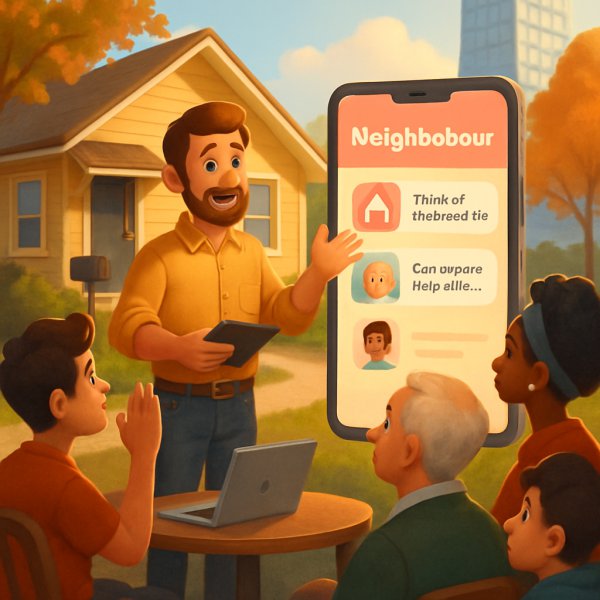
The maple outside Hubert's bedroom window held on to the last of its red leaves like it was trying to decide whether to let him go. Hubert stood at the window, hands in his pockets, and watched the street below. The bungalow with its low roof and the little porch where he had learned to skate in winter waited quietly, like an old friend who refuses to ask for anything more than presence.
He had an email that morning from a company in Toronto. It was the kind of email that could change the size of his life - more money, a team to lead, a glossy plan to move somewhere that smelled less of syrup and more of big-city lights. He had told himself he would be practical about it. He had told himself that this was the kind of choice adults made. But his mouth tasted like metal now, as if the decision had already climbed into him and made itself comfortable.
Hubert walked down the creaky stairs to the basement. The room under the house was his thinking place, a square of concrete and light bulbs and old maps tacked to the walls. His laptop sat on a folding table with coffee rings around it. There were boxes against the far wall labeled in his mother’s handwriting - “cherubins”, “photos”, “recettes”. He liked to keep languages together: French, English, Spanish. He flipped open the laptop and the lines of his code scrolled like a familiar song. The app he had been building for two years pulsed on the screen - Neighborhood, a gentle map for small favors, for asking a neighbor for eggs, posting a lost cat, offering to teach someone to code.
He had made something easy to use, not fancy, because most of the people on his street did not want fancy. They wanted to be seen.
A knock on the front door made the house answer with the low groan that had become a language of its own. Hubert padded upstairs and opened the door to Mrs. Boucher, who lived three houses down. She smelled like cinnamon and wet wool and always had a story.
"Tu penses déménager, hein?" she asked bluntly, looking past him at the street. She had that way of assuming facts the way you assume the sky will be blue. Hubert laughed to hide the quick pull in his chest.
"Peut-être," he said. He spoke French naturally, words falling out like leaves. "They offered me a job. In Toronto."
Mrs. Boucher's eyes softened. "Ils offrent souvent la lune. Mais la lune, on peut la regarder d'ici aussi, non?" she said, and before he could answer she was telling him about the maple on the corner that had been planted by the town long ago. People came by to see it in October, she'd said, and once a year, the neighbors had a potluck on the lawn.
It was that potluck, Hubert realized, that had started his app. Last year a storm had taken down a branch and the phones lit up. Someone needed a ladder, someone else had a pickup, and Mrs. Boucher had dropped off a pie. It had all worked because people showed up. Neighborhood, he had thought, could make it easier.
After she left, Hubert went back downstairs to the basement. He needed one more line of code, one more test. He needed an answer that did not come from his heart or from his friends but from the cold logic of a machine.
He opened the second box, the one labeled "photos - papi", and a folded envelope fell out. The handwriting on the envelope was his father's - a tight loop on the letter P, a small flourish on the t. He had not seen his father in eight years. His father had died the winter Hubert moved to Montreal, before the app, before the job offers.
He slid his thumb under the flap. Inside were three recordings on an old memory stick and a letter folded twice.
Hubert almost laughed at the thought that his father, who had never used a computer for more than email, would leave a memory stick. He pressed the play on his laptop.
The recording was in Spanish. His father's voice was older than it had been in the last photographs, but it carried the same calm timbre. "Hola, hijo," his father said. Hubert’s throat tightened. He had not heard that private tone in years.
"I never got to finish saying everything I wanted," the voice started. "But I watched you. You always cared. You made friends easily, and you made sure no one had to carry their troubles alone. Si algún día piensas que el mundo es un lugar para salir corriendo, piensa en la casa primero."
Think of the house first. The words were simple. His father talked about building a home more than building a house. He spoke of the kitchen that had room for hands to knead bread, of the basement where a son could spread out screws and ideas, of doors that opened to neighbors who brought soup when a baby cried through the night. Hubert tried to keep the sound off his face but his hands trembled.
There was a second recording. In it, a woman’s voice, his mother’s, laughed in French and said, "Ton père disait toujours que la maison est un livre. You need to read the pages." Then, quieter, she said, "Stay where you help people write their chapters if it makes you happy."
On the table, under the stack of letters, there was a folded sheet in rough handwriting. It was from Mateo, a kid across the street who played soccer on the sidewalk. He had helped Hubert one winter with shoveling when Mrs. Boucher slipped, and Hubert had helped him with algebra. The note read simply: "Hubert, when you were here I learned my multiplication and I learned to fix a bike tire. You teach like a friend. If you go maybe I am stuck. Please don't go."
Hubert sat back in the chair and let the basement go quiet around him. For the first time the word "home" felt like a thing that could be chosen instead of something that inherited him. The job in Toronto might give him a title. It might give him a city tattooed on his passport. But here, Mrs. Boucher would bring him stew when he was sad, Mateo would ring the doorbell with a broken chain and a brave face, and the maple would hold its leaves until he made up his mind.
He thought of the app's launch next week. He had been planning to pitch it to investors, to move where the money was, to prove that a small idea could make a big noise. He thought of the basement, of soldering wires and untangling code lines with coffee breath and foxed notebooks. He thought of the little events it could host - a tutor tonight, a tea next Saturday, a class for the kids on Sunday.
Hubert called the Toronto recruiter. He was polite, the way men are when business is breathing down their necks.
"Thank you for the offer," Hubert said, his French accent softening his English. "I need a little more time to think. Could I ask about remote options?"
There was a pause. The recruiter said something about policy and remote teams and the difficulty of integration. Hubert waited for the polite closing. Instead, the voice softened, almost curious.
"Why the hesitation? You seem good on paper," the recruiter said.
Hubert sat on the basement floor, the concrete cold beneath his knees. He looked at the box of letters. He thought of his father’s voice saying, think of the house first. He remembered the smell of Mrs. Boucher's stew. He remembered Mateo's note.
"I am deciding if I want to put my work where my life already is," Hubert said. "I made something not for the market, but for the people who shovel my walk. I want to try that first."
The recruiter hummed. "We can make exceptions," she said, and Hubert felt the ground lift under him, an offer bending to fit him like a palm. He was astonished and a little ashamed that the city could bend. He had expected to bend.
A week later the basement held a different kind of noise. The neighbors came with folding chairs and casseroles, and the little table by the laptop had a sign that said "Neighborhood Demo - Come Try." Hubert ran through his app in French and English. He made jokes in Spanish because Mateo's mother was from Madrid and laughed at the translation. He asked people if they needed help and they did not just say yes - they reached for examples. Someone clicked a button and offered to take Mrs. Boucher to the clinic. Someone else posted a tutor request and two retired teachers signed up.
When the laptop screen showed the little map lighting up with favors, a woman from two houses over grabbed Hubert's hand. Tears were in her eyes. "You brought us together," she said in a voice that might have been more for herself than for him. "Thank you."
Hubert sat down on the steps to the basement and let the warmth of the room move through him. He thought of his father's voice and laughed a little, the sound coming out like a secret. He had nearly left a place that had taught him who he wanted to be. He had nearly chosen a city over people.
The twist that made his chest ache did not arrive as a grand scene. It arrived as a small envelope slid under his door that night. The developer from town, the one saying they wanted to build a line of condos down by the river, had changed their plans. They had met Mrs. Boucher and had listened to the neighborhood's stories. They left a note saying they would preserve the street and the maples. They said, awkwardly, that Hubert's project had helped them see what they were about to take.
It was not only his choice that mattered. It turned out his house was a hinge for other people's choices too. He had assumed the world would tilt under him if he stayed. Instead, other people leaned too. He felt small, and grateful, and like an actor caught between a scene and a life.
Months later, the basement was brighter. The Neighborhood app had a modest server and a tidy group of volunteers. Mateo learned to write his first lines of code. Mrs. Boucher started a weekly knitting group with a digital signup. Hubert worked as a remote lead part of the week and came home to the bungalow each night. He taught, he coded, he fixed a bike tire now and then, and he listened to neighbor's stories like they were precious files waiting to be read.
One evening he replayed his father's recording again, closing his eyes at the Spanish words that had warned him against hasty running. He smiled and said aloud, "You were right."
Outside, the maple shed the last of its leaves. The street was quiet and full of small lights - lamps in windows, white bulbs in a wreath. Hubert walked to the porch and held the rail. He had not become someone else. He had grown into someone older and maybe wiser. He had found that coming of age was not one act of leaving or staying, but a thousand small decisions - to answer a knock, to listen to a child, to open a basement to the neighborhood, to let the house be a home.
Inside, the basement hummed with a computer's gentle fan and the conversation of people who had come to learn. Hubert listened for a moment, then went down the stairs to help a boy who could not get his code to run. He knelt beside him and pointed at the screen, and the boy's face lit up when the app finally showed the little map dot moving.
"Nice," the boy whispered.
"Tu vas bien," Hubert said, switching languages the way some people change coats. He loved how easily the words fit. He loved this house that had taught him how to be at home in himself.