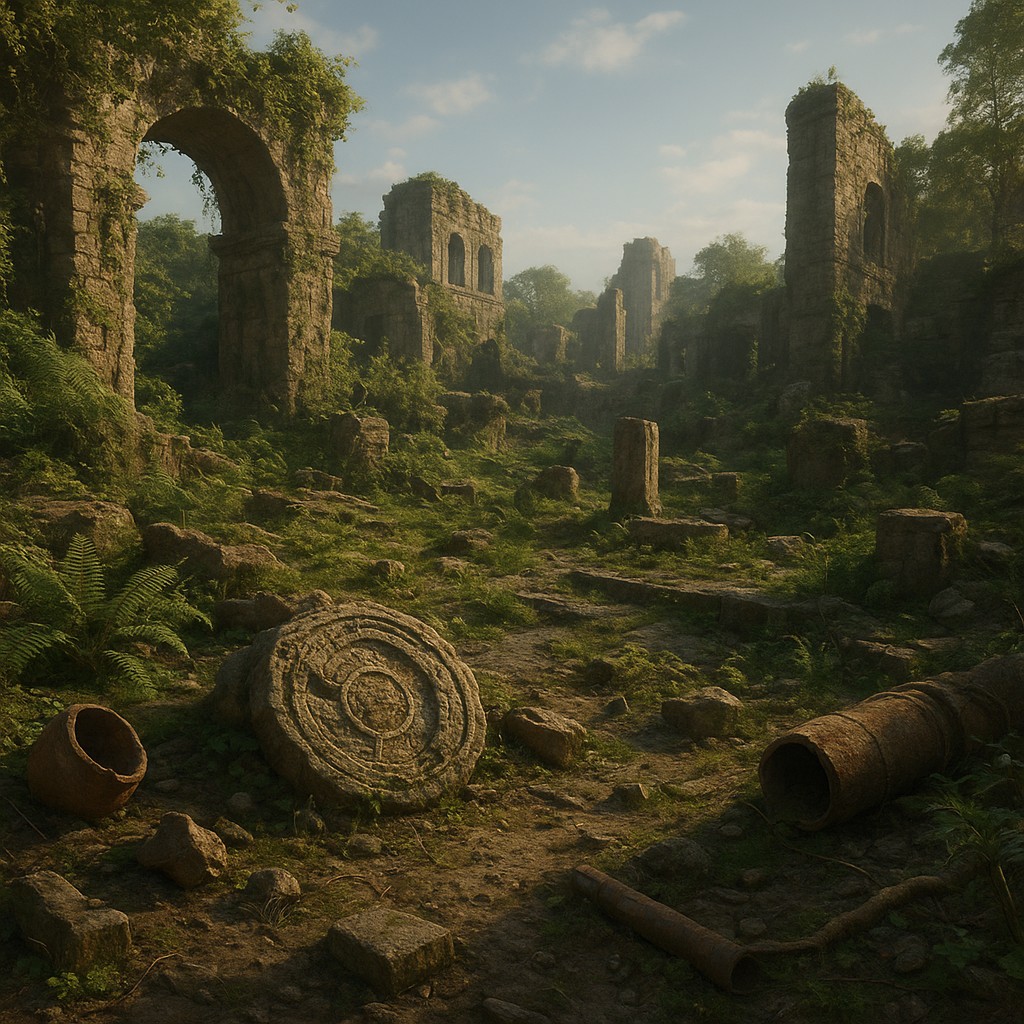
Picture a scene straight out of a science fiction movie, except there is no hero to save the day: tomorrow, every human being is gone. No explosion. No dramatic final message. Just... nobody. Nature exhales. Cities fall silent. And the machines, with no workers and no upkeep, slowly start to break down. The question that is hard to resist is this: 10,000 years later, what would still prove we were here?
Ten thousand years is far longer than written history. It is older than the pyramids, longer than most civilizations, bigger than what our shared memory can hold. And yet, in Earth time, it is a blink. The planet is 4.5 billion years old, and it has the patience of a librarian waiting for you to return an overdue book. So what actually holds up against time, erosion, microbes, oceans, and all that plant life that loves to cover everything?
To answer that, you have to think like a detective from the future. Not someone hunting for fossilized selfies, but someone tracking signatures: materials that do not exist in nature, strange disruptions in sediment layers, unlikely isotopes, shapes that are too neat to be a fluke. In short, clues tough enough to survive on a planet that has no reason to preserve our memories.
What 10,000 years does to objects: time’s giant wash cycle
The first mental trap is thinking our monuments are "built to last." In reality, almost everything we build depends on constant maintenance. Without pumps, tunnels and subway systems fill with water. Without heat and ventilation, moisture works like invisible termites. Without repairs, roofs collapse, structures rust, frost cracks materials, and roots eventually ram their way through.
On a 10,000-year timeline, the main enemy is not one big disaster. It is the slow pileup of small damage. Concrete cracks. Steel corrodes. Wood rots. Plastics break into pieces. Even stone takes a beating: freeze-thaw cycles, sand-filled wind, acidic water, and plain gravity grind things down and shift them around. For a gut-check, look at an outdoor statue after 100 years, then imagine that effect multiplied by 100.
Geography matters a lot. Something in a dry desert is far more likely to survive than something in a wet forest or on a coast. With little plant growth, low biological activity, and not much water, decay slows down. That is one reason some very old human traces made it to us: not because our ancestors built "better," but because the environment acted like a natural safe.
The likely survivors: when materials refuse to quit
If humanity vanished, the strongest evidence would not necessarily be the most famous. It would be whatever combines three things: a lot of mass, chemical stability, and a lucky location. Sadly, "meaningful" objects like artworks or libraries have little chance of making it through 10,000 years of rain and an eager forest.
Heavy stone structures have a decent shot at leaving traces, even if they are no longer standing like a postcard. Pyramids, temples, mega-foundations of buildings, sea walls, dams, these could become rubble fields, but still recognizable rubble. The clearest clue is often geometry: alignments, right angles, cut blocks, repeating patterns. Nature makes strange shapes, but it rarely makes "almost perfect."
Some very tough materials could also survive as fragments. Ceramic is a quiet champion: once fired, it holds up well to water and time. Glass can last a long time too, even if it breaks, especially if it gets buried. Certain metal alloys will partly persist, but ordinary steel rusts enthusiastically. Aluminum and copper can leave longer-lasting traces, often as distinctive oxides.
And burial is archaeology’s superpower. Anything quickly covered by sediment, volcanic ash, sand, or even building collapses is far better protected. Ten thousand years later, a future excavation team (human or otherwise, let’s stay open-minded) is more likely to find a buried city than an exposed one.
Table: some possible traces and their chances of survival
| Trace of our presence |
Why it might last |
What could erase it |
Chance of being detectable at 10,000 years |
| Stone ruins (pyramids, massive walls) |
Huge mass, slow to change, clear geometry |
Erosion, earthquakes, natural reuse |
High (especially in dry regions) |
| Concrete foundations and urban rubble |
Enormous volume, a lasting "scar" in the ground |
Carbonation, cracking, burial |
Medium to high (as layers) |
| Ceramics (tiles, dishes) |
Very chemically stable |
Scattering, deep burial |
High (as fragments) |
| Plastics and microplastics |
Extremely persistent, everywhere |
UV light, breakup, ocean spreading |
High (but mostly as widespread pollution) |
| Industrial deposits (metals, slag) |
Distinct chemical fingerprints |
Sediment mixing, oxidation |
Medium (but very clear when found) |
| Nuclear waste and isotopes |
Long half-lives, strong signals |
Containment, geological dilution |
High locally, very high as a "marker" |
| Satellites and space debris |
No atmospheric weathering in high orbit |
Orbital decay, collisions |
Variable (high in stable orbit, low in low orbit) |
The "human layer": what geology will remember about us
Even if cities vanish from the surface, Earth stores records with slow, steady care. Our activities leave layers, mixtures, and odd patterns that future geologists could read the way we read a sediment cliff today. The key idea is this: a civilization is not just buildings, it reshapes entire material cycles.
Take concrete. We make it in massive amounts. Once structures collapse, it turns into a recognizable kind of rubble, often rich in compounds from lime and cement. Urban soils also end up with strange mixes: glass, metal bits, ceramics, plastics, and residues from burning. Over time, that can form an "anthropic" layer, basically a very unnatural recipe in the ground.
Metals are another strong clue. Unusual concentrations of copper, lead, zinc, or rare earth elements in certain deposits can point to mining, industry, and electronics. Nature can concentrate metals too, of course, but industrial patterns often look different: mixed distributions, isotope patterns, and element combinations that resemble manufacturing more than a natural ore vein.
Then there is combustion. Soot, ash, and particles from large-scale burning of fossil fuels can get locked into sediments. It is not a geological billboard, but it is a marker. A future scientist might notice a short slice of time, geologically speaking, with specific carbon-rich deposits and fast shifts in certain chemical indicators.
A stubborn myth: "everything will vanish completely"
No, it will not all evaporate. What disappears is easy readability. Cities will turn into odd hills. Roads will become strips of different material. Ports will show up as underwater anomalies. The information degrades, like a photo that gets compressed again and again: details fade, but proof that the image existed can remain.
Plastic, the strange fossil: our planet-wide confetti
People like to say "plastic takes centuries to break down," which is true, but incomplete. Plastic does not vanish like a dead leaf, it breaks into pieces. UV light, abrasion, salt, and temperature swings crack it into smaller and smaller bits, down to microplastics and nanoplastics. Ten thousand years from now, it is plausible that intact plastic objects will be rare, but their fragments will be everywhere.
That is where it gets interesting. Microplastics can settle into ocean sediments, lake deposits, and soils. Some will be buried and partly shielded from light, which slows further breakdown. People sometimes talk about "plastiglomerates," rock-like lumps where melted plastic mixes with sand, shells, and pebbles. This is not just trash. It is a new hybrid kind of rock, and geology loves to label that kind of oddity.
A common misunderstanding is thinking plastic would be the best "visible" proof we existed. In reality, its power is backwards: it lasts as contamination, not as a monument. The future might not find an intact shopping bag, but it could find an entire era stamped with synthetic polymers spread worldwide. Less romantic than a statue, but much harder to deny.
The clearest signal: the nuclear fingerprint and isotopes
If you had to pick one almost "hard to argue with" piece of evidence over 10,000 years, nuclear traces are a strong candidate. Atmospheric nuclear tests in the 20th century spread human-made isotopes across the whole planet. Some have half-lives long enough to remain detectable for thousands of years, even as they fade. It is a precise time marker, like a highlighter line in Earth’s notebook.
There is also nuclear waste stored in specific sites. These places were designed to limit leaks, but even if the isolation holds up well, the simple discovery of non-natural materials and isotope mixes would speak volumes. It would not look like a classic ruin. It would look like a sealed vault containing chemistry that makes no sense in a natural setting.
A popular idea is: "in 10,000 years, it will all be gone because the radioactivity will stop." Wrong. Some isotopes fade fast, others much more slowly. And even when radioactivity drops, it leaves decay products and isotope oddities behind. The future takeaway would be simple: someone manipulated atomic nuclei here.
Giant scars: mines, dams, canals, and reshaped land
Buildings can fall, but reshaped landscapes are a different story. Open-pit mines, for example, are enormous bites taken out of the ground. They will fill with water, grow over with plants, and erode, but the landform can stay visibly artificial for a long time. Spoil heaps and mining waste piles can also remain as hills that local geology alone cannot easily explain.
Dams and levees are hybrids, part structure and part reworking of a watershed. Even if they fail, they leave behind unusual sediment patterns, valleys filled in different ways, and altered deltas. Canals and large river straightening projects also change how a region lays down sediment. Over millennia, these effects can blur, but some clues linger in deposit geometry and material spread.
And then there is agriculture. Ten thousand years later, fields will not be visible on the surface, but soils can keep fingerprints: increased erosion during certain periods, pollen from cultivated plants, shifts in nitrogen ratios, and signs of repeated land use. Nature rewrites the surface, but it often leaves footnotes in the layers.
The "unexpected" evidence future investigators would love
Without turning this into an endless list, a few clues have an especially human smell:
- Unnatural concentrations of concrete, glass, metals, and ceramics mixed together in the same layer.
- Long, straight networks of compacted material, old roadbeds or rail lines, detectable with geophysics (tools that "scan" the ground without digging).
- Burn layers rich in specific particles tied to industrial activity.
- Fast, global shifts in certain biological markers (pollen, invasive species), linked to travel and farming.
And what about space? Artifacts out of reach of rain
Earth is very good at erasing evidence. Space is much less so, at least once you get away from the atmosphere. Satellites in low Earth orbit will fall back down fairly quickly (on a geological clock, "quickly" can still mean a few centuries). But objects placed in more stable orbits, or on the Moon, could last a very long time.
On the Moon there is no rain, no wind, no rivers. There are micrometeorites and radiation, but erosion is slow. The footprints from the Apollo missions, for example, could remain for a very long time. Ten thousand years from now, they would probably still be there, a small dusty museum under an airless sky. If someone wants a clean, sharp, almost untouched proof of our presence, the Moon is an excellent storage drawer.
But do not get too dazzled: space will not preserve everything. Collisions, radiation damage, and orbital changes can turn objects into fragments. Still, even fragments made of unusual alloys and clean geometry would be strong evidence, because nature does not casually produce solar panels and antennas.
How we would really prove we existed: the logic, not the one perfect object
Another common mistake is thinking you would need "the" perfect proof, like a time capsule with a manual titled: How to Recognize Humanity. Science usually works through a bundle of clues. A convincing future civilization would not say, "we found an intact skyscraper." It would say: we see a period when synthetic materials, artificial isotopes, global sediment disruptions, and consistent industrial signals all appear together.
That is exactly how archaeology works today, just on a larger scale. You do not prove an ancient culture with one pot. You prove it with pots, tools, structures, biological remains, and the context around them. Ten thousand years after we are gone, context will be our best witness: a planet carrying signs of fast, intense, technologically strange activity spread across wide regions.
And one thing will outlast our buildings in the deepest sense: the story Earth tells in its layers. Rocks and sediments do not lie. They simply record. The real question is not "will anything remain?" but "what will still be readable, and by whom?"
The hidden lesson: we are temporary, our effects are not
Thinking about what will remain of us in 10,000 years is not a gloomy exercise. It is a clean way to reset our sense of scale. Our lives are short. Our empires are too. But our materials, our waste, and the changes we trigger can last far longer than we expect. Earth forgets our names, but it remembers chemical shifts very well.
If that thought makes you dizzy, good. It is a useful kind of dizziness. It points toward a clear-eyed responsibility: what we make is not only "for now." It is also a message left for the future, often by accident. So we might as well leave a message that is less toxic, more thoughtful, and, who knows, maybe even good enough that someone will want to understand it.