Time Travel
We Burned the Ledger to Teach Them How to Care
September 20, 2025
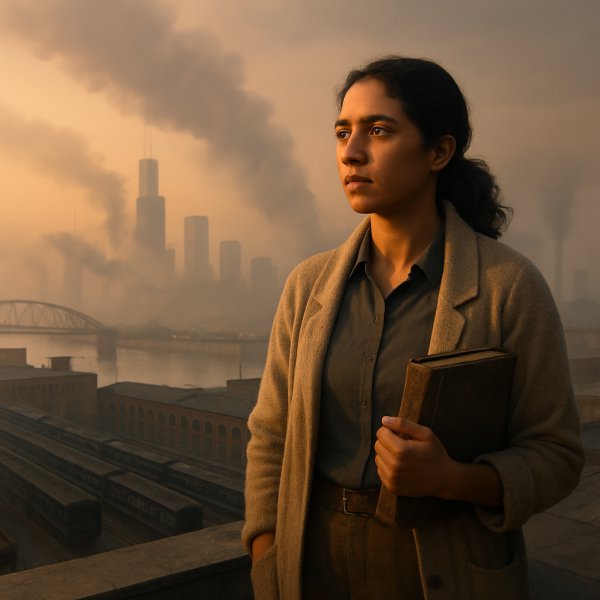
The day Chicago woke with coal in its teeth and neon still sleeping, I stood on the roof of the Institute and smelled two centuries at once. Smoke from distant factories moved like a tide over the river. Below, our trains sat silent, their screens dark. The skyline looked wrong - thinner, cleaner, like someone had taken a photograph of the future and left the frame blank.
My name is Maya Ortiz. I was a city planner when the city moved. Now I was one of the teachers - not of equations or engines, but of bad choices. We had a library of what the next hundred years had taught us: mistakes, disasters, laws that had saved lives, ways people had hurt one another. The plan was simple on paper. Keep the tech small, share the lessons large. Teach the past what not to do, so a better future could grow from honest roots.
The first months felt like running two cities at once. We built classrooms in old warehouses. We stood in front of coal miners and factory foremen and teachers and union women and said, do not build highways that cut neighborhoods in half. Do not let private guards set your streets on fire. Do not let a single company own the water. We showed them pictures, maps with the lines we had cut across human lives. We taught the words democracy, regulation, commons, and then we sat back to watch how people used them.
It was harder than we thought. People wanted quick answers. They wanted prosperity now, and knowledge looked like a shortcut. Jonah Weiss, the head of the Civic Council and the man the city trusted to translate our plans into action, had a way of making urgency sound like compassion. He spoke of rail lines and electric plants and patents that would bring money and jobs. He made a ledger, neat as a hymn, listing inventions and medicines and construction methods we could teach. He said the ledger would seed factories and hospitals and end famines.
I met my father in that first spring, a thing I had never let myself hope for. In our old timeline he died in 1999, a name on a cemetery stone. Here he walked into my warehouse with hair like paper and the same crooked smile, and for a week I could not breathe. He had been organizing in his time, pulling neighbors together, fighting for safer tenements. He had taught me to measure city blocks as if they were stories.
"Do you regret it?" he asked on that first night, when the city hummed with generators and the sky over the lake was a bruise of stars. "Bringing all this...knowledge?"
I wanted to tell him everything and nothing. His life, the life we had taken from him in our first life, glowed raw at my feet. But I had promised the Institute we would not use the jump to make small fortunes of our own. We would not hand people the keys to a future without teaching them how to look after the house once they had it.
"No," I said. My voice cracked. "I regret the parts we forgot to teach."
He reached for my hand like I was a child again. He smelled like peppermint and coal dust. "Then teach the rest," he said. "Teach them to be neighborly. Teach them to keep their promises."
Those words became a kind of prayer I said into my pillow at night.
The ledger grew. Jonah opened workshops and sent machinists and doctors out into the region. Towns that hadn't seen steady electricity in a generation lit up. Hospitals got tools and medicines years ahead of schedule. Farmers learned crop rotations that doubled yields. For a while the city felt like it could correct itself.
Then a factory burned.
It was not the first fire we had seen in emergency footage. It was worse because it could have been stopped. The plant that caught flame belonged to one of Jonah's seed companies. They had moved fast, cutting corners to meet demand. Workers said they had been told to skip drills, to work with frayed wiring because the machines needed to keep the line alive. The fire killed eleven people and left a dozen children waiting at a door with empty hands.
Jonah spoke at the memorial with a voice like an apology wrapped in a suit. "We will learn," he said. "We will be better."
But I saw the ledger change. The next entry was not about worker safety. It was about patents and distribution. He had begun to trade knowledge for control. You wanted a clean water plant? Pay with shares. You wanted a vaccine? You had to sign a contract. He said he was protecting the knowledge from being misused, but he was turning it into currency. The same hunger that had hollowed cities in our future was waking in him.
That was the midpoint. My choice was sudden and heavy. I could sit in meetings and argue till my voice went thin, or I could act. The Institute's central archive held our collective memory: interviews, blueprints, everything we'd learned from the century we had left behind. I knew the price of deleting it - not just data, but the small recordings my brother had left for me before he died. He had been a friend of mine once, gone before his time, and I carried his voice in the files like a prayer bead.
The plan I chose would burn the ledger and free the archive. It would be violent - an erasure of the things that made us who we were, and a redistribution of what remained. I told only Liam and Anoosh, the two people who trusted me enough to follow.
"You're going to make us nameless," Liam said. He was a mechanic who could make a radio sing from a pair of spoons. "If Jonah's people catch you, they won't just arrest you. They'll make an example."
"And if we do nothing?" I said. "If we let him sell the cures and the roads to a few people, the rest will starve faster than any file gets deleted."
Liam pressed his jaw. He had a little boy who liked to wind up tin cars until they crashed. "Okay," he said. "Let's set the world on fire the right way."
We moved on a night when the rain smelled of batteries. Jonah's security was trained and polite. We used the old tunnels under the river, places I had walked with my father when he wanted to show me how the city drank. The archive was a glassed-in heart, humming with drives and voices. There was a console the size of a desk, and at its center the ledger sat like a shining bone.
I thought of my brother's voice, the words he had saved for me. I thought of my father's hand. I thought of the faces of the miners and the children at the memorial. I put my fingers on the keyboard and Liam fed the network a script. The plan was not simply to delete. We would open every file to everyone - a flood that would wash away ownership.
"We only get one shot," Anoosh murmured. He worked the feed like a surgeon.
Security came faster than the script. Jonah's face flashed through the glass; he had realized the ledger was moving. He called our names. People we had thought were friends turned away.
There was a moment, bright as a knife, when I thought we had failed. Then the connection went live. Screens across the city that had been dark all blinked and filled with the archive. People in warehouses and on rooftops and in the riverfront apartments watched footage of past fires, read blueprints, saw policies and court rulings and lists of "what not to do." The knowledge spilled like rain.
Liam's voice cut through the servers as he rerouted the last packets into public channels. Footsteps pounded behind us. A guard fired a warning shot. Time narrowed. Anoosh grabbed my arm.
"Run," he said.
Liam did not run. He stayed at the console, hands on the keys, smiling like someone holding a candle against the wind. Jonah shoved through the door and reached for him. Liam twisted and caught Jonah's shoulder, his shoe tangled in a cable. The guard shoved him to the floor. It looked like a bad fall. I moved to help and Jonah's hand slapped me down.
Liam's eyes found mine through the rain of data. "Teach them how to care," he said, voice a scrape of courage. "Not how to win."
He did not get up.
We carried him out. The city smelled of copper and rain and old coal. People had gathered outside, strangers wrapped in coats, looking at the screens of the archive now shining on storefronts and river barges. The ledger, the patents, the contracts, everything Jonah had wanted to gate were broadcast. The files could not be owned anymore. We had made knowledge common.
The consequences were immediate and messy. Some towns used the medicines without training and made mistakes. Some industries built faster and polluted faster. But other things grew - councils of citizens, worker-led factories, neighborhood clinics taught by traveling doctors who did not ask for payment. People organized to learn safety before machines. My father stood in a doorway with a group of men who had once been rivals, and he taught them how to build a shared pump system that could not be owned. He cried when he pounded a shovel into the ground, and I cried with him.
Jonah was arrested, and his supporters scattered into the shadows that greed always finds. Some of our own left the city, hurt and angry. The Institute dissolved into a dozen smaller centers that answered to local councils. We spent long afternoons stitching laws into human bodies, not into vaults. We taught people to think in pages of consequences, not in profits.
The poignant thing I expected was regret for having erased my brother's voice. I held that loss like a hollow in my chest for months. But one morning, as kids planted a garden in a cleared lot by the old rail yard, a little boy handed me a trowel and said, "This is for my sister. We share." The soil smelled like rain and coal and something new. The sound of children laughing offset the absence like wind against a door.
Years later, people still argue about our choice. Some say we should have kept tighter control, given the world a safer, slower arc. Others call the flood of knowledge the only moral thing to do. I think of Liam when I answer. I think of my father's callused hands and the way he taught me to measure a block as a promise. I think of the mines and the factories and the faces at the memorial.
We had one blunt lesson that every class we taught tried to wring into a usable shape: progress without care is a machine for leaving people behind. Teach people what not to do, yes, but also teach them how to care for people they might never meet. Share knowledge, make tools that cannot be owned by a single hand, and build institutions that welcome failure and accountability.
Sometimes, when the wind comes off the lake and smells of rain and new wood, I walk to the garden by the rail and sit on the low stone wall. Children pass, carrying buckets. My father's laugh meets them from behind a line of vegetables. The city looks different now - not impossibly bright, but green in a sturdy way. We did not fix everything. No one pretends we did. But the ledger is gone as a private treasure. Knowledge is messy, and so are its keepers.
Liam's words are in my head when I teach: not how to win, but how to care. It is a small compass, but when a whole city follows a small compass together, the map changes. I think of the boy who gave me the trowel, and I picture a future that might one day be kinder. The last thing I do before I leave the garden is press my palm to the soil and say thank you, to the city and to the people who stayed to remake it. The soil is cool and dark and full of the small, honest things we do when we want to be better.
Time Travel