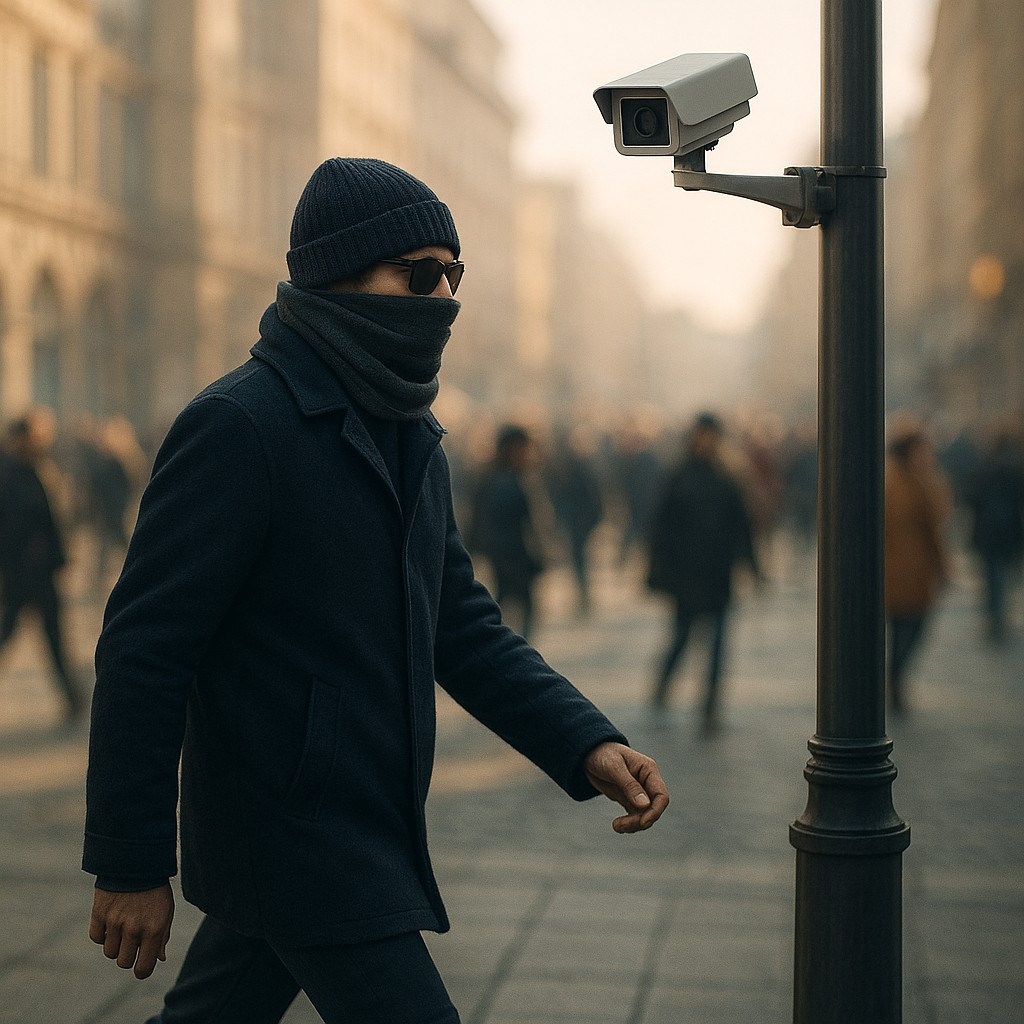
Imagine for a moment that you are walking through a crowded city square on a chilly afternoon. You have a scarf wrapped tightly around your face to block the wind, a beanie pulled low over your brow, and dark sunglasses to shield your eyes from the glare. You might feel perfectly anonymous, hidden behind layers of wool and plastic, blending into the sea of commuters. But as you navigate the sidewalk, a high-definition camera perched on a nearby lamp post is watching more than your face. It ignores your features entirely, focusing instead on the rhythmic swing of your arms, the specific angle of your knees, and the duration of your footsteps. Even without specialized sensors, the software behind that lens is recording a signature as unique as your thumbprint: your gait.
This isn't the plot of a dystopian thriller; it is the reality of modern biometric surveillance. Most of us have become comfortable, or at least familiar, with the idea that our faces can unlock our phones or get us through airport security. However, gait analysis represents a significant leap in how we are tracked in the physical world. Unlike facial recognition, which requires a clear line of sight and decent lighting, gait analysis can identify you from behind, in low light, or from hundreds of feet away. It turns the simple act of walking into a data stream, a biological Morse code that tells a story about who you are, where you’ve been, and even your current mood or health. As this technology creeps into public spaces, it forces lawmakers and citizens to rethink what it means to be truly "private" in public.
The Secret Language of Your Limbs
To understand how a computer can recognize you by your walk, we have to look at the human body as a complex mechanical system. Every person has a distinct skeletal structure, muscle distribution, and set of ingrained habits that dictate how they move through space. When you take a step, your brain coordinates a massive symphony of signals to balance your weight, swing your hips, and plant your feet. This creates a "gait cycle," which is essentially the sequence of movements from the moment one foot hits the ground until that same foot hits the ground again. Because our bone lengths, joint flexibility, and centers of gravity are all unique, no two people perform this symphony in quite the same way.
Automated gait recognition systems use computer vision to strip away the "noise" of your clothing and skin, reducing your body to a simplified stick figure or a "silhouette sequence." The software then measures specific variables with mathematical precision. It looks at your stride length (the distance between your steps), your cadence (how many steps you take per minute), and the "bounce" in your vertical oscillation. More advanced systems track the trajectory of your joints, analyzing the precise arc formed by your elbows or the angle of your ankles during a stride. By crunching these numbers, the computer creates a biometric template that can be compared against a database of known individuals, often with surprising accuracy.
This technology is particularly powerful because it is passive. You don't need to stop and place your finger on a scanner, and you don't need to look directly into a camera. In fact, you don't have to do anything at all besides exist. This lack of "friction" makes gait analysis an attractive tool for security agencies and smart city planners, but it also removes the element of consent that usually accompanies biometric checks. While you might choose to bypass a facial recognition gate at an airport, it is much harder to "opt out" of walking while moving through a public park or a train station.
Comparing the Pillars of Biometric Identification
When we talk about biometrics, we often lump all technologies together, but they serve different purposes and carry different risks. To see where gait analysis fits into the broader landscape, it helps to compare it against the methods we already know. Each biometric has a "sweet spot" where it excels, along with a set of limitations that make it vulnerable to being tricked or bypassed.
| Biometric Type |
Primary Data Point |
Requirement for Success |
Ease of Concealment |
| Fingerprint |
Ridge patterns on skin |
Physical contact with a sensor |
Moderate (wear gloves) |
| Facial Recognition |
Distances between features |
Clear, front-facing view |
High (mask, makeup, or hood) |
| Iris Scanning |
Patterns in the eye |
Close proximity, steady eye |
Low (hard to hide if looking) |
| Gait Analysis |
Rhythm and joint angles |
Ability to see body movement |
Very Low (hard to change walk naturally) |
| Voice Recognition |
Pitch, tone, and frequency |
Clear audio recording |
Moderate (don't speak) |
As shown in the table, gait analysis fills a gap that other biometrics cannot. If a suspect in a crime is wearing a balaclava, facial recognition is useless. If they are wearing gloves, fingerprints are off the table. But unless they are willing to crawl or remain perfectly stationary, they are likely to reveal their gait. This "distance-at-a-distance" capability is what makes it a prized asset for law enforcement, but also a lightning rod for privacy advocates who argue that it eliminates the last vestiges of anonymity in our daily lives.
The Chess Match Between Sensors and Subterfuge
While gait analysis might sound like an infallible "super-sensor," the reality is more grounded. Like any technology, it is an interpretation of data, and that data can be noisy. One of the biggest hurdles for gait recognition is what researchers call "covariate factors." These are outside influences that temporarily change the way you walk. For instance, if you are carrying a heavy grocery bag in one hand, your center of gravity shifts, and your stride changes to compensate. If you are wearing a tight pencil skirt versus baggy sweatpants, your leg movement is physically restricted, which can confuse a system trained on your "normal" walk.
Then there is the element of footwear. Walking in flip-flops requires a different muscular engagement than walking in stiff hiking boots or high heels. Even the surface you are walking on matters; your gait on a sandy beach is fundamentally different from your gait on a polished marble floor. Because of these variables, gait analysis often requires a "probabilistic" approach rather than a definitive one. Instead of saying, "This is definitely Person A," the system might say, "There is an 85 percent probability that this movement pattern matches Person A." While 85 percent is high, it leaves a margin for error that can have serious consequences in a legal or security context.
This has led to a fascinating game of cat and mouse. People who are aware of surveillance might attempt to "spoof" the system. You could put a small pebble in your shoe to force a limp, or consciously change your rhythm to be faster or slower than your natural pace. However, the human brain is remarkably bad at maintaining an unnatural gait for long periods. Eventually, our "muscle memory" takes over, and we slip back into our subconscious patterns. Researchers are currently developing deep-learning models that can see through these intentional changes, identifying the underlying skeletal structure even when a person is trying to hide it.
Drawing the Digital Line in the Sand
As gait analysis moves out of research labs and into the real world, the legal landscape is struggling to keep pace. In many parts of the world, there are few laws that specifically address the collection of movement data. If you are in a public space, the traditional legal view has been that you have no "reasonable expectation of privacy" regarding things that are visible to the public. However, the sheer scale and precision of gait analysis are starting to shift this perspective. Lawmakers in various jurisdictions are now proposing "Biometric Privacy Acts" that would classify gait as a protected form of sensitive data.
The debate usually centers on a conflict between two valid goals: public safety and personal liberty. Proponents of the technology argue that it is a vital tool for finding missing persons, identifying terrorists in crowded areas, or tracking suspects who have intentionally masked their faces. They see it as a "non-intrusive" way to keep cities safe. On the other hand, critics point out the potential for "function creep." A system installed to find criminals could easily be repurposed to track political protesters, monitor the movement of union organizers, or even analyze the health of citizens to sell that data to insurance companies.
Recent legislative efforts, such as those in New York and within federal travel security discussions, suggest a growing appetite for regulation. Some proposed laws seek to ban law enforcement from using gait analysis entirely, while others want to mandate "opt-in" systems where your biometric data cannot be stored without your explicit consent. There is also a significant concern about bias. Early biometric systems were often trained on limited datasets, leading to lower accuracy rates for certain ethnicities, genders, or people with disabilities. If a gait analysis system misidentifies someone because of a permanent physical injury or a cultural style of walking, the results could be discriminatory or even life-altering.
Decoding the Ethics of our Digital Shadows
The rise of gait analysis invites us to ask a deeper question: who owns the data generated by our bodies? When we walk down the street, we aren't just moving from point A to point B; we are broadcasting a constant stream of biological information. In the past, that information was ephemeral. It existed for a second and then vanished into the air. But in an era of cheap storage and powerful AI, our movements can be recorded, indexed, and searched years later. This creates a "digital shadow" that follows us everywhere, one that we cannot easily cast off or change.
For the average person, the best way to approach this new reality is through "biometric literacy." Understanding how these systems work allows us to engage in the conversation about how they should be used. It helps us see that privacy isn't just about hiding a face; it's about the right to navigate the world without being constantly categorized and tracked. As we build the "smart cities" of the future, we have to decide whether we want those cities to be spaces of total visibility or spaces where we still have the freedom to be anonymous travelers in a crowd.
Ultimately, gait analysis is a testament to the incredible uniqueness of the human form. It is a reminder that every one of us moves through the world in a way that is distinctly our own. While technology might try to reduce that movement to a series of angles and coordinates, there is still something profoundly personal about a person’s stride. As we move forward, the challenge will be to ensure that our laws and our ethics are just as robust as the sensors watching us. By staying informed and vocal about biometric rights, we can ensure that our unique way of walking remains a part of our identity, rather than just an entry in a database.
The next time you find yourself strolling through a park or rushing for a train, take a moment to notice your own rhythm. Feel the way your weight shifts, the swing of your arms, and the specific cadence of your steps. It is a beautiful, complex dance that you have been perfecting since the day you took your first wobbly steps as a toddler. This rhythm is yours, a private piece of your biological story. As the world around us becomes more digital and more "connected," protecting that rhythm becomes a vital part of protecting our shared human dignity. Embrace the curiosity of how you move, but remain vigilant about who is watching the dance.