There are few natural spectacles that fire the imagination like a volcano. From glowing rivers of lava to ash clouds that can circle the globe, volcanoes are dramatic, dangerous, and deeply important to life on Earth. They reshape landscapes, create islands, and provide soils and minerals that sustain ecosystems and human cultures. Learning how they work helps you understand not only risk and beauty, but also how our planet keeps recycling itself.
If you picture a volcano as just a smoking mountain, you are missing most of the story. Volcanoes are the surface expression of deep processes - heat, pressure, chemistry, and plate motions - operating far beneath our feet. This Learning Nib will take you from the source of molten rock to the moment of eruption, explain why lava behaves differently, clear up common myths, and leave you with memorable images and facts you can use in conversation or school reports.
How giant pots of molten rock form - the origins of magma
The word magma refers to molten rock that remains underground; once it reaches the surface it is called lava. Magma forms when solid rock in the mantle or lower crust melts. There are three common ways that melting happens: reduced pressure, added heat, and the presence of water. At mid-ocean ridges, upwelling mantle experiences lower pressure as it rises, so it partially melts - similar to opening a pressure cooker. In subduction zones, an oceanic plate sinks and releases water into the overlying mantle, lowering the melting point and creating magma. Hotspots, such as Hawaii, result from concentrated thermal plumes that heat the mantle locally until rock melts.
Magma is not uniform. Its composition varies with the source rock and the processes it undergoes as it moves upward. The key chemical factor is silica content - high silica makes magma sticky, low silica makes it runny. Temperature also matters: basaltic magma is hotter and less viscous, rhyolitic magma is cooler and very viscous. While rising, magma can mix with other magmas, assimilate surrounding rock, and release dissolved gases. All these changes influence whether an eruption will be mellow and effusive, or explosive and catastrophic.
The plumbing system beneath a volcano - chambers, conduits, and vents
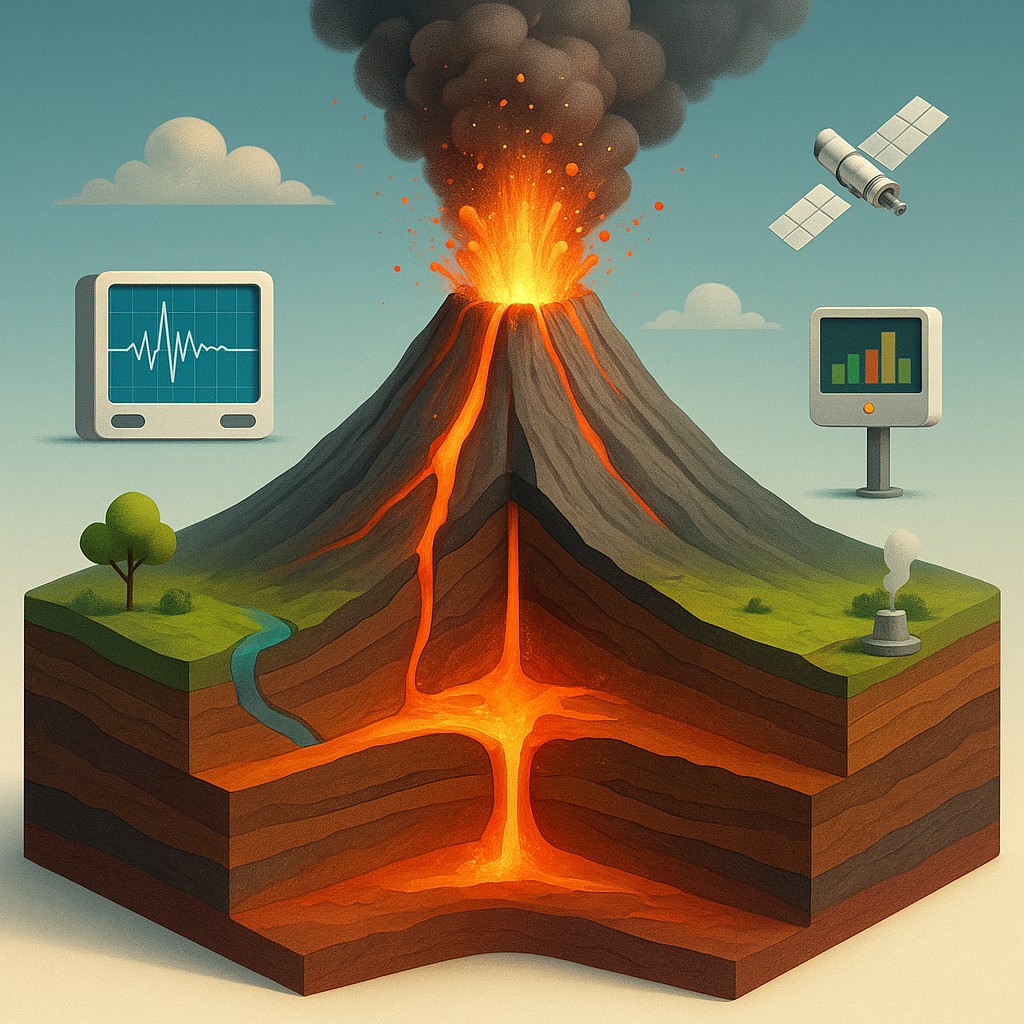
Volcanoes have plumbing, just like a house - chambers, pipes, and outlets. Magma commonly pools in magma chambers, often many kilometers underground, where it can linger, cool, or fractionate - meaning minerals crystallize out and change the composition of the remaining melt. From these chambers, magma ascends through conduits - cracks and dikes that cut through the crust - and finally reaches vents at the surface. A volcano’s visible cone, crater, or caldera is only the tip of this plumbing system.
Magma movement is driven by pressure differences and buoyancy - hot, low-density magma wants to rise through denser surrounding rock. As it rises, dissolved gases like water vapor, carbon dioxide, and sulfur dioxide start to come out of solution and form bubbles. That gas expansion can dramatically increase pressure. If the conduit is narrow or the magma is sticky, gas cannot escape easily and pressure builds until it explodes outward. If the magma is fluid and gassy, gas can bubble out gently and allow lava to flow in calmer eruptions.
Why eruptions happen - triggers and the build-up to an explosive event
Eruptions are fundamentally about pressure balance. Over time, magma supply, gas exsolution, crystallization, and tectonic stresses change the pressure in a magma chamber and conduit. An eruption can be triggered when internal pressure exceeds the strength of the overlying rock, creating fractures and pathways to the surface. Several specific triggers commonly initiate eruptions: the injection of new, hotter magma into a chamber can raise pressure and destabilize the system; earthquakes can crack a sealed roof and release pent-up gases; or rapid gas growth may fracture the conduit from within.
Not all eruptions come as sudden surprises. Many are preceded by warning signs that volcano monitoring can detect. Seismic swarms - bursts of small earthquakes - indicate rock is fracturing or magma is moving. Ground deformation shows inflation when magma accumulates and deflation when it is released. Gas emissions often change in composition and volume before eruptions. However, predicting the exact timing and magnitude remains challenging - volcanoes are complex systems and sometimes behave unpredictably.
Lava and its moods - types of magma, lava behavior, and eruption styles
Lava behavior depends mostly on chemistry and temperature. Basaltic lava, like that in Hawaii, is hot (about 1100 to 1200 degrees Celsius), low in silica, and very fluid. It flows easily, building broad shield volcanoes and producing pahoehoe or a’a textures. Andesitic and dacitic magmas are intermediate and build the steep stratovolcanoes we associate with Mt Fuji or Mount St Helens. Rhyolitic magmas are high in silica, very viscous, and prone to explosive eruptions because gases get trapped.
Eruption styles align with these properties. Effusive eruptions produce lava flows and fountains; explosive eruptions blast ash, volcanic bombs, and pyroclastic flows - fast, deadly avalanches of hot gas and rock. Some eruptions are mixed, starting explosively and switching to effusive activity, or vice versa. The Volcanic Explosivity Index, or VEI, is a handy scale that ranks eruptions by the volume of ejecta and other factors, from small strombolian bursts to colossal caldera-forming events.
Volcano types you will remember - from gentle giants to fiery throwers
Different volcano shapes reflect eruption style and magma type. Shield volcanoes are broad and low, built by repeated, fluid basaltic lava flows. Think of an upturned warrior’s shield - Hawaii is the classic example. Stratovolcanoes, or composite volcanoes, are tall and conical, built of alternating layers of lava and ash from more explosive andesite or dacite eruptions. Cinder cones are small, steep piles of volcanic fragments formed during short, often single eruptions. Calderas are large depressions formed when a volcano’s magma chamber empties and the roof collapses, sometimes after truly massive eruptions.
There are also submarine volcanoes, fissure eruptions that produce long cracks of lava like Iceland’s Laki, and volcanic domes formed by viscous lava piling up near the vent. Knowing the type gives clues about likely hazards, beneficial effects, and what to expect visually and physically during eruptions. Each type carries a different signature of sound, smoke, ash, and lava.
Comparing magma types at a glance - a quick reference table
| Magma/Lava Type |
Silica Content (approx) |
Viscosity |
Gas Content |
Typical Eruption Style |
Example Volcano or Location |
| Basaltic |
45-52% |
Low - very fluid |
Lower gas trapping |
Effusive flows, lava fountains |
Mauna Loa, Hawaii |
| Andesitic |
52-63% |
Medium |
Moderate gas trapping |
Explosive to effusive mixed |
Mount St Helens (earlier eruptions), Andes |
| Dacitic |
63-68% |
Higher |
Higher gas trapping |
Explosive, pyroclastic flows |
Mt Pinatubo |
| Rhyolitic |
>68% |
Very high - sticky |
Very high gas trapping |
Highly explosive, caldera events |
Yellowstone (supervolcano context) |
This table simplifies a complex range, but it helps you remember the relationship between chemistry, physical behavior, and eruption consequences. Keep in mind that real magmas can lie between these categories and change over time.
Myths busted - common misconceptions about volcanoes
Many myths about volcanoes persist because they are dramatic and people like simple stories. One myth is that "volcanoes are only on the tops of mountains." In reality, many volcanoes are submarine, and some mountains that look volcanic are not volcanoes at all. Another myth is that "volcanoes will destroy everything around them every time." While some eruptions are locally catastrophic, many volcanoes produce relatively small and manageable events, and communities adapt with land use and monitoring.
A dangerous misconception is that scientists can predict exact eruption times - they cannot yet do so with absolute certainty. Monitoring gives probabilities and warning windows, not perfect clocks. Also, lava is not always the biggest hazard. Ash and pyroclastic flows cause the most fatalities and can disrupt air travel on a wide scale. Finally, the idea that volcanic soils are useless until centuries old is false - in many regions volcanic soils become fertile within decades or less, which is why people choose to live near volcanoes despite the risks.
How scientists watch sleeping giants - tools and techniques for monitoring
Volcano monitoring is a mix of classic detective work and high-tech surveillance. Seismographs record tiny earthquakes that show magma moving or rock breaking. GPS and satellite radar measure ground deformation with millimeter precision, revealing inflation or subsidence. Gas sensors track sulfur dioxide and carbon dioxide, which often increase before eruptions. Thermal cameras and satellites watch for hotspots and changes in surface temperature.
Scientists also use remote sensing to track ash clouds and map lava flows, and they analyze rock and gas chemistry to understand magma properties. Community-based observation is vital in many places, because local reports often catch subtle changes. Taken together, these tools do not provide perfect predictions, but they dramatically improve warning times and reduce risk. The goal is to turn uncertainty into actionable information for evacuation and hazard planning.
Volcanoes and people - hazards, benefits, and ways to stay safe
Volcanoes present multiple hazards: lava flows, ash fall, pyroclastic flows, lahars (mudflows), volcanic gases, and long-term climate effects from massive eruptions. Different hazards require different responses - for example, lava flows move slowly enough that many people can evacuate on foot, but pyroclastic flows travel faster than a car and are usually lethal. Ash can collapse roofs, contaminate water, and disrupt aviation, so preparedness includes masks, stockpiled food and water, and clear evacuation routes.
Despite the risks, living near volcanoes has benefits. Volcanic soils are mineral-rich and highly productive for agriculture, geothermal energy harnesses subsurface heat for power and heating, and volcanoes create valuable minerals and landscapes for tourism. Responsible land use, building codes, early warning systems, and community education are the best ways to balance risk and reward.
Little wonders and big stories - fun facts that stick
Volcanic eruptions have some quirky and memorable features. Volcanic lightning occurs when ash particles collide and generate electrical charges in an eruption column. Pillow lavas form when lava erupts underwater, creating rounded pillows as it cools quickly - you can see these in coastal rocks. Obsidian is natural volcanic glass produced by very rapid cooling, and it was prized by ancient people for cutting tools because it can form ultra-sharp edges. The largest known volcanic event in recent geological history, the Toba eruption about 74,000 years ago, may have affected global climate for a period.
Volcanoes also occur beyond Earth. Jupiter’s moon Io is the most volcanically active body in the solar system; its volcanoes are driven by tidal heating rather than plate tectonics. Olympus Mons on Mars is a shield volcano many times taller than any on Earth, because Mars’ lower gravity and lack of plate motion allowed it to build up higher. These cosmic comparisons show how planetary settings change volcanic behavior and help us appreciate Earth’s unique dynamics.
How you can explore volcanoes safely and what to do during an event
If you want to see volcanoes, national parks and guided tours in volcanic areas are the safest options. Look for visitor centers, follow park rules, and respect exclusion zones. If you live near a volcano or visit an active volcanic region, prepare a basic emergency kit, learn evacuation routes, and stay informed through official channels.
During an eruption, follow official evacuation orders immediately. If ash falls, stay indoors, seal windows and doors, use masks or damp cloths to filter ash, and avoid driving if visibility is poor. For lahars or pyroclastic flows, evacuate to high ground and do not shelter in valleys. Remember that volcanic events can produce secondary hazards like landslides, floods, and long-lasting air quality issues.
Closing: why curiosity about volcanoes pays off
Volcanoes are vivid reminders that Earth is not a static ball of rock but a dynamic, breathing planet. Understanding how magma forms, how eruptions are triggered, and how lava behaves turns fear into respect and curiosity. Whether your interest is purely awe-based, scientific, or practical, learning about volcanoes equips you to appreciate their beauty, anticipate their risks, and enjoy the economic and environmental benefits they provide. Next time you see a photo of lava or hear about an eruption, you will know the deep processes at work - and you might even impress a friend with a fact about pillow lavas or volcanic lightning. Keep asking questions, read maps and safety guides if you live near a volcano, and let the raw drama of Earth’s inner heat inspire you rather than intimidate you.