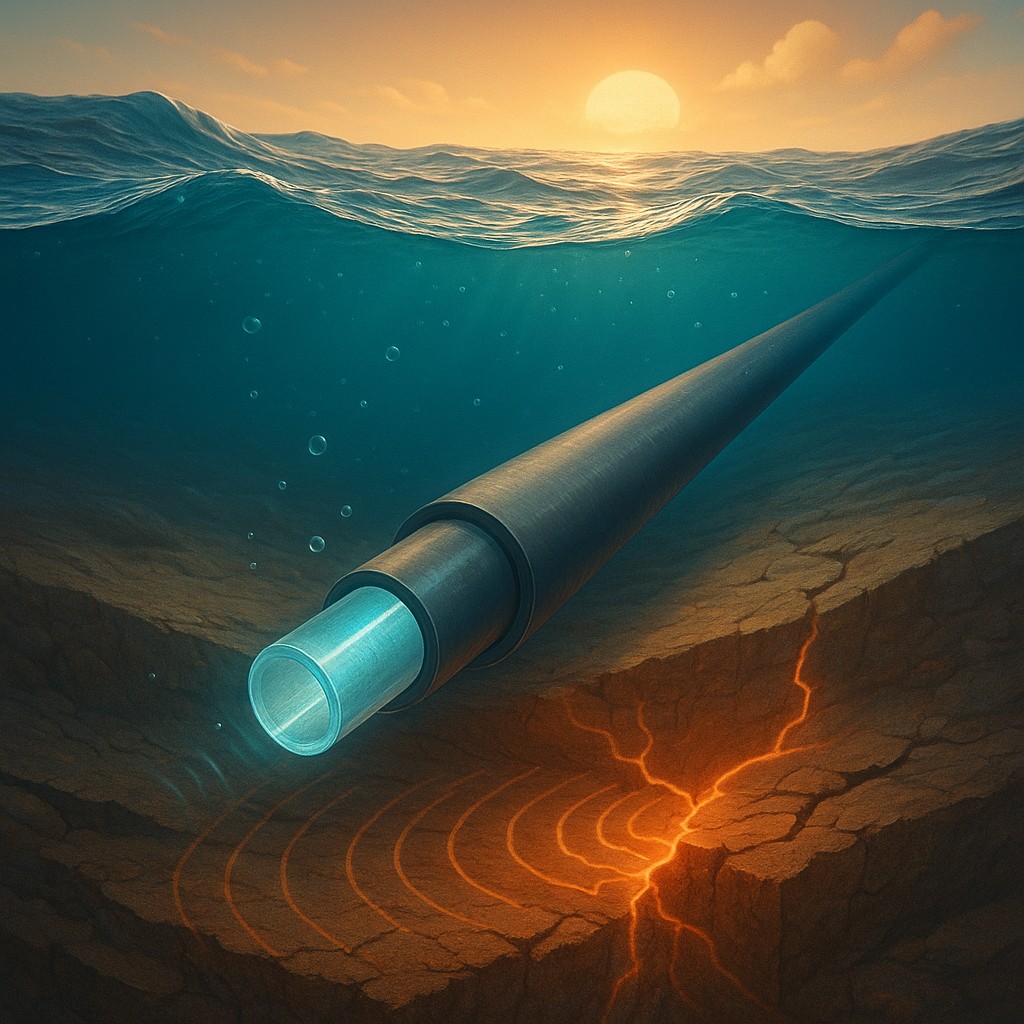
Deep beneath the rolling waves of the Atlantic and Pacific, hidden in the silent, high-pressure world of the abyssal plain, sits a sprawling web of glass. These are the submarine fiber-optic cables, the literal nervous system of our modern planet. While we often think of the internet as existing in a magical "cloud," it is actually grounded in these physical strands. Some are no thicker than a garden hose, yet they carry trillions of bits of data every second. They are the reason you can stream a video from a server in Dublin while sitting on a beach in California. Until very recently, however, we thought of them as nothing more than passive delivery pipes for our digital lives.
Lately, scientists have realized that this global network is capable of much more than just moving cat videos across oceans. Because these cables are made of incredibly sensitive glass fibers, they can actually "feel" the planet. When the earth shifts, or when a massive wave rolls overhead, the cable stretches and bends ever so slightly. By repurposing the technology used to transmit data, researchers are turning thousands of miles of seabed infrastructure into a massive, accidental telescope for seismic activity. We are essentially teaching our internet cables how to listen to the heartbeat of the Earth, providing a high-resolution view of underwater earthquakes that were previously invisible.
The Physics of a Glass Microphone
To understand how a chunk of glass on the ocean floor can detect an earthquake, we first have to look at how these cables function. At the core of every fiber-optic cable are strands of ultrapure glass. To send information, an operator at a land station fires a laser pulse down the fiber. If the fiber were perfectly still and conditions remained constant, that light would travel in a predictable way. However, if the cable is nudged, stretched, or squeezed by a seismic wave, the internal structure of the glass shifts by a microscopic amount. These changes are so small they are measured in nanometers, which is roughly the width of a single strand of DNA.
This is where a technique called Distributed Acoustic Sensing, or DAS, comes into play. When a laser pulse travels through the fiber, a tiny portion of that light naturally "backscatters," or bounces back toward the source, because of microscopic imperfections in the glass. If the cable is being stretched by an earthquake, the time it takes for that bounced light to return changes. By measuring these tiny delays with incredible precision, scientists can treat every few meters of a thousand-mile cable as an individual sensor. It is as if we suddenly installed millions of tiny microphones along the seafloor without having to send a single submarine down to place them.
Bridging the Mid-Ocean Blind Spot
This breakthrough is vital for planetary safety because of a simple problem of geography. Most of our high-quality seismic sensors are located on land, where they are easy to maintain and power. However, 70 percent of the Earth's surface is covered by water, and many of the most dangerous tectonic plate boundaries are located far out at sea. When an earthquake happens in the middle of the ocean, land-based sensors only catch the "echoes" after the waves have traveled long distances, losing clarity and precious seconds of warning time. Putting traditional seismometers on the seafloor is also far too expensive, requiring specialized ships, robotic submersibles, and batteries that eventually die.
By using the cables that are already there, we bypass the need for new hardware. There are over 1.4 million kilometers of submarine cables currently in operation. This existing network crisscrosses the very areas where tectonic activity is most frequent, such as the Ring of Fire in the Pacific. Instead of having a few isolated sensors separated by hundreds of miles of "dark" ocean, we can now use the entire length of a cable as a continuous monitoring device. This allows us to see the exact point where a rupture begins and track its movement in real time, providing a much clearer picture of how much energy is being released and where it is headed.
Distinguishing Earthquakes from Ocean Noise
One might wonder how scientists can tell the difference between a catastrophic tectonic shift and a heavy cargo ship passing overhead. The ocean is a noisy place, filled with the sounds of whales, boat engines, and the constant thrum of surface waves. The beauty of the Distributed Acoustic Sensing system is its ability to filter through this chaos. Seismic waves from deep within the crust have a specific frequency. They move through the seabed in a way that is distinct from the pressure waves created by moving water or surface activity.
Researchers use sophisticated computer programs to analyze the light signals and categorize the vibrations. Because the cable is so long, they can see the "shape" of the vibration as it moves across the fiber. A ship might only affect a small section of the cable for a short time, whereas an earthquake sends a massive, coordinated pulse that hits large sections of the cable in a predictable sequence. This spatial resolution, or the ability to see exactly where things happen in space, is what makes the technology so powerful. It doesn't just tell us that something happened; it tells us exactly where it occurred and how fast it is moving.
| Feature |
Traditional Seismometers |
Fiber-Optic DAS |
| Location |
Mostly land-based or isolated ocean nodes |
Continuous along the entire cable length |
| Cost |
High (requires new hardware and deployment) |
Low (repurposes existing infrastructure) |
| Sensitivity |
Extremely high at a single point |
High for strain and vibration patterns |
| Maintenance |
Requires physical visits to the site |
Managed remotely from land-based stations |
| Data Recovery |
Often delayed (if recorded on-site) |
Instantaneous via laser backscatter |
The Race for Tsunami Warning Time
Perhaps the most practical use for this accidental sensor network is the improvement of tsunami early warning systems. When an underwater earthquake occurs, the primary goal of any emergency agency is to determine if the sea floor has moved enough to trigger a massive wave. Every second counts. Currently, many coastal regions rely on pressure sensors located on the seafloor that send data to buoys, which then beam the info to headquarters via satellite. This chain of communication can take minutes to process. Fiber-optic sensing, however, moves at the speed of light.
If a cable is lying directly over a fault line, it can detect the rupture the moment it happens. By analyzing the physical strain on the cable, scientists can estimate the magnitude of the quake almost instantly. This data can be fed into computer models to predict the size of a resulting tsunami before the water has even begun to move toward the shore. In many parts of the world, gaining an extra five or ten minutes of warning time is the difference between an orderly evacuation and a tragedy. It turns our global communication network into a shield, using the same fibers that carry our emails to protect our lives.
Overcoming the Challenges of Dark Fiber
While the potential is enormous, moving to a global fiber-seismic network has its hurdles. Many of the cables on the ocean floor are owned by private telecommunications giants who are protective of their equipment. Sending high-powered laser pulses for sensing while simultaneously moving massive amounts of consumer data requires careful management to ensure there is no interference. However, many fiber bundles include "dark fibers," which are extra strands of glass installed for future expansion that are currently unused. These dark fibers are the perfect playground for geophysicists, allowing them to run experiments without touching active data traffic.
Another challenge is the sheer volume of data produced by this method. Because the system can turn a single cable into thousands of virtual sensors, it generates a massive stream of information every second. Processing this "firehose" of data requires significant computing power and advanced artificial intelligence to pick out relevant signals. As machine learning continues to improve, our ability to automate earthquake detection will only get better. Eventually, we may have a fully automated global alert system that monitors the sea floor 24/7 without human intervention.
A New Era of Geophysical Observation
We are entering a phase where the boundary between "communication" and "observation" is blurring. The fact that a technology designed to help us browse the internet can also help us understand the deep interior of our planet is a testament to the unexpected benefits of global connectivity. It reminds us that our infrastructure is more than just tools for convenience; it is a physical extension of our senses that can be tuned to perceive things our bodies never could.
As you consider the vast network of cables lying in the dark, cold depths of the ocean, imagine them not just as wires, but as a living skin stretched over the Earth. Every time the planet breathes, shifts, or shudders, these glass fibers feel the movement. By listening to these subtle vibrations, we are gaining a new level of intimacy with the world we inhabit. Each nanometer of stretch is a piece of data that tells the story of a dynamic, shifting planet. Our newfound ability to read that story is making the world a safer, more predictable place for everyone living on its shores.