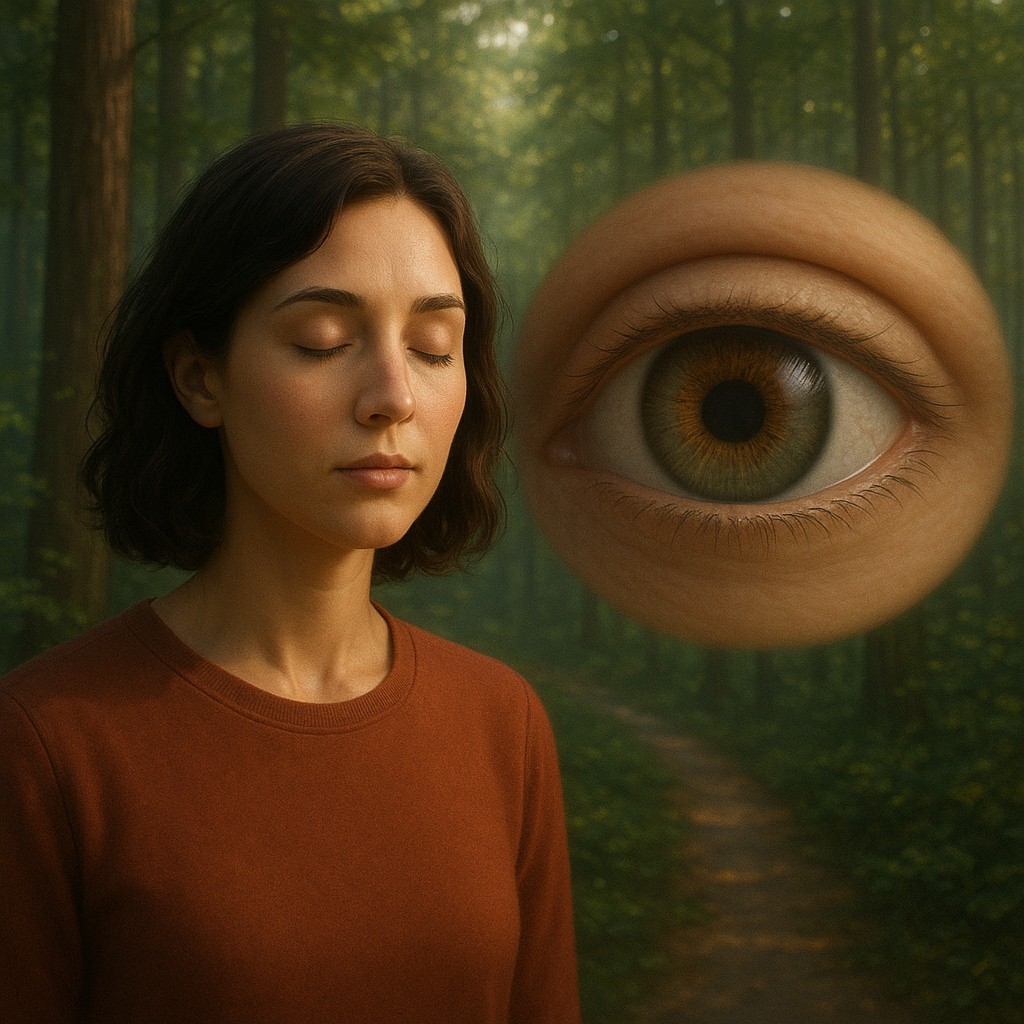
Imagine you are walking through a thick forest or a busy city street. Suddenly, a car swerves toward you or a branch snaps loudly behind you. In a heartbeat, your pulse quickens, your palms grow damp, and everything disappears except the immediate threat. This is more than a feeling; it is a total body overhaul. Your pupils dilate to let in more light, and your vision narrows into a sharp "pipe" focused only on the danger. This tunnel vision is a brilliant survival gift from our ancestors designed to help us outrun predators, but in the modern world, it often triggers for a stressful email or a tense conversation. This locks you into a high-alert panic that is hard to shake.
The fascinating thing about this "fight or flight" response is that it works like a two-way street. While your brain tells your eyes to narrow when you are stressed, the state of your eyes also tells your brain how stressed it should be. Most of us feel like victims of our own bodies during a crisis, assuming we have to wait for the adrenaline to wear off before we can feel calm again. However, there is a hidden manual override built into your visual system. By intentionally changing the way you look at the world, specifically by softening your gaze and widening your field of view, you can send a high-priority message back to your brain, hijacking the stress response and forcing your nervous system to gear down.
The Optical Highway to the Nervous System
To understand why widening your vision works, we have to look at how the Autonomic Nervous System (ANS) operates. Think of the ANS as your body’s autopilot, divided into two main branches: the sympathetic nervous system, which acts like an accelerator, and the parasympathetic nervous system, which acts like a brake. When you are under pressure, the sympathetic system takes the wheel. It releases chemicals like norepinephrine and adrenaline, which sharpen your focus but also raise your heart rate and blood pressure. This system is hardwired to the muscles that control your eyes. In a high-stress state, your eyes physically adjust to create "focal vision." This is great for tracking a moving target, but it is exhausting for the brain to maintain and keeps the "alert" signal looping indefinitely.
The eyes are actually the only part of the brain that sits outside the skull. They are not just sensors; they are a working part of the central nervous system. When you use focal vision, you use a path that leads directly to the amygdala, the part of the brain responsible for detecting threats. This creates a feedback loop: the sight of a stressor keeps the body tense, and that tension keeps the eyes locked in a narrow focus. Breaking this loop requires a deliberate move using a different set of neural paths. By shifting into "panoramic vision," you engage the parasympathetic branch, the "rest and digest" system. This begins the process of lowering your heart rate and relaxing your muscles.
How the Panoramic Soft Gaze Works
Widening your peripheral vision is not about looking around or moving your eyes from side to side. In fact, eye movement can sometimes make you more alert. Instead, it is a technique of "softening" your focus while keeping your head and eyes relatively still. When you do this, you are trying to see the space around you, including the corners of the room, the floor, and the ceiling, all at once. This shift from central vision to peripheral vision changes how the brain processes information. Peripheral vision is handled by different nerve cells that are more closely linked to the brain’s calming systems.
When you broaden your field of view, you are essentially telling your brain: "I can see everything. Since nothing is attacking me, I must be safe." It is a physical signal of security. Even if your boss is still speaking to you in a frustrated tone or you are stuck in traffic, the act of seeing the dashboard, the windows, and the sky in one wide, relaxed image forces the brain to realize there is no immediate physical threat. This is a "bottom-up" way to manage emotions. Rather than trying to talk yourself out of being stressed, which often fails during a peak crisis, you are using a physical lever to change your internal chemistry.
Comparing the Two Visual States
Understanding the differences between these two modes of seeing can help you recognize when you have accidentally slipped into a stress-induced "focal pipe." The goal is to move from the left column to the right column when you need to regain your composure.
| Feature |
Focal (Tunnel) Vision |
Panoramic (Peripheral) Vision |
| Nervous System |
Sympathetic (Fight or Flight) |
Parasympathetic (Rest and Digest) |
| Primary Chemical |
Norepinephrine / Adrenaline |
Acetylcholine |
| Brain Signal |
"Alert! Focus on the threat!" |
"Safe. Survey the environment." |
| Physical Effect |
Higher heart rate, shallow breath |
Lower heart rate, deeper breath |
| Best Used For |
Specific tasks, tracking, danger |
Problem solving, calming, creativity |
| Mental State |
High urgency, narrow perspective |
Broad awareness, relaxed clarity |
Overcoming the Mental Hurdle
The biggest challenge to using panoramic vision is that it requires a conscious choice at the exact moment your brain is least likely to think logically. When the amygdala takes over, the prefrontal cortex, the part of your brain responsible for logic and remembering "stress tips," tends to go offline. This is why many people find it hard to remember to breathe or use grounding techniques during a panic attack. The brain is so convinced of the danger that it views any attempt to relax as a threat to survival. To overcome this, widening your vision must become a practiced habit rather than an emergency brake used only as a last resort.
One effective way to make this tool useful is to practice it during low-stress moments. For instance, while you are sitting at your desk or walking the dog, spend sixty seconds intentionally seeing the world in "wide-angle mode." Notice how the edges of your vision feel and how the muscles around your eyes relax. By doing this regularly, you create a stronger mental path that makes the technique easier to find when stress clouds your mind. You can also use reminders in your environment; perhaps every time you walk through a doorway, you take a second to expand your gaze. This builds the muscle memory necessary to use the tool when things get difficult.
The Physical Side of Emotions
It is a common mistake to think our emotions are purely "in our heads" and that the only way to fix an emotional problem is through better thinking. However, the body is often what drives our emotional state. If your eyes are strained and your vision is narrow, your brain will struggle to believe that everything is okay, no matter how much you tell it so. Realizing this gives you a deep sense of control. You may not be able to stop a missed deadline or a conflict with a partner, but you have absolute control over the muscles that move your eyes.
Using a physical lever for an emotional problem is incredibly empowering. It moves the solution away from the abstract world of "trying to be positive" and into the concrete world of biology. When you feel your chest tighten or that sudden "zoom-in" effect of stress, you can simply reach for your "wide-angle" lens. It is a silent, invisible tool. No one in a meeting or a grocery store line will know you are doing it. You are simply expanding your awareness of the space you are in, and in doing so, you are gently guiding your nervous system back to its balance point.
Broadening the Horizon of Calm
Mastering your brain’s internal clock through panoramic vision is like discovering a secret volume knob for your own anxiety. It reminds us that we are not just passengers in our bodies, but active participants in our physical experience. By understanding the direct link between our eyes and our internal alarm systems, we can stop the snowball effect of stress before it becomes an avalanche. It turns a moment of panic into a moment of observation, allowing us to see not just the problem in front of us, but the entire world around us.
As you move forward, try to treat your visual field like a garden that needs care. When life feels overwhelming and the walls seem to close in, remember that you have the power to mentally push those walls back just by looking at them. This simple shift from "focus" to "awareness" can change your entire biological state in less than a minute. It is a testament to the human body that such a powerful mechanism for peace is literally hidden in plain sight, waiting for you to simply open your eyes a little wider and let the calm in.