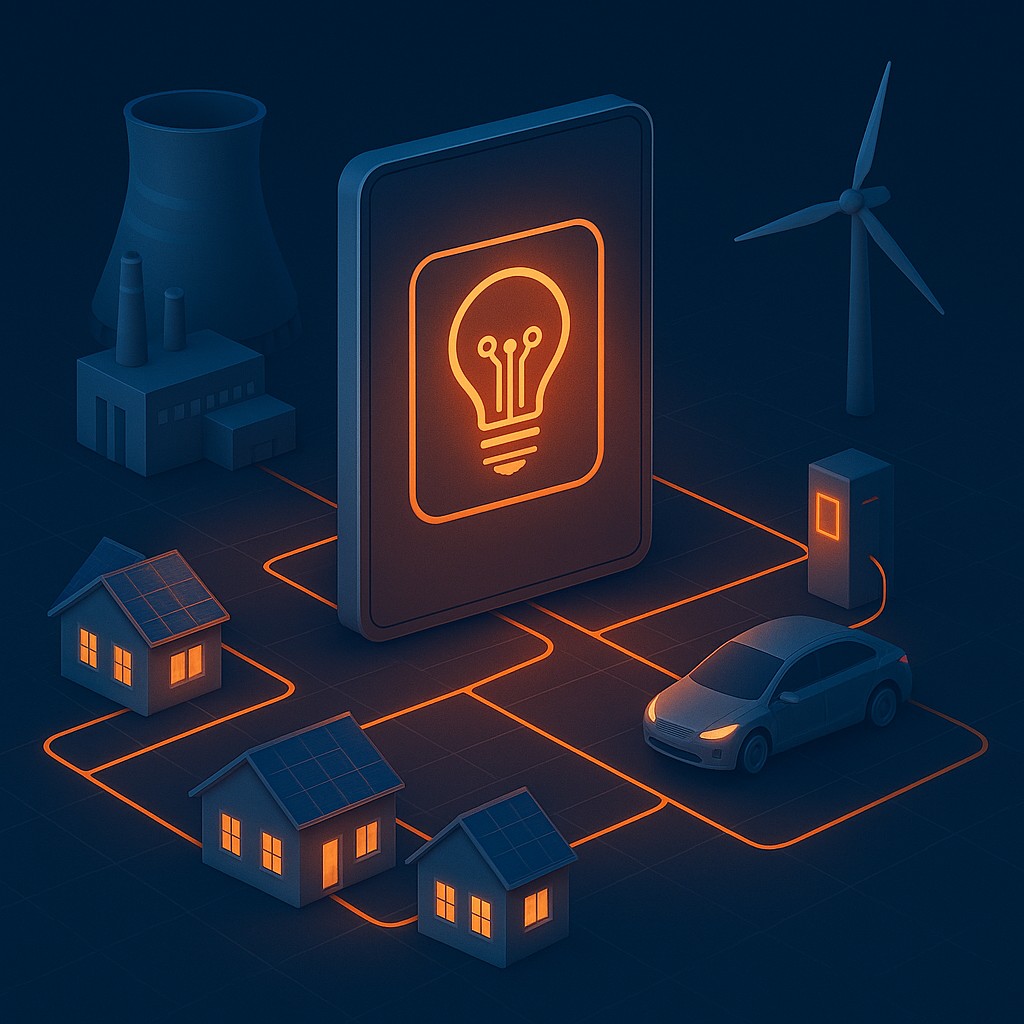
Think of your local power grid as a massive, synchronized dance troupe. Every light switch you flip, every electric vehicle charger you plug in, and every air conditioner humming in the suburbs is a dancer moving in time. For decades, the energy industry operated on a simple, frantic rule: when the tempo increases, add more dancers. This forced utility companies to build huge, expensive power plants that sat idle for months, just to be ready for those few sweltering summer afternoons when everyone cranked their AC to the max, pushing the system to its limit.
We are now seeing a fundamental shift in this philosophy. We are moving away from the brute-force method of adding supply and toward the elegant, invisible art of managing demand. Instead of blindly rushing to build more power plants, cities are beginning to see your home appliances as a secret reservoir of potential. By subtly directing the flow of energy at a granular level, modern smart grids are effectively turning millions of individual homes into a distributed, virtual power plant. This evolution transforms consumers from passive recipients of electricity into active, automated participants in a high-stakes balancing act that keeps the lights on without anyone ever needing to reach for a flashlight.
The Invisible Choreography of Peak Management
At the heart of this transformation lies the concept of dynamic load shedding. Traditionally, when a power grid reached a breaking point, the solution was catastrophic: wide-scale rolling blackouts where entire neighborhoods were plunged into darkness to save the system from total failure. This was a blunt tool, a desperate last resort that felt like amputating a limb to save the body. Dynamic load shedding replaces that blunt tool with a surgical scalpel, using smart software to communicate with home devices in real-time.
When sensors detect that the grid is nearing its maximum capacity, the central control system does not shut down your home. Instead, it identifies non-essential, energy-hungry tasks that can wait a few moments. Your air conditioner might pause its compressor for five minutes, or the smart charger for your electric vehicle might temporarily draw a little less power. Because these adjustments are spread across thousands or millions of homes, the collective drop in demand is massive. This gives the grid operator the breathing room needed to keep everything stable. By the time you notice your living room is a single degree warmer, the grid crisis has already passed, and your equipment resumes its normal operation.
Reframing the Household as a Virtual Power Plant
The beauty of the virtual power plant, or VPP, is its ability to redefine what counts as energy production. We often think of power plants as imposing structures with smokestacks or sprawling fields of solar panels. In the modern era, however, a power plant is simply any resource that keeps the electrical frequency steady. By tapping into the latent potential stored in smart home technology, utilities can treat a fleet of home batteries, water heaters, and EV chargers as a reliable, dispatchable asset.
This is not a theory or a distant dream. Utility providers across the globe are integrating these tools into their daily operations to manage everything from extreme heat waves to sudden drops in renewable energy production. During a cloudy day when solar input dips unexpectedly, VPP software instantly triggers these demand-side adjustments to cover the gap. The result is an incredibly resilient system that relies on thousands of decentralized nodes rather than a single, fragile point of failure. It turns the collective behavior of a city into a flexible, intelligent resource that responds to the environment far faster than any traditional turbine ever could.
Dispelling the Myth of Grid Deprivation
A common fear about these technologies is that participating in demand response programs requires personal sacrifice or a drop in your quality of life. It is easy to imagine a scenario where the utility company turns your home into an icebox or leaves your car battery dead when you need to commute. However, the software governing these interventions is designed with strict limits that prioritize your comfort above all else.
These systems operate on the principle of minimal impact. They use machine learning to predict how much slack your home's energy consumption has without compromising your preferences. The goal is to maximize stability while remaining entirely invisible to you. This ensures the grid stays balanced without the major inconveniences often linked to older, manual conservation efforts. When you sign up for such a program, you are essentially establishing a contract where the system manages "hidden" energy waste behind the scenes, allowing you to go about your day without worrying about voltage fluctuations or power shortages.
The Mechanics of Harmony in Complex Systems
To understand how this works at scale, we can look at the interplay between consumption and supply through the lens of a control loop. The grid operator continuously monitors demand. When that demand encroaches on the safety buffer, the control system initiates a series of small, temporary adjustments that ripple through the network. The table below highlights the differences between the old, reactive grid and the new, proactive smart grid.
Contrasting Traditional Grid Management and Modern Virtual Systems
| Feature |
Traditional Grid Management |
Modern Virtual Power Plant (VPP) |
| Response Type |
Reactive (Crisis-based) |
Proactive (Predictive) |
| Primary Tool |
Scaling generation capacity |
Dynamically managing demand |
| User Role |
Passive consumer |
Active grid asset participant |
| Blackout Risk |
High (All or nothing) |
Low (Surgical interventions) |
| Infrastructure |
Large, centralized power plants |
Distributed, networked devices |
The beauty of this architecture is that it scales as more people adopt smart technology. As more people integrate heat pumps, smart appliances, and EVs into their homes, the capacity of the VPP grows automatically. Each new device added to the network is not just a consumer of energy, but a new point of control that helps the entire city withstand the chaotic fluctuations of the modern world. It is a transition from an environment of scarcity and panic to one of abundance and orchestration.
Designing the Future of Resilient Cities
We are approaching an era where the concept of a blackout may eventually become an artifact of history, relegated to textbooks describing the "dumb" grids of the twentieth century. The integration of dynamic load shedding is just the beginning of a broader movement toward intelligent resource management. As we refine our ability to predict demand and automate the response, we are building a more sustainable and equitable foundation for urban life. Every smart charger and connected thermostat serves as a brick in this new foundation. It ensures that as our populations grow and our reliance on electricity deepens, our ability to keep that energy flowing grows even faster.
The power of this technology lies in its transparency. You do not need to be an engineer to help stabilize your city's grid; you simply need to participate in the connected ecosystem. By allowing your devices to communicate with the utility, you are playing a vital role in the infrastructure that supports modern civilization. You are no longer just a user of electricity, but a foundational pillar of its reliability. As you look toward an increasingly electrified future, remember that the most stable systems are not the ones that are the strongest or the most rigid. They are the ones that are the most adaptable, the most responsive, and the most cleverly connected. Embrace the change, secure your smart appliances, and rest easy knowing that the grid is dancing perfectly in step with the pulse of your city.