For decades, the relationship between homeowners and the electrical grid was a simple one-way street. You plugged in your toaster, and that simple act signaled a massive, distant turbine to spin a little faster. At the end of the month, you paid for the privilege. This centralized model relied on two assumptions: that power demand is predictable, and that supply can be adjusted instantly by burning more coal or gas. But as the world shifts toward weather-dependent energy like wind and solar, that old, rigid logic is starting to fail. The wind doesn’t always blow when we are cooking dinner, and the sun sets right when we need our lights the most. This creates a massive logistical headache for grid operators who must balance supply and demand in real-time.
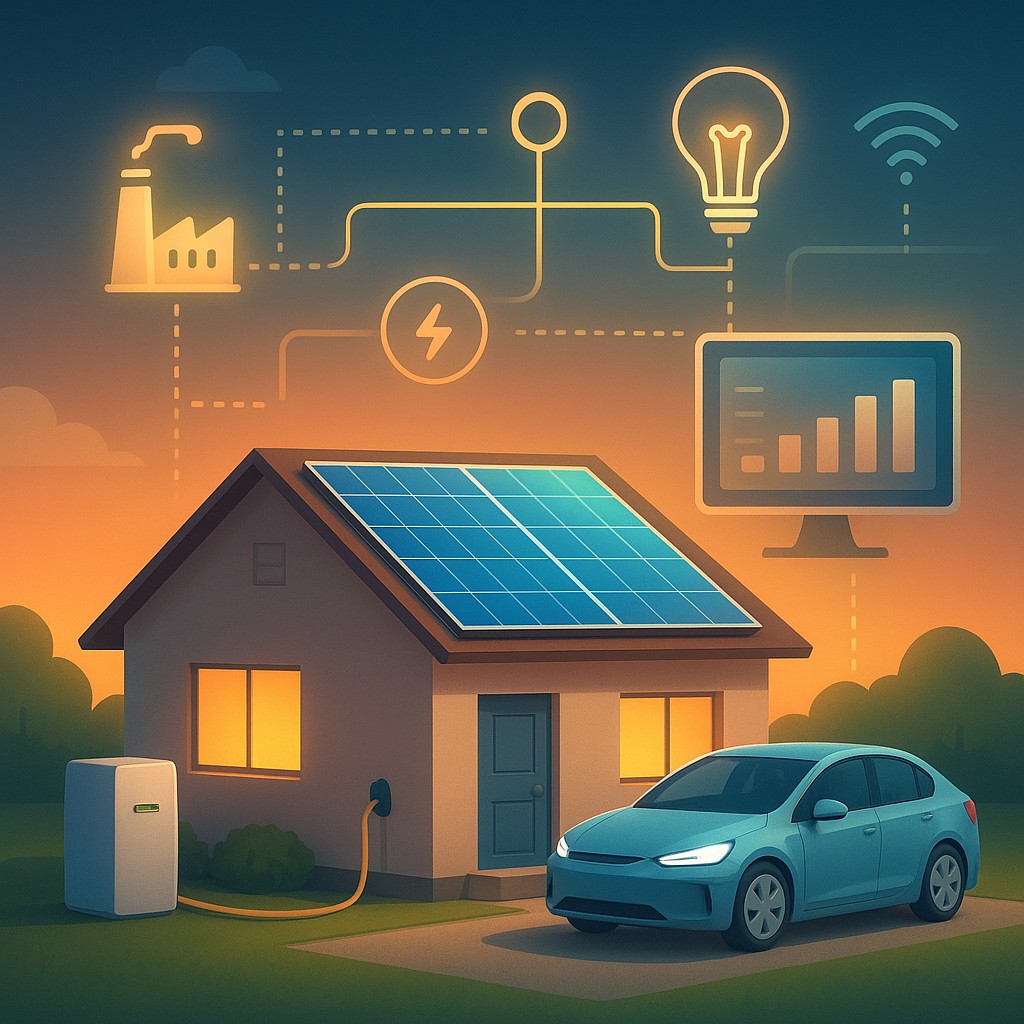
Instead of building more massive, smoky power plants to fill these gaps, engineers have developed a solution that is almost invisible. This concept, known as the Virtual Power Plant (VPP), flips the traditional "top-down" energy model on its head. By using smart software to link thousands of individual home batteries, electric vehicles, and even smart thermostats, we can create a "crowdsourced" power station. This collective resource can feed energy back into the grid during a crisis or soak up extra power when there is a surplus, all without releasing a single puff of greenhouse gas. It transforms the grid from a one-way lecture into a high-tech group chat, where everyone plays a small but vital role in keeping the lights on.
Orchestrating a Symphony of Small Electrons
To understand how a Virtual Power Plant works, it helps to stop thinking of the grid as a giant reservoir and start seeing it as a finely tuned living system. In a traditional setup, when thousands of people come home and turn on their air conditioners at 5:00 PM, the grid operator has to call up a "peaker plant." These are essentially giant jet engines bolted to the ground, designed to ramp up quickly to meet sudden spikes in demand. They are notoriously expensive to run and incredibly dirty. Most of the year, they sit idle, only firing up for a few profitable, smoky hours.
A VPP replaces that single, dirty giant with ten thousand tiny helpers. When that 5:00 PM spike hits, the VPP software sends a signal to a fleet of home batteries scattered across the city. Instead of one plant providing 100 megawatts, the software asks 20,000 homes to contribute just five kilowatts each. This happens in the blink of an eye. The homeowner might not even notice that their battery, which was charged by solar panels during the sunny afternoon, is now quietly feeding a little bit of that power back into the neighborhood. By pooling these tiny contributions, the VPP provides the exact same service as a gas-burning plant, but with zero emissions and much lower infrastructure costs.
Moving From Constant Combustion to Intelligent Storage
The big challenge with modern energy is that electricity is "perishable." Generally, it has to be used the exact moment it is created. In the past, we solved this by burning fuel on demand, which is basically a way of storing energy in chemical form until it’s needed. Solar and wind don't give us that luxury; they provide energy when the environment decides, not when we do. This is why storage has become the "holy grail" of the green transition. However, building massive, industrial-scale battery farms is incredibly expensive and takes years of permits and construction.
VPPs bypass this bottleneck by using the storage we have already bought and paid for. If you have an electric vehicle (EV) in your garage or a backup battery on your wall, you are sitting on a goldmine of unused capacity. Most cars stay parked for 22 hours a day, and most home batteries are only used during rare power outages. By "renting" a small portion of that capacity back to the grid, owners can turn their idle hardware into a source of income. The grid gets the stability it needs, and the homeowner gets a check in the mail, which helps lower the cost of switching to clean technology. It is the ultimate "sharing economy" application, but for electricity instead of car rides or spare bedrooms.
The Invisible Guardrails of Smart Management
One common worry about joining a Virtual Power Plant is the fear of being left in the dark. No one wants to find their EV battery empty when they need to rush to the hospital because the grid "borrowed" all the power. This is where the "intelligence" of the VPP is critical. These systems are not just simple siphons; they follow strict rules set by the user. A participant might tell the software, "You can use my battery as much as you want, but never let it drop below 50 percent," or "Ensure my car is fully charged by 7:00 AM every morning."
The software treats these limits as absolute laws. It uses machine learning to predict your household's typical energy patterns, ensuring it only taps into the "buffer" of extra energy you aren't likely to need. Furthermore, VPPs are "locally aware." If a storm is forecasted for your specific zip code, the software can automatically stop drawing power and focus on topping off every battery in the area to prepare for potential blackouts. It turns out that a spread-out network is much harder to break than a centralized one; if one house's battery fails, the remaining 9,999 units simply pick up the slack.
| Feature |
Traditional Peaker Plant |
Virtual Power Plant (VPP) |
| Response Time |
Minutes to tens of minutes |
Milliseconds to seconds |
| Environmental Impact |
High CO2 and pollution |
Zero operational emissions |
| Construction Time |
3 to 10 years |
Weeks (software integration) |
| Ownership |
Large utility companies |
Individual homeowners |
| Reliability |
Single point of failure |
Many backup units |
| Primary Cost |
Fuel and heavy machinery |
Software and networking |
Navigating Software Challenges and Public Trust
While the hardware for VPPs already exists in millions of homes, the real "magic" lies in how the devices talk to each other. Most home gadgets speak different digital languages. A Tesla battery might not naturally communicate with a Ford truck or a Nest thermostat. The current frontier for VPPs is the creation of standardized platforms that can coordinate these different assets as if they were a single, unified machine. This requires intense cybersecurity, as a network connected to the power grid is a high-stakes target. Engineers use advanced encryption and digital verification to ensure that no hackers can hijack the system.
Beyond the technical bits, there is a psychological hurdle to overcome. Most of us are used to being passive customers of utility companies. The idea that our water heater or car is part of a "collective" can feel invasive at first. However, as more people see the financial benefits, this skepticism tends to fade. In some regions, VPP participants have earned hundreds of dollars a year simply by letting their batteries help the neighborhood during hot summer afternoons. The VPP model transforms the homeowner from a customer into a partner, creating a sense of "energy citizenship" where people feel a direct connection to the health of their local community.
Debunking the Myths of Battery Wear and Tear
A common misunderstanding about VPPs is that constantly charging and discharging the battery to help the grid will wear it out too soon. While batteries do have a limited lifespan, VPPs interact with them very gently. Most VPP events only require a small percentage of the battery's total capacity and happen relatively infrequently, perhaps 20 to 50 times per year. In the world of battery physics, these "shallow" uses are far less stressful than the deep "empty-to-full" cycles that happen during daily household use.
In many cases, the clever management of VPP software might actually extend the life of the battery. By keeping the battery within an ideal charge window (usually between 20 percent and 80 percent) and avoiding extreme heat or cold, the software acts as a high-tech guardian. Manufacturers are becoming so confident in this that many now offer warranties that specifically cover VPP participation. They recognize that the future of their business isn't just selling a box of chemicals, but selling a vital part of a global energy network.
The Dawn of the Interactive Energy Era
The rise of Virtual Power Plants marks the end of the "static" grid and the beginning of a living ecosystem. We are moving toward a world where energy is not just something you buy, but something you participate in. As we add millions more EVs and home solar systems to our cities, the potential of VPPs will only grow. Eventually, every neighborhood could become its own self-sustaining microgrid, capable of supporting itself and its neighbors through the coordination of millions of small devices.
This shift represents a significant democratic movement for our infrastructure. For the first time, the power to stabilize the grid and determine our energy future is literally in the hands (and garages) of the public. By participating in these networks, you are doing more than just saving money; you are a pioneer of a smarter, more resilient civilization. The next time you see a solar panel on a roof or an EV plugged in at the curb, don't just see a piece of equipment. See a small, vital part of a giant, invisible engine working to keep the world bright, clean, and connected.