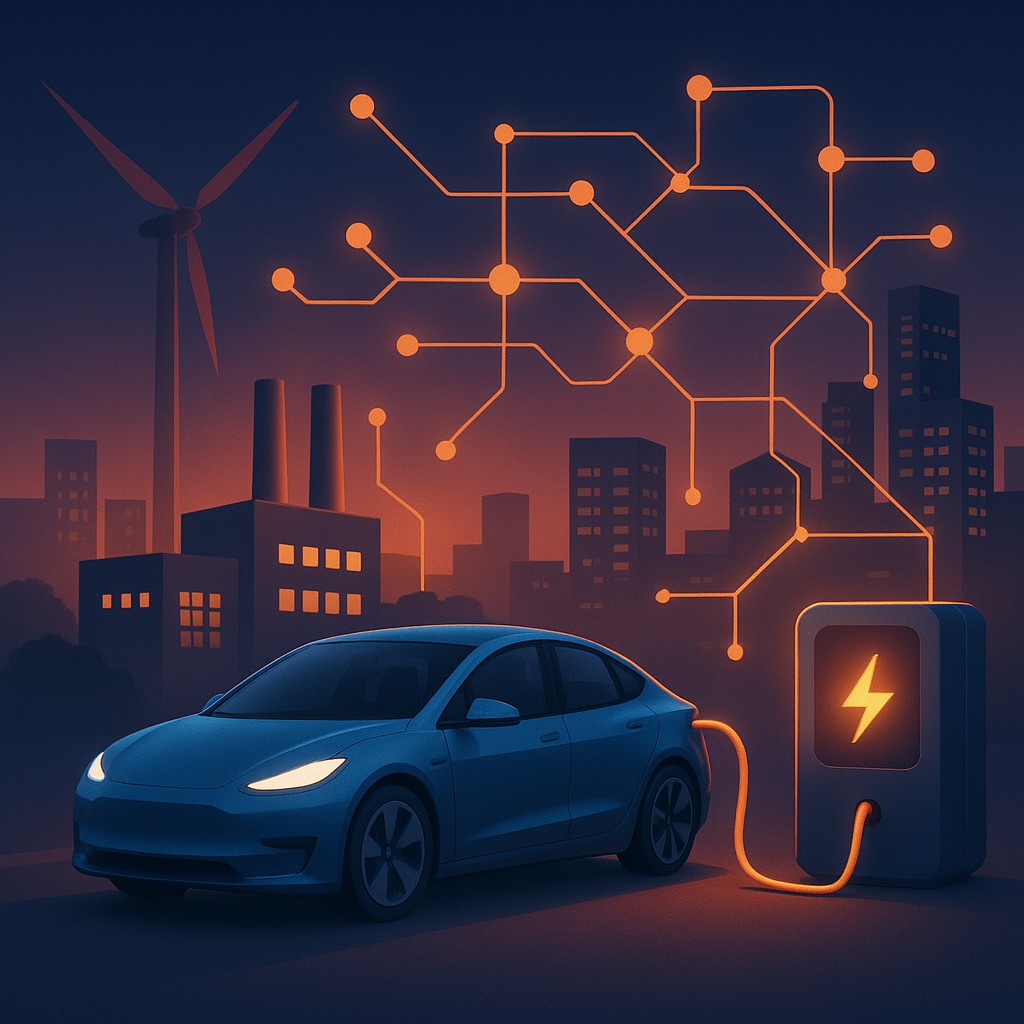
Imagine for a moment that your car is more than just a way to get around. It is a silent participant in a massive, hidden dance that keeps your city's lights on. While you sleep, or perhaps as you sit at your desk with a cup of coffee, your electric vehicle is having a complex conversation with the local power grid. It is no longer just a consumer of energy; it has become a miniature power station. This shift marks a fundamental change in how we think about infrastructure, moving away from giant, smoking chimneys and toward a distributed web of smart machines that can outsmart the problems of peak demand.
We are currently witnessing the birth of the Virtual Power Plant, or VPP. This concept turns the traditional "top-down" energy model on its head. Instead of one massive plant sending electricity out to thousands of homes, thousands of homes and their cars send tiny trickles of electricity back to the center when it is needed most. This creates a resilient, flexible system that breathes with the rhythm of human life, soaking up excess wind power at 3:00 AM and feeding it back out when everyone turns on their air conditioners at 5:00 PM. It is a masterpiece of software engineering and logistics that solves one of the hardest problems in modern physics: keeping supply and demand in perfect balance every single second of the day.
The Fragile Balancing Act of the Modern Grid
To understand why a parked car is suddenly so important, we have to look at the high-stakes tightrope walk performed by utility companies. The electrical grid is arguably the most complex machine humans have ever built, and it has a very specific, demanding requirement: electricity must be used the exact moment it is generated. If people turn on ten million blenders at once and there isn't a corresponding surge in production, the system's frequency drops, equipment gets damaged, and the entire network can collapse into a blackout.
To prevent this, utilities have traditionally kept "peaker plants" on standby. These are often expensive, gas-burning facilities that sit idle for 95% of the year, only roaring to life during the hottest summer afternoons to keep the grid from failing. Building a new peaker plant is a nightmare of red tape, expense, and environmental damage.
This is where the Virtual Power Plant steps in as a clever, software-driven alternative. By linking together thousands of smaller batteries, such as those in electric vehicles or home storage units, an energy operator can create a "phantom" power plant. When demand spikes, the VPP controller sends a digital signal to thousands of connected cars, asking them to stop charging or, in some cases, to discharge a few kilowatts back into the home or grid. To the utility company, the effect is exactly the same as turning on a massive gas turbine, but without the carbon emissions or the billion-dollar construction bill.
The Mechanical Heart of Bidirectional Charging
The magic that allows a car to act as a battery for a city is known as bidirectional charging, which comes in two main types: Vehicle-to-Home (V2H) and Vehicle-to-Grid (V2G). Most older chargers were one-way streets that only pushed energy into the car. Modern bidirectional systems use sophisticated inverters that can turn the Direct Current (DC) stored in the car's battery back into the Alternating Current (AC) used by your toaster and the wider power lines. This transformation is managed by "smart" software that monitors the health of the grid and the needs of the car owner at the same time.
There is a common fear that participating in a VPP will leave you with a "dead" battery when you need to drive to work. In reality, these systems operate within strict, user-defined limits. A driver might tell the app, "I need at least 80% charge by 7:00 AM," and the software will ensure that no matter how much the grid needs help overnight, it never dips below that mark. Most of the time, the grid only needs a tiny "nudge" from each car. If ten thousand cars each give up just 5% of their battery capacity, that adds up to a massive amount of power, but for the individual driver, it is barely a hiccup in their daily range.
| Feature |
Traditional Power Plant |
Virtual Power Plant (VPP) |
| Physical Location |
Centralized in one massive facility |
Spread across thousands of homes |
| Response Time |
Minutes to hours to "ramp up" |
Milliseconds to seconds via digital signal |
| Environmental Impact |
High carbon footprint (usually gas/coal) |
No extra emissions; uses stored green energy |
| Primary Cost |
Construction and fuel (Billions) |
Software and data networks (Millions) |
| Flexibility |
Rigid; difficult to adjust quickly |
Highly modular; can scale up or down instantly |
Solving the Solar Sponge Problem
One of the great ironies of renewable energy is that we often have too much of it at the wrong times. On a sunny, windy Sunday afternoon when businesses are closed, solar panels and wind turbines can produce more electricity than the grid can handle. In the past, utilities had to "curtail" this energy, essentially throwing it away because there was nowhere to store it. This creates a "duck curve," a graph showing how electricity demand drops significantly during the day and then shoots up like a rocket as the sun sets and everyone goes home to cook dinner.
Virtual Power Plants turn EVs into a "solar sponge." When there is a surplus of green energy, the VPP software triggers thousands of cars to start charging at high speeds, soaking up the excess juice that would otherwise go to waste. Later that evening, when solar production stops but demand is at its peak, those same cars can release some of that stored sunlight back into the system. This effectively levels out the peaks and valleys of energy usage, making the entire ecosystem more stable. It is a "systems-thinking" solution that helps provide cheap storage for renewables while reducing the strain on aging grid infrastructure.
Overcoming the Hurdle of Battery Anxiety
The biggest barrier to adopting VPPs isn't the technology, but the concern over battery wear and tear. It is a logical worry: if the grid is constantly "borrowing" energy from my car, won't that wear out the battery faster? This is an area where modern materials science provides some comfort. Contemporary EV batteries are designed to handle thousands of cycles. The amount of energy drawn by a VPP is typically a "shallow cycle," which is much less stressful on lithium-ion cells than the "deep cycles" of driving from a full charge down to zero.
Recent studies and pilot programs suggest that the impact on battery health is negligible compared to the financial benefits. Many VPP programs actually pay car owners for their participation. By allowing the utility to use your car as a tiny slice of a power plant, you might receive monthly credits on your electric bill or even direct payments. In some cases, the car could effectively pay for its own fuel through these "grid services." We are entering an era where the car is no longer just an expense that loses value in the driveway, but an active, income-generating asset.
The Digital Intelligence Behind the Scenes
Creating a VPP is less about pouring concrete and more about writing brilliant code. The "brain" of a VPP is a massive cloud-based platform that processes millions of data points every second. It looks at weather forecasts to predict solar output, checks traffic patterns to guess when people will be home, monitors real-time electricity prices, and tracks the charge level for every car in its network. This level of coordination was impossible twenty years ago; it requires high-speed internet and the predictive power of machine learning.
This software layer also acts as a digital firewall to keep the grid safe from cyber threats. Because the system is decentralized, it is naturally more resilient than a single huge power plant. If a traditional plant fails, a whole city goes dark. If a thousand cars in a VPP lose their connection, the rest of the network continues to operate without a hitch. This "swarm intelligence" represents a more democratic energy system, where power is not dictated by a central authority, but co-created by citizens and their smart devices.
The transition to Virtual Power Plants is more than an engineering trick; it is a new social contract between the individual and the city. We are moving from being passive consumers to being "prosumers," active participants who help stabilize the world around us simply by plugging in. This model offers a hopeful glimpse into a future where technology doesn't just demand more resources, but weaves our existing tools together to create a cleaner, more resilient world. By turning our parked cars into the backbone of the grid, we are proving that the most powerful solutions are often already sitting in our own driveways.