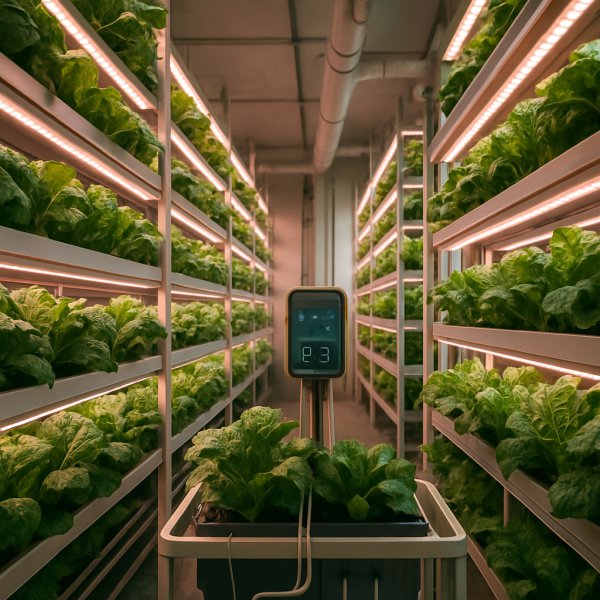
Imagine your supermarket moved into a glass tower next door: fresher food, less travel, and fewer surprises
Picture this - a head of lettuce harvested two hours before you buy it, still crisp from a rack of stacked trays inside a building down the street. No long truck journeys, no days lost in cold storage, no produce that looks tired by the time it reaches your plate. That is the promise of vertical agriculture, a blend of gardening, engineering, and logistics designed to bring farms closer to people. If you like the idea of food that tastes like the farm rather than the freight yard, read on.
Curious question to ponder: what would your neighborhood look like if produce did not need to be shipped thousands of kilometers to be considered fresh? Hold that image while we unpack how vertical agriculture could get us there, why it matters, and how you can take part.
What vertical agriculture actually is, in plain terms
Vertical agriculture is growing crops in vertically stacked layers inside buildings or shipping containers, using controlled environment technologies like LED lights, nutrient-rich water, and precise climate controls. Instead of widening fields outward, this approach builds upward to use urban space efficiently, turning warehouses, rooftops, and empty retail spaces into productive gardens. It includes methods such as hydroponics - plants in nutrient solutions, aeroponics - roots misted with nutrients, and aquaponics - combining fish farming with plant production.
Think of a vertical farm as a greenhouse on steroids - every variable that affects plant growth is measured and managed, from light spectrum to humidity and nutrient mix. That control means predictable harvests year-round, less dependence on weather, and the ability to site farms where people live.
Why food transport is a problem and how vertical farms solve it
Much of the food we eat crosses long distances, often enduring long storage periods and multiple handoffs. Those journeys add cost, time, and emissions, and they reduce freshness and nutrient quality. Perishable produce loses flavor and texture with every hour it sits in transit, and complex supply chains are vulnerable to disruptions from storms, strikes, or global events.
Vertical agriculture tackles these issues by placing production near consumption. Reduced transport means food gets from harvest to plate faster, lowering spoilage and the need for heavy packaging and preservatives. It also builds resilience: when regional supply lines break down, local vertical farms can keep supermarkets, hospitals, and schools stocked with fresh produce.
How vertical farms actually work - the tech and daily rhythm
A typical vertical farm uses LED light banks tailored to plant needs, stacked trays with circulating nutrient solutions, sensors monitoring CO2, humidity, and temperature, and software that automates watering, lighting, and harvest schedules. Water is recirculated, often cutting consumption by 70 to 95 percent compared with open-field agriculture, and pesticides are rarely needed because crops grow in protected indoor environments.
Automation and data are vital: cameras and sensors spot pests or nutrient imbalances early, robots can transplant or harvest delicate leaves, and software optimizes light cycles for energy efficiency and crop quality. Some farms operate in retrofitted shipping containers or grow towers, offering scalable models from hobbyist to industrial.
Quick comparison - conventional farms versus vertical farms
| Factor |
Conventional field agriculture |
Vertical agriculture |
| Freshness at point of sale |
Often days to weeks after harvest |
Often hours to a day after harvest |
| Transport needs |
High, long distance common |
Low, localized distribution |
| Water use |
Variable, often high |
Much lower due to recirculation |
| Land use |
High per unit yield |
High yield per footprint |
| Energy use |
Lower on-farm, higher in refrigeration/transport |
Higher on-farm (lighting, HVAC) |
| Crop range |
Wide - grains, fruits, roots |
Currently focused on leafy greens, herbs, strawberries, expanding |
| Capital cost |
Lower per hectare, long tradition |
Higher upfront, modular scaling possible |
| Seasonality |
Seasonal and weather dependent |
Year-round, climate-independent |
This table simplifies tradeoffs. Life cycle assessments suggest net greenhouse gas benefits in urban settings where transport emissions are large, while rural large-scale production still often holds energy advantages for staple crops.
Real projects that show vertical farms can work in cities
AeroFarms in Newark transformed a former steel mill into a vertical farm supplying local schools and stores, demonstrating scalable production in an urban setting. In Jackson Hole, Vertical Harvest operates a three-story greenhouse that not only supplies nearby restaurants and markets but also provides employment and training for people with disabilities, showing the social as well as ecological potential of urban growing. Singapore, with limited land, has invested heavily in vertical farming research and subsidies to increase local fresh produce availability.
These examples show different models - high-tech modular farms, social enterprises, and national strategies - each solving the freshness and transport problem in their context. They prove the concept is more than a novelty; it is an adaptable approach that can serve diverse goals.
Common misunderstandings, corrected
Myth: vertical farms are just energy hogs and bad for the planet. Reality: indoor farms do use electricity, mostly for lighting and climate control, but placing production close to consumers cuts transport emissions and spoilage. When paired with renewable energy and efficient LEDs, the overall footprint can be competitive for high-value, perishable crops. Life cycle analyses indicate benefits depend on context - urban placement near consumers and clean electricity tilt the scale in favor of vertical farming.
Myth: vertical farms can replace all agriculture. Reality: they excel at greens, herbs, and some fruits but are currently not economical for staple grains or root crops at scale. Vertical agriculture is a powerful complement to traditional farming, not a wholesale replacement.
Myth: vertical farming is only for large companies. Reality: models range from community-run rooftop systems and shipping-container farms to large commercial operations. Technology is democratizing access, with smaller, affordable units for schools, restaurants, and urban neighborhoods.
How you can get involved - practical steps and small experiments
If you want tastier local greens, consider joining a community-supported agriculture program that sources from nearby vertical farms where available, or visit farmers markets and ask how far produce traveled. For hands-on learning, try a small hydroponic kit at home or convert a sunny windowsill into a herb station - micro-experiments teach the basics of nutrient balance and plant light needs. Neighborhoods can advocate for zoning changes to support rooftop and indoor farms, or partner with local businesses to pilot a container farm for a restaurant or grocery.
Challenge yourself: find three items in your kitchen and trace where they were grown. How long did they likely travel? Next week, try buying two comparable items - one from local urban-grown sources if possible, and one from a traditional supply chain - and compare taste, texture, and freshness. Share your observations with neighbors or on social media to spark local interest.
Final picture - fresher food close to home, step by step
Vertical agriculture will not eliminate long-haul farms, but it offers a realistic path to fresher, more resilient food systems near cities. By reducing transport, cutting waste, and producing year-round, vertical farms can make fresh salads that taste like they were picked this morning a daily reality for more people. With smart policies, renewable energy, and community-scale experiments, this vision is not science fiction, but a practical part of the urban future.
Quote to remember:
"Growing up instead of out changes the way we eat, where we shop, and how communities thrive."
If you leave with one idea, let it be this - bringing farms closer to people is not just about novelty, it is about better taste, lower waste, and stronger local food systems. Ready to try a mini hydroponic kit, visit an urban farm, or start a neighborhood project? Freshness is closer than you think.