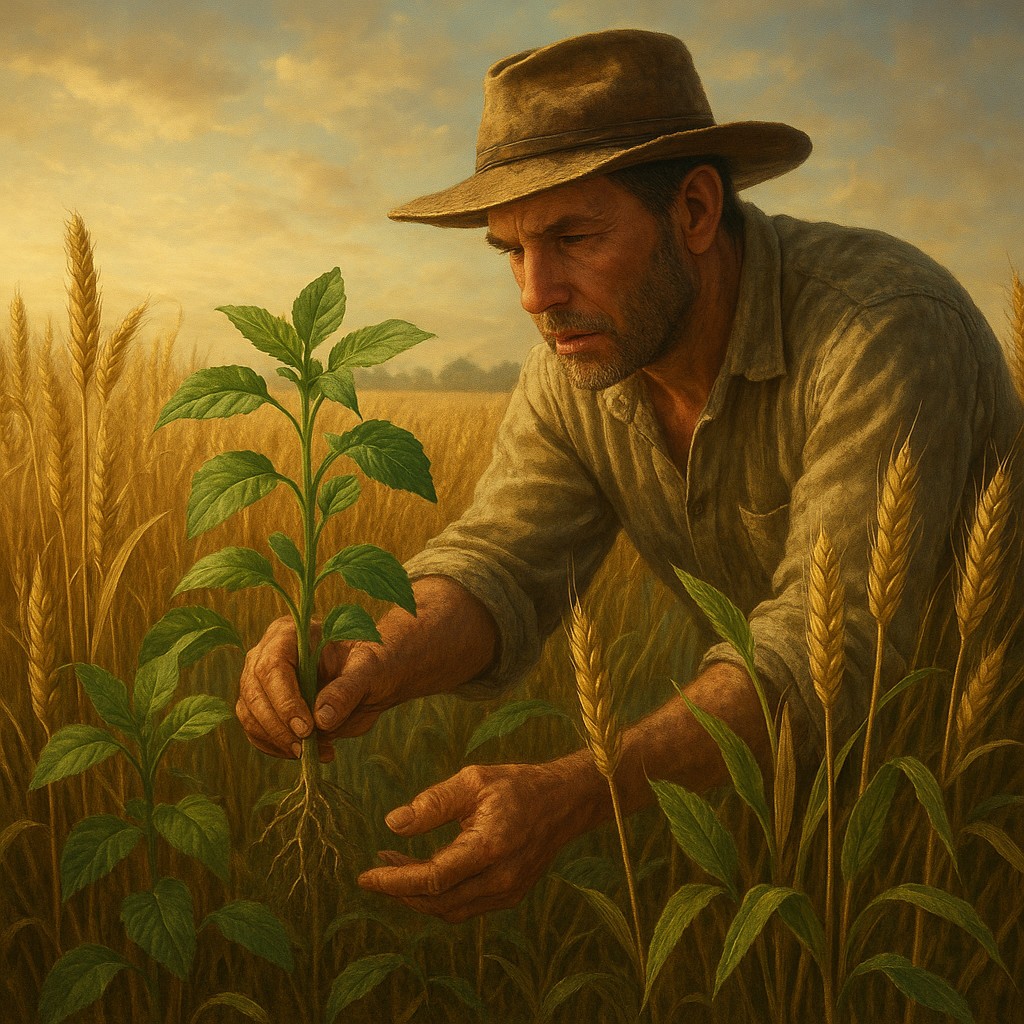
Imagine yourself as a farmer thousands of years ago, strolling through a golden field of wheat. Your eyes are sharp, trained by necessity to catch the jagged, dark leaves of a weed that might steal water and nutrients from your crop. You reach down, find a plant that looks slightly out of place, and pull it up by the root. By doing this, you have just performed a basic act of biological selection. You didn’t realize it, but you were acting as a high-pressure evolutionary filter. Any weed easy to spot died before it could drop its seeds. Any weed that happened, by a stroke of genetic luck, to look just a little bit more like wheat survived to see another day.
Over centuries of this ritual, these weeds didn't just survive; they transformed. They didn't choose to change, but those that survived your "weeding" passed on the genes for "looking like wheat." Eventually, the weeds became so good at playing dress-up that you could no longer tell them apart from the crop itself. This is the fascinating world of Vavilovian mimicry, also known as crop mimicry. It is a story of how human interference, despite our best efforts to clean our fields, accidentally engineered some of the most successful imposters in nature. It proves that nature doesn't need a brain to outsmart us; it only needs time and a consistent set of rules.
The Unintended Architect of Deception
To understand how a weed can "learn" to look like a crop, we have to look at the main character in this drama: the operator. In most biological mimicry, the operator is a predator, like a bird that avoids a harmless fly because it looks like a stinging wasp. In Vavilovian mimicry, the operator is the human. For thousands of years, humans have been obsessed with agricultural "purity." We want only the plants we planted to grow in the spaces we gave them. We provide a massive, nutrient-rich environment that is essentially an all-you-can-eat buffet for any plant, but we guard the entrance with a lethal policy: if you don’t look like you belong here, you’re evicted.
This creates an intense type of selective pressure. If a weed looks similar enough to avoid the hoe or the hand, it gains access to the same fertilizer, the same water, and the same protection from hungry animals that the crop enjoys. This isn't a passive process. It is a high-speed evolutionary arms race where the human hand is the engine of change. The more diligent the farmer, the faster the weed must evolve to match the crop. Unlike many forms of evolution that take millions of years, this mimicry can occur in just a few hundred generations because the life-or-death stakes are applied every single growing season.
The concept was first mapped out by Nikolai Vavilov, a brilliant Russian botanist who traveled the world in the early 20th century to study where crops first began. He noticed something strange: many of our secondary crops, like rye and oats, actually started their journey as weeds. They were the unwanted guests in wheat and barley fields. Because humans were constantly filtering them out, they evolved to mimic the size, shape, and even the seed-dropping timing of the main crop. Eventually, they became so healthy and productive that when humans moved to colder or harsher climates where wheat failed, they realized these "mimic weeds" were actually quite good to eat. We essentially domesticated the mimics by accident.
How Selection Works
It is important to set aside the idea that the weed is "trying" to do anything. Plants do not have a sense of self, nor do they have mirrors to check their progress against the wheat next door. The process is entirely based on statistics. Within any group of weeds, there is a natural mix of genetic traits. Some weeds might have slightly wider leaves, some might have seeds that stay on the stalk longer, and some might grow a few inches taller than others. If a farmer is looking for "skinny leaves" to identify weeds, then the weeds with slightly wider leaves are the ones that survive.
This is a classic feedback loop. If the farmer’s "detection system" (their eyes and brain) targets a specific trait, they effectively remove every plant carrying the genes for that trait. This leaves only the mimics behind to reproduce. By the next year, the "average" look of the weed population has shifted slightly closer to the crop. This is why Vavilovian mimicry is often more precise than other types of mimicry. In the wild, a predator might only need a split second to be fooled. In a field, a farmer might spend hours looking closely at individual plants. This forces the mimicry to become incredibly detailed, affecting everything from how the seedling grows to the chemical makeup of its seeds.
There are three main stages where this selection happens, and each one targets a different part of the plant's life cycle. First is the seedling stage, where manual weeding happens. Second is the growth stage, where the mimic must match the height and canopy shape of the crop to avoid being spotted from a distance. Third, and perhaps most importantly, is the harvesting and sorting stage. If the weed's seeds are the same size and weight as the crop seeds, they will be swept up by the harvester and sorted into the same bags as the "clean" grain. This ensures that the farmer unknowingly plants the weed seeds back into the field the following year.
| Phase of Growth |
Selective Pressure |
Mimicry Outcome |
| Seedling Stage |
Hand-weeding or robotic sensors. |
Leaf shape, color, and stem thickness match the crop. |
| Vegetative Stage |
Mechanical tilling or visual inspection. |
Growth rate and height match the crop leaf cover. |
| Reproductive Stage |
Threshing and winnowing (sorting seeds). |
Seed size, weight, and flight patterns match the grain. |
| Harvest Time |
Deciding when to cut the field. |
The weed drops its seeds exactly when the crop is harvested. |
The Modern Era of Robotic Sight
The transition from human hands to machine lenses has not stopped this process; it has simply changed the rules for "survival of the fittest." Today, we use massive farm machines and, increasingly, AI-powered robots equipped with computer vision to identify and destroy weeds. These machines use deep-learning models trained on thousands of images of crops and weeds. You might think a computer would be impossible to fool, but in reality, these systems are just another type of "operator" that weeds can evolve to bypass.
If a robotic weeder is programmed to recognize the "deep green" shade of a corn leaf, it will ignore any weed that happens to produce that same color of chlorophyll. If an AI is trained to look for specific jagged edges on a leaf, it will leave behind the mutant weeds with smooth edges. We are now entering an era of "digital Vavilovian mimicry," where the selective pressure is no longer human psychology but the specific mathematical formulas of a neural network. This creates a fascinating possibility where weeds might evolve traits that are invisible to the human eye but perfectly tuned to trick a specific camera sensor or infra-red signature.
Furthermore, our reliance on weed-killers (herbicides) has introduced chemical mimicry. While not strictly "visual" in the way Vavilov described it, some weeds have evolved to have similar internal processes to the crops they live with. This makes it incredibly difficult to create a chemical that kills the weed without also killing the crop. In a way, the weed has "blended in" at a molecular level. This reinforces the core lesson of crop mimicry: every time we create a more precise way to kill a pest, we are accidentally training that pest to become a more perfect copy of the thing we are trying to save.
Common Misconceptions and the Limits of Deception
One of the most frequent misunderstandings about this phenomenon is the belief that these weeds are somehow "devolving" or becoming "weaker" by mimicking farm crops. In truth, it is the opposite. To mimic a domesticated crop, a weed often has to give up some of its "wild" advantages. For example, many wild plants have "shattering" seeds - seeds that fall off the plant the moment they are ripe so they can spread in the wind. Domesticated crops have "non-shattering" seeds so they stay on the stalk for the harvester. A weed that mimics a crop must also evolve non-shattering seeds to get into the farmer's grain bag.
This makes the weed dependent on human farming. If the farmer stops planting that specific crop, the mimic weed might actually struggle to survive in the wild because it has lost its natural way of spreading seeds. It has specialized so deeply in the art of deception that it can only exist within the theater of the farm. This specialization is a double-edged sword. It allows the weed to thrive in a protected environment, but it ties its fate to the crop it is imitating. It is a biological parasite of identity, thriving only as long as its disguise remains necessary.
Another misconception is that any weed found in a field is a Vavilovian mimic. Most weeds are just "pioneer" plants - species that are good at growing in disturbed soil. A true Vavilovian mimic is a specialist. To qualify, the mimicry must be a direct result of human selection. If a plant just happens to look like wheat but grows better in the forest, it’s not a Vavilovian mimic. The mimicry must provide a specific survival advantage against the act of weeding itself. This distinction is vital because it highlights the unique role we play as the driving force of this evolutionary branch.
Finding Harmony in the Arms Race
The story of the mimic weed is a humbling reminder of our place in the ecosystem. We often view ourselves as the masters of the land, bending nature to our will through technology and chemistry. Yet, Vavilovian mimicry shows us that nature is always listening to our actions and responding in kind. Every time we "clean" a field, we are actually editing the genetic code of the weeds, refining them into more resilient and deceptive versions of themselves. We are not just farmers; we are unintended breeders of our own biggest headaches.
By studying these patterns, however, we can become smarter about how we manage our food systems. Understanding that our weeding behaviors drive evolution allows us to vary our tactics - using different crop rotations, changing our harvesting methods, and being mindful of how we "teach" our AI systems to recognize life. Instead of trying to achieve total purity, which only speeds up the arms race, we can learn to work with the natural adaptability of plants. The mimic weed is not just a pest; it is a mirror reflecting our own farming history back at us, showing us exactly how we have treated the land for the last ten thousand years.
Take a moment to appreciate the sheer resilience of a life form that can change its entire physical identity just to stay alive near you. The next time you see a weed that looks suspiciously like a garden plant, don't just pull it out in frustration. Marvel at the fact that you are witnessing a masterpiece of accidental engineering. It is a testament to the fact that life will always find a way to persist, even if it has to wear a mask to do so. Our challenge is to keep learning from these masters of disguise, ensuring that our search for a "pure" harvest doesn't inadvertently create a world of perfect, un-weedable imposters.