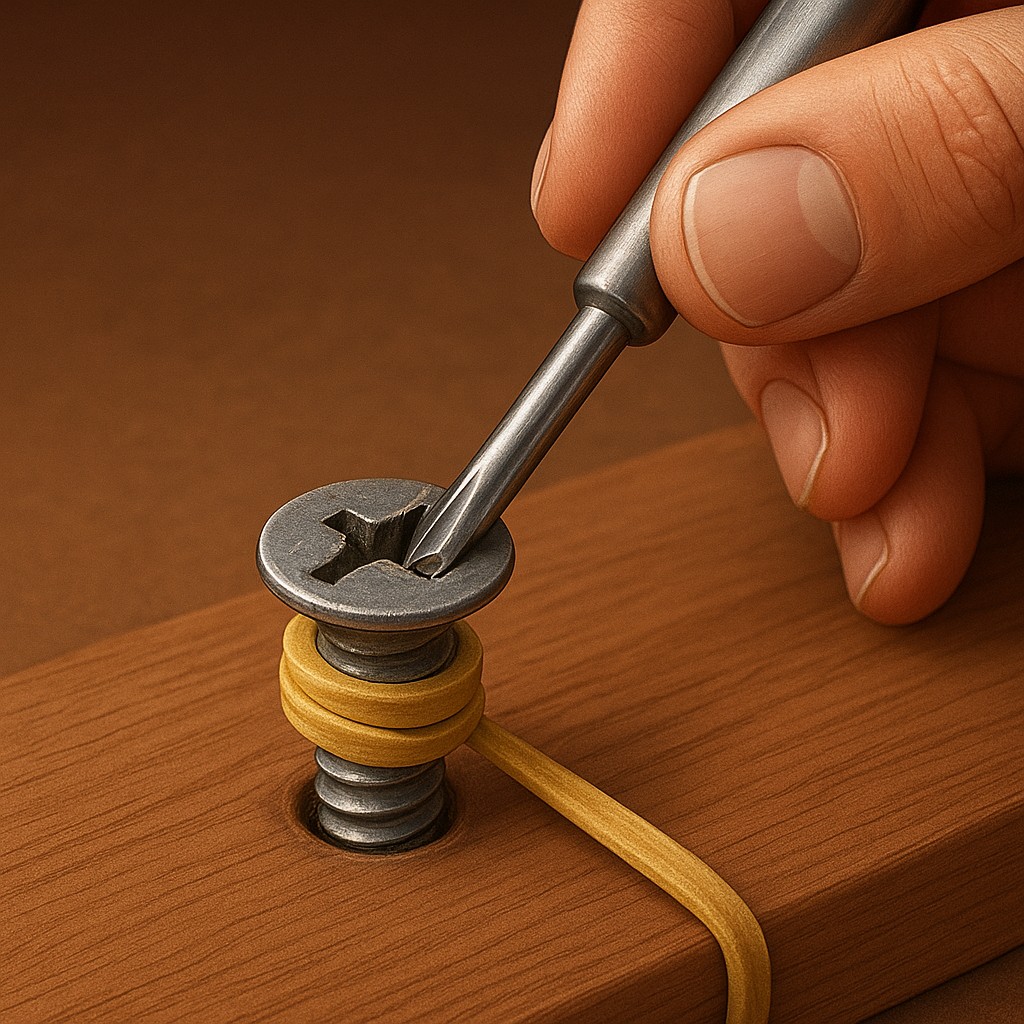
It starts with a sickening, hollow feeling in the palm of your hand. You are halfway through building a bookshelf or fixing a kitchen cabinet when the screwdriver suddenly slips. Instead of that solid metal-on-metal lock, you hear a gritty, grinding sound. You look down and see that the crisp, clean cross-shape of the screw head has been ground into a smooth, shiny crater. You have officially stripped a screw, and in that moment, the laws of physics seem to be working against you. The tool designed to fix things has become a spinning needle of frustration, carving away the last bits of grip.
A stripped screw is a rite of passage for anyone who has ever used a tool, but it is also a fascinating lesson in geometry and friction. Most of us respond to a slipping screw by pushing harder and turning faster, which is exactly what we shouldn't do. This instinct turns a minor setback into a mechanical crisis, as the hardened steel of the screwdriver bit acts like a lathe, milling away the softer metal of the fastener. To solve this, we have to look past the ruined metal and find a way to bridge the gap between two surfaces that no longer fit together.
When Geometry Fails and Friction Flees
To understand why a rubber band is such a brilliant fix, we first have to understand why the connection failed. Screws work through a combination of downward pressure (axial force) and turning force (torque). The screwdriver bit is engineered to fit perfectly into the recesses of the screw head, creating a large area of contact. When you turn the handle, that force is spread across the walls of the screw's drive. However, if the bit is the wrong size or if it starts to tilt, the pressure concentrates on tiny points instead of broad surfaces. This exceeds the "shear strength" of the metal - the point where the material can no longer hold its shape - causing it to deform and flatten out.
Once those sharp internal walls are gone, you are left with a smooth bowl. The screwdriver bit can no longer find "purchase," or a point of leverage, to push against. No matter how much you turn, the tool has nothing to grab. This is where the physics of friction becomes our only hope. Static friction is the force that resists the initial sliding motion between two surfaces. In a brand-new screw, the shape of the metal does the heavy lifting. In a stripped screw, we must manually create a massive increase in friction to make up for the lost shape.
The Elastic Bridge to Mechanical Grip
This is where the humble, wide rubber band acts as a high-performance engineering fix. By placing a flat piece of rubber over the head of the stripped screw and pressing your screwdriver into it, you create a temporary, custom-molded gasket. Rubber is a polymer with high elasticity and an extremely high "coefficient of friction" - a measure of how grippy a material is - compared to polished steel. As you apply downward pressure, the rubber is forced into the irregular nooks and crannies remaining in the damaged screw head.
The rubber acts as a gap-filler. It flows into the hollows where the metal has been carved away, essentially reshaping the screw head in real-time. Because the rubber is thin and flexible, it hugs the screwdriver bit on one side and the jagged remains of the screw on the other. This creates a "sandwich" where the surface area of contact is vastly increased. Instead of the screwdriver touching only three or four tiny points of metal, it is now pushing against a continuous, grippy membrane locked into the entire circumference of the screw’s recess.
Choosing the Right Materials for the Rescue
Not all rubber bands are up to the task. Using a thin hair tie or a brittle, old elastic will likely leave you with snapped rubber and even more frustration. You need a wide, flat rubber band, often called a "file band" or the kind found around broccoli in the grocery store. The width is crucial because it ensures the rubber doesn't slip out from under the tool as you turn it. The thickness provides enough "meat" for the screwdriver to bite into without being so thick that it prevents the tool from reaching deep enough into the hole.
Excellent technique also requires a shift in how you use your body. When driving a normal screw, you might split your energy 50/50 between pushing down and turning. To extract a stripped fastener with a rubber band, you should shift that ratio to about 80% downward pressure and 20% turning force. You want to keep the rubber compressed so it cannot slide. If the rubber starts to bunch up or tear, stop immediately, reposition it, or find a fresh section of the band and try again.
Comparing Common Extraction Methods
While the rubber band trick is a legendary "life hack," it is part of a wider range of solutions used by mechanics and carpenters. Depending on the damage, you might need to try a different tactic. The following table compares the rubber band method with other common DIY techniques.
| Method |
Best For |
Pros |
Cons |
| Rubber Band |
Slightly to moderately stripped screws |
Fast, cheap, no special tools needed |
Won’t work on rusted or "seized" screws |
| Duct Tape |
Shallow screws with wide heads |
High friction, usually on hand |
Can leave sticky residue; tears easily |
| Valve Grinding Compound |
High-precision electronics or small screws |
Very effective at stopping the bit from slipping |
Can be messy; requires buying special paste |
| Screw Extractor (Easy-Out) |
Severely damaged or snapped screws |
Professional-grade solution |
Requires drilling into the screw; permanent |
| Vise-Grip Pliers |
Screws with exposed, protruding heads |
Massive leverage and grip |
Cannot be used on screws that are flush with the surface |
The Role of Heat and Chemistry
Sometimes, friction isn't your only enemy. If a screw is stripped, it might be because the threads are bonded to the material around them. This is common in car repairs, where "galvanic corrosion" - a chemical reaction between different metals - acts like a natural weld. It also happens in old furniture where wood glue has seeped into the threads. In these cases, the rubber band provides the grip, but you might still be fighting a losing battle against the bond. This is why professionals often combine the rubber band trick with "penetrating oil."
Penetrating oils are very thin liquids designed to seep into the microscopic gaps between screw threads. If the rubber band keeps tearing despite your best efforts, the resistance of the threads is higher than the strength of the rubber. Applying a drop of oil and letting it sit for ten minutes can weaken the bond of rust or glue. Once the "breakaway torque" - the force needed to get the screw moving - is lowered, the rubber band can do its job much more easily.
Avoiding the Pitfalls of Success
When the rubber band finally works, you will feel a distinct "pop" or a sudden release of tension as the screw begins to turn. It is a moment of immense satisfaction. However, a common mistake is to speed up once the screw is moving. You must maintain heavy downward pressure until the screw is at least halfway out. A stripped screw is structurally weak, and backing it out can still cause the head to crumble. If you move too fast, the friction from the spinning screwdriver can heat the rubber band, causing it to melt or snap.
It is also vital to remember that a screw removed this way is a "dead soldier." Never try to reuse a stripped screw. Once the shape of the drive is gone, it will be ten times harder to drive it back in, and even harder to get it out a second time. Toss the damaged fastener into the scrap bin immediately and replace it with a high-quality screw. If possible, use one made of hardened steel or one with a "Torx" (star) drive, which is much harder to strip than a standard Phillips head.
Mastering the Art of Mechanical Patience
The rubber band method is more than just a clever trick; it is an invitation to slow down and think like an engineer. Most mechanical failures happen when we apply too much impatient energy to a poor fit. By stepping back and using an interface material like rubber, you are adapting to the reality of the situation. This mindset - the ability to switch from brute force to creative friction - is what separates a frustrated amateur from a master fixer.
Next time you hear that dreaded "zrrrrt" of a screwdriver slipping, don't clench your teeth and force it. Reach for your toolbox, find that thick rubber band from the grocery store, and remember that you can outsmart physics with a bit of elastic. There is a profound sense of confidence that comes from knowing how to reverse a mistake. When you successfully remove a ruined screw using nothing but a bit of rubber and steady pressure, you haven't just finished a project; you've proven that with the right perspective, even a ruined screw can be conquered.