Think of your local power grid as a network of water pipes. For over a century, these pipes have only flowed one way: a massive reservoir (the power plant) pushes water down a large main, which branches into smaller pipes until it reaches your kitchen sink. The system is simple, reliable, and completely passive. If you suddenly tried to pump water out of your house and back into the street, the system would likely shudder, valves would bang, and the water pressure in your neighbor’s bathroom would go hay-wire. The grid was never built for a world where every house is its own little reservoir. This is exactly why neighborhood green energy goals are currently hitting a massive wall.
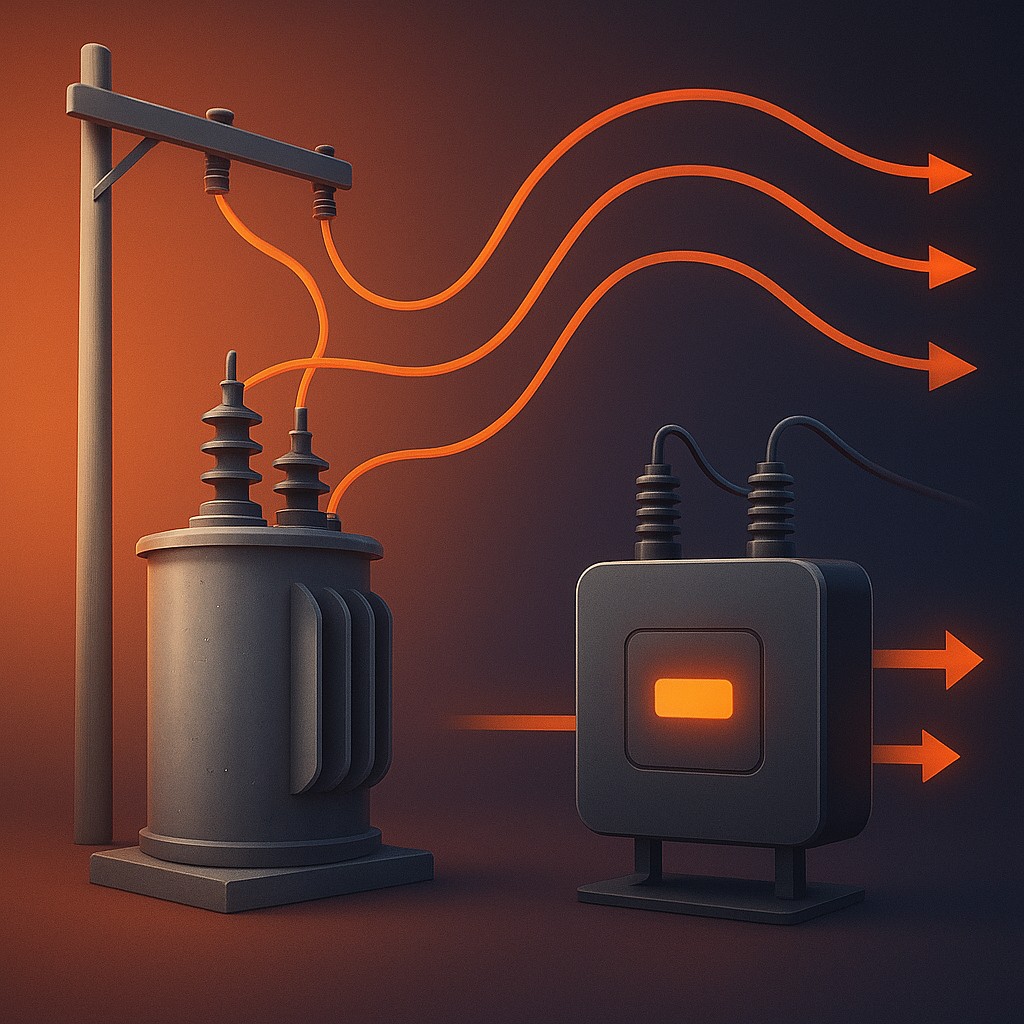
This obstacle comes in the form of the traditional transformer - those heavy, gray, oil-filled drums perched on utility poles or sitting in green metal boxes on the sidewalk. These machines are masterpieces of 19th-century engineering. They use simple coils of wire and iron cores to "step down" high voltages to levels your toaster can handle. They are incredibly good at one thing: letting electricity flow downhill. However, as thousands of homeowners install solar panels and plug in high-demand electric vehicles, that "downhill" flow is turning into a chaotic, multi-directional swirl. To keep the lights from flickering and the wires from melting, engineers are replacing these old iron boxes with "Solid-State Transformers" (SSTs). Essentially, they are turning the "dumb" pipes of the past into the high-speed internet routers of the future.
The Limits of Iron and Oil
To understand why we need a digital upgrade, we have to look at the beautiful simplicity of the classic transformer. At its heart, a traditional transformer is just two coils of wire wrapped around a heavy iron frame. When electricity flows through the first coil, it creates a magnetic field. This field then "induces," or creates, a current in the second coil. By changing the number of loops in each coil, you can raise or lower the voltage with almost no moving parts and very little energy loss. They are the marathon runners of the engineering world, often sitting out in the rain, snow, and summer heat for fifty years without needing a single software update or a repair visit.
However, this simplicity is also their greatest weakness today. A traditional transformer is "passive," meaning it just reacts to whatever is happening on the line. It cannot think, it cannot throttle energy, and it certainly cannot communicate with a solar power system. When a cloud passes over a neighborhood and five hundred solar arrays suddenly stop producing power, the voltage on the grid drops instantly. The traditional transformer just sits there, unable to make up for the dip. On the flip side, when the sun comes out and everyone's panels pump excess power back into the grid at once, the voltage can spike and potentially damage your appliances. The old iron boxes are simply too slow and "dumb" to manage the split-second fluctuations of a renewable-energy world.
Silicon Takes Control
Enter the Solid-State Transformer, or SST. If the old transformer is a simple mechanical valve, the SST is a high-end computer that happens to move massive amounts of electricity. Instead of relying purely on heavy iron and copper to change voltage, an SST uses power electronics - specifically high-speed semiconductors made of materials like silicon carbide or gallium nitride. These are the same materials found in your laptop or phone, but beefed up to handle thousands of volts. Instead of a steady, unmanaged flow, the SST "chops" the incoming electricity into tiny segments thousands of times per second. By moving these segments around, the SST can perfectly rebuild any voltage or frequency it needs on the other side.
This "switching" ability transforms the device from a passive part into an active manager. Because it is digital, it can sense a voltage drop the moment it starts and instantly boost the output to keep your lights steady. It acts as a firewall between your house and the rest of the grid. If your neighbor’s faulty car charger starts sending "dirty" electrical noise back into the wires, the SST identifies that noise and wipes it out before it ever reaches your sensitive home computer. This level of precise control is why we call the SST a "power router." Just as an internet router takes packets of data and sends them to the right address, an SST takes packets of energy and directs them exactly where they are needed most, all while keeping the "pressure" of the grid perfectly balanced.
| Feature |
Traditional Transformer |
Solid-State Transformer (SST) |
| Core Components |
Copper coils and heavy iron |
Semiconductors and high-frequency magnets |
| Weight and Size |
Extremely heavy and bulky |
Significantly smaller and lighter |
| Response Time |
Passive / Slow |
Real-time / Millisecond response |
| Power Flow |
Primarily one-way |
Fully two-way (Perfect for solar) |
| Grid Intelligence |
None (Mechanical) |
High (Programmable and connected) |
| Cooling Method |
Mineral oil (often flammable) |
Air or liquid cooling (Sensing required) |
The Two-Way Dance of Clean Energy
The real magic of the SST happens with "bidirectional," or two-way, flow. In a traditional grid, electricity is a one-way street: the utility company sends power to you, and you pay for what you use. But in a neighborhood full of solar panels and "Vehicle-to-Grid" (V2G) technology - where cars can send power back to the house - the street becomes a two-way highway. On a sunny afternoon, your roof might produce three times more power than your house needs. That extra energy has to go somewhere. In an old-fashioned system, this back-flow can cause safety issues or power surges that force the utility company to shut down sections of the grid for safety.
The SST handles this transition easily. Because it uses a "DC Link" - a stage in the middle of its process where it turns AC power into DC and back again - it can separate the house from the grid. It can take the extra DC power from your solar panels, convert it to the exact AC frequency needed for the street, and push it out without disturbing the neighbors. Furthermore, it can manage different types of energy sources at once. An SST can have one port for the high-voltage grid, one for your home's outlets, one for a fast charger in your garage, and even one for a backup battery. It serves as a universal translator for energy, allowing different systems to talk to each other without needing special adapters.
Solving the Heat and Reliability Puzzle
If Solid-State Transformers are so much smarter, why aren't they everywhere already? Like many high-tech leaps, the move from iron to silicon comes with trade-offs, mostly regardingheat and long-term reliability. Traditional transformers are nearly indestructible because they are fundamentally just chunks of metal sitting in a giant tank of oil. The oil acts as both an insulator and a coolant, carrying heat away from the core. They can survive lightning strikes, extreme heat waves, and decades of neglect because there isn't much inside that can "break" in a digital sense.
SSTs, however, are packed with sensitive micro-electronics. Semiconductors are notoriously picky about temperature. If they get too hot, they lose efficiency; if they get even hotter, they can fry instantly. This is the great engineering challenge today: how do you build a high-power computer that can survive a 110-degree summer day in Phoenix while sitting in a small box on a pole? Engineers are working on advanced cooling systems, like tiny liquid channels or specialized heat sinks, but these add cost and complexity. Additionally, while an iron transformer lasts 50 years, we don't yet know if a complex circuit board will last more than 15. For a utility company, reliability is the only thing that truly matters, so the SST has to prove it can be as rugged as its low-tech ancestors.
Designing the Internet of Electricity
This transition is often called the "Digitalization of the Grid." It represents one of the most significant shifts in infrastructure since the days of Edison and Tesla. By installing SSTs throughout the network, we are building a nervous system for our energy supply. This allows for "microgrids" - sections of a neighborhood that can disconnect from the main power plant during an emergency and run entirely on their own local solar and battery power. An SST makes this possible by maintaining the delicate balance of frequency and voltage that usually requires massive spinning turbines at a power plant to achieve.
As we look toward a future where our cars serve as backup batteries and our windows are made of solar glass, the role of the "passive" grid will continue to shrink. We are moving away from a model of central control toward a model of local cooperation. The Solid-State Transformer is the mediator of that cooperation. It ensures that when you and everyone else on your block plug in your cars at 6:00 PM, the grid doesn't collapse. Instead, it intelligently negotiates who gets power now and who gets it in an hour, all while keeping the voltage steady for your neighbor’s refrigerator.
This technological leap is a reminder that the biggest changes often happen in the background, inside the gray boxes we walk past every day. The next time you see a utility crew working on a local transformer, you might be looking at the moment your neighborhood stops being just a consumer of energy and starts being a tiny, pulsating heart of a global, digital energy network. We are building a world where energy flow is as flexible as data flow, making the transition to a sustainable future a reality of "smart" distribution. This is the hidden architecture of the energy revolution, where iron and oil are finally giving way to the precision of the silicon age.