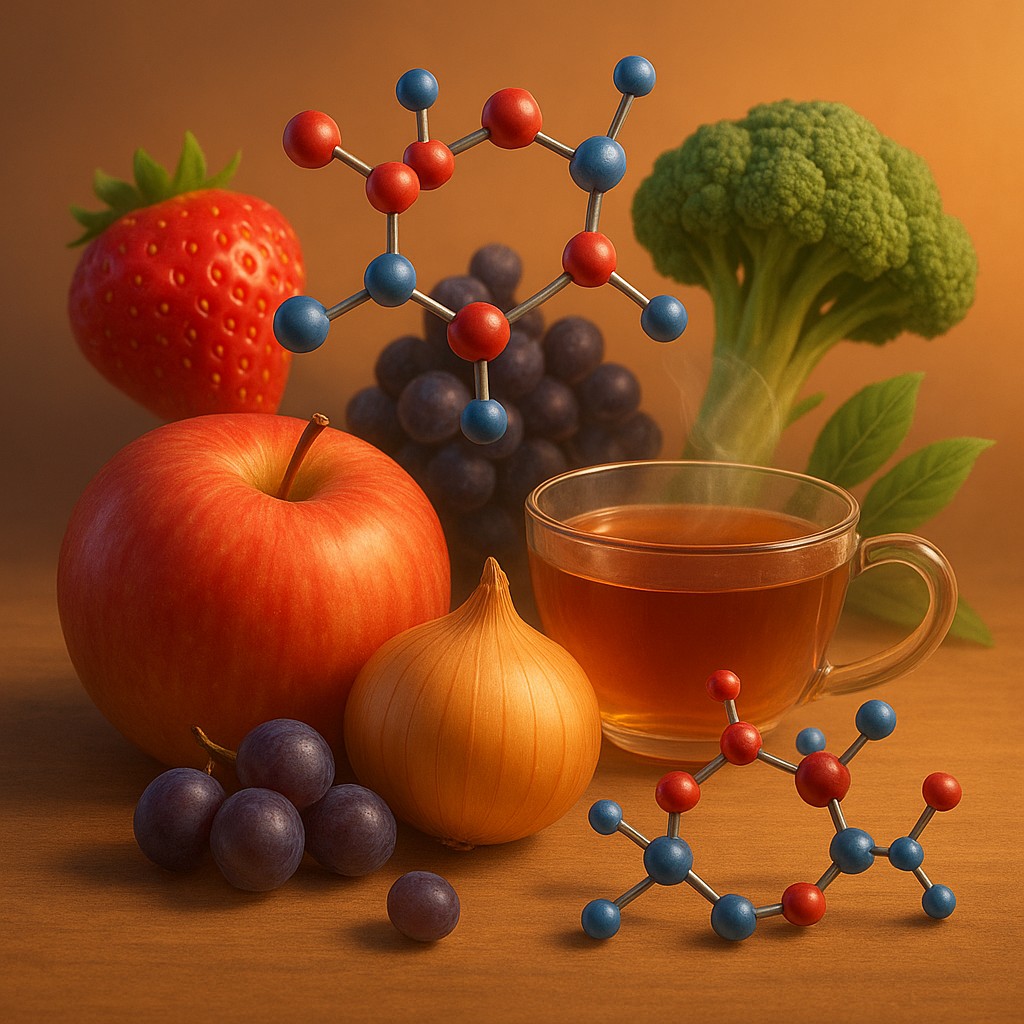
Have you ever considered that your dinner plate is actually a high-tech pharmacy, just much tastier than a bottle of pills? Every time you bite into a crisp apple, enjoy a square of dark chocolate, or sip a cup of green tea, you are welcoming invisible but incredibly active guests to your table. These guests belong to a massive family of plant chemicals called polyphenols, specifically a fascinating group known as flavonols. Far from being simple extras, these molecules act as a plant's natural bodyguards, helping them survive harsh UV rays and ward off hungry insects.
What is truly remarkable is that when we eat these plants, those same protective molecules don't just vanish in our stomachs. They begin a complex journey through the body, interacting with our cells to influence our health in subtle but deep ways. Understanding flavonols is like learning to read nature's secret code; it completely changes how we look at food. We no longer eat just to feel full, but to give our bodies the tools they need to stay healthy and live longer. Let's dive into this microscopic world to see how these quiet pigments shape our daily well-being.
The invisible signature of colorful plants
To get a grip on what flavonols are, you first have to see where they sit in the plant family tree. Flavonols are a branch of the flavonoid family, which are themselves a type of polyphenol. If that sounds like a set of nesting dolls, it’s because nature loves hierarchy. Flavonols stand out from their cousins (like the anthocyanins that turn berries blue) because of their specific chemical structure, which includes a "hydroxyl" group, a oxygen and hydrogen pairing, attached to a precise spot on their carbon frame. This architectural quirk allows them to act as powerful antioxidants, capable of neutralizing free radicals, those unstable molecules that try to damage our cells.
In the plant world, flavonols are found mostly in the outer layers, like fruit skins and leaves. This is a brilliant survival move: since flavonols absorb ultraviolet light, they act as an internal sunscreen for the plant. That is why the concentration of flavonols in an apple is much higher in the peel than in the flesh. Once you realize this, it becomes clear that peeling fruit is a small nutritional tragedy. The pale yellow or transparent color of flavonols is easy to miss, but their role is vital for a plant's ability to handle environmental stress.
What makes flavonols unique compared to common antioxidants like Vitamin C is their ability to influence how cells communicate. They don't just clean up waste; they whisper instructions to our genes. They can help manage inflammation, improve blood flow, and even protect our brain cells against age-related decline. When you consume quercetin or kaempferol, the two most common flavonols, you aren't just providing fuel; you are sending protective signals to your entire system.
Farmers' market champions and their molecular benefits
While flavonols are found in a huge variety of plants, some foods act as massive storage tanks for these compounds. Variety is the secret here, as every plant offers a slightly different cocktail of flavonols. The undisputed star is often the onion, especially red or yellow varieties, which are packed with quercetin. Tea, whether green or black, is another major source, offering a steady dose to those who make it a daily ritual. We also shouldn't forget leafy greens like kale or broccoli, which hide an impressive amount of kaempferol beneath their green chlorophyll.
Interestingly, flavonol levels can change based on how a plant is grown. Studies suggest that plants grown under slightly "stressful" conditions, such as organic farming without synthetic pesticides, often produce more flavonols to defend themselves. It is a biological paradox: the more a plant has to fight for its survival, the richer it becomes in nutrients that benefit us. Here is a quick look at some top sources and their specific roles to help you plan your next grocery trip.
| Food Source |
Main Type of Flavonol |
Primary Suggested Benefit |
| Red onions |
Quercetin |
Immune support and anti-inflammatory |
| Kale |
Kaempferol |
Heart protection and antioxidant |
| Capers |
Quercetin and Isorhamnetin |
Record-high concentration per gram |
| Green tea |
Myricetin and Quercetin |
Metabolic health and alertness |
| Apples (with skin) |
Quercetin |
Lung and heart health |
| Dark chocolate |
Fisetin and others |
Protection of brain function |
The way you prepare these foods matters immensely. Because flavonols are concentrated in the outer layers, over-processing can ruin them. For example, boiling vegetables in a lot of water can cause the flavonols to leak out into the cooking liquid. Steaming or eating them raw whenever possible helps keep these precious molecules intact. Additionally, eating them with a little bit of healthy fat (like olive oil) can sometimes help the body absorb them, though the science on exactly how much the body can take in is still an active area of research.
The secret dialogue between flavonols and human health
Why is the scientific world so excited about flavonols? The answer lies in "vascular health." Our blood vessels aren't just passive pipes; they are dynamic organs. Their inner lining, called the endothelium, must stay flexible and responsive. Flavonols help stimulate the production of nitric oxide, a molecule that tells blood vessels to relax and widen. By helping this process along, flavonols help maintain healthy blood pressure and reduce the workload on the heart. It is a form of silent but vital preventive maintenance.
Beyond the heart, the brain seems to be one of the biggest winners. Recent research has highlighted a link between high flavonol intake and a slower decline in memory and thinking as we age. It appears these molecules can cross the blood-brain barrier, the selective filter that protects our brain, to fight brain inflammation and support healthy cell connections. In other words, eating flavonol-rich foods might help your neurons communicate better, preserving your memory and mental sharpness over the long term.
Flavonols also play a key role in balancing the immune system. They don't just "boost" immunity, a term that is often overused, but rather help regulate it. For instance, during allergy season, quercetin is known to stabilize mast cells, the cells that release the histamine responsible for sneezing and itchy eyes. This ability to work on several fronts at once, without the side effects often found in synthetic drugs, makes flavonols invaluable for a well-rounded approach to health.
Clearing up myths and doubts about supplements
In our quest for a quick health fix, it is tempting to think that if a few flavonols in an apple are good, then a mega-dose in a capsule must be better. This is where we need to be careful. Nature rarely gives us nutrients in isolation. In a plant, flavonols come with fiber, vitamins, minerals, and other polyphenols that all work together. So far, science consistently shows that the benefits seen in people who eat lots of flavonol-rich foods aren't always found in those who take isolated supplements.
Another common myth is the idea of the "miracle food." We often hear that a certain exotic fruit is the ultimate source of health. In reality, a steady and diverse mix of common sources (tea, onions, broccoli, apples) is what actually makes the difference. The body isn't designed to handle a massive spike of flavonols once a month; it prefers a constant flow every day. Furthermore, taking too many supplements can sometimes interfere with medications like blood thinners, which is why it is usually better to focus on your plate rather than a pill bottle.
Finally, we should clarify "bioavailability," or how much the body actually uses. Critics sometimes say that because only a small fraction of the flavonols we eat ends up in our bloodstream, they are useless. This ignores the fact that even the parts we don't absorb play a vital role: they interact with our gut microbiome. The good bacteria in our colon feast on these compounds, breaking them down into simpler pieces that the body can then use, or that help improve digestive health locally. We are feeding our bacteria as much as we are feeding ourselves.
Toward a lifestyle of longevity
Eating a diet rich in flavonols doesn't require a radical overhaul or a boring menu. Instead, it’s an invitation to explore a world of plant flavors and add color back to your meals. Try adding a handful of capers to your pasta, leave the skin on your organic apples, or choose 85% dark chocolate instead of a sugary version. Every small choice adds up over the years to build a strong biological shield against the stresses of time and the environment.
The beauty of flavonols is that they are simple and easy to find. They aren't just for the wealthy or people with access to specialty health stores. They are right there in the onion you chop for soup or the tea you share with a friend. When you understand what these molecules do, you stop seeing nature as just a background and start seeing it as a source of biological intelligence. It is ancient wisdom backed by modern science.
So, next time you walk past the produce stand, look at those bright colors as more than just decoration; see them as signals for health. Flavonols are your silent allies, working tirelessly inside your cells to keep your health in balance. By inviting them to your table more often, you are doing more than just eating; you are celebrating life in its most sophisticated and protective form. Enjoy the discovery, because by savoring the richness of plants, you are building a more vibrant and resilient future, one bite at a time.