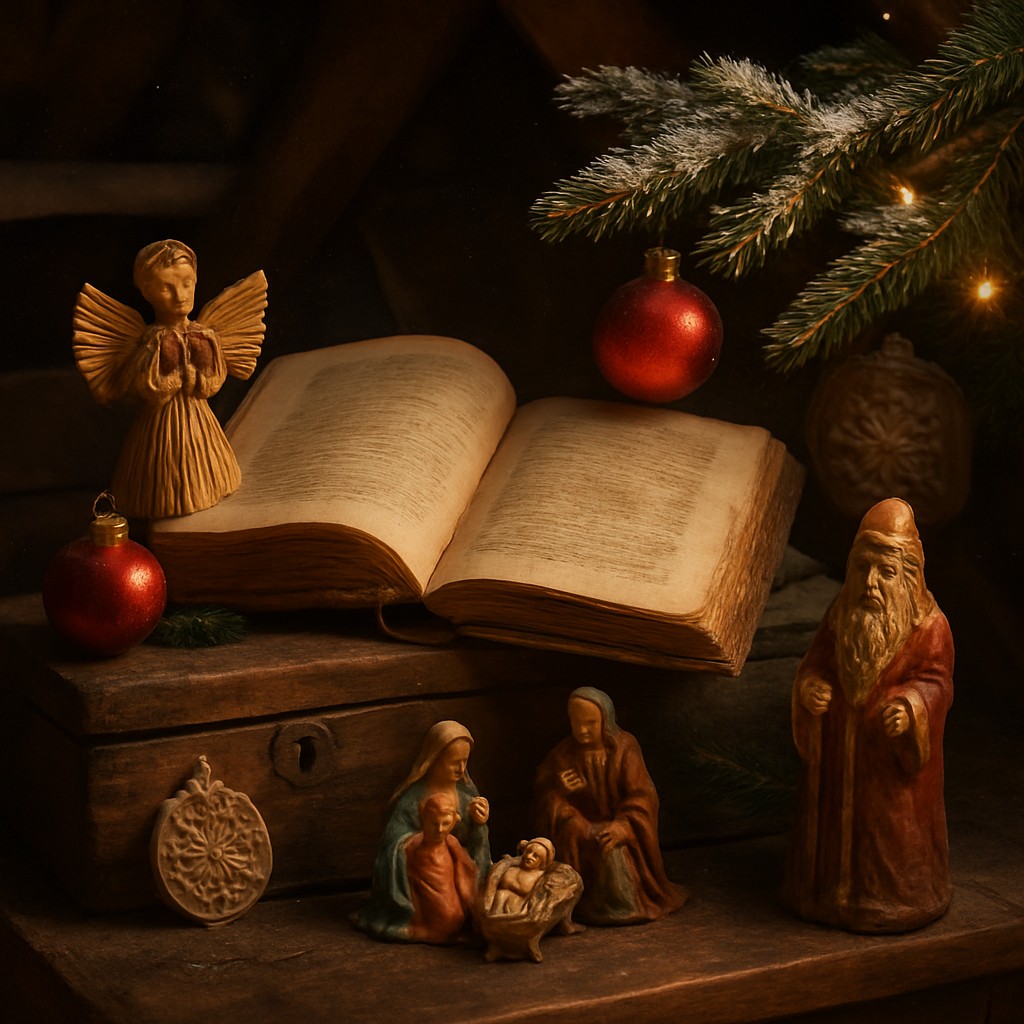
Why the origins of Christmas still fascinate us
There is something irresistible about unpacking Christmas, like opening an old attic and finding objects from many different eras stacked together. Tracing where Christmas comes from means understanding not just a religious holiday, but a cultural palimpsest - a mixture of rites, stories, objects and feelings that have traveled and shifted meaning over centuries. It helps us see how societies invent shared meaning and give warmth to their winters.
Knowing the history of Christmas does not kill the magic, quite the opposite - it deepens it. When you learn that the nativity scene comes from an Italian monk, that some customs come from Roman festivals, and that Santa Claus is the product of European figures mixed with American commercial design, you can celebrate with fuller awareness. Curiosity turns habit into a conscious choice.
This text will take you step by step, from the pagan roots to modern forms of Christmas, with stories, analogies and questions to ponder. You will come away with clear landmarks, practical ideas for celebrating with meaning, and the tools to distinguish facts, hypotheses and myths.
Ancient roots: solstices, Saturnalia and fire festivals
Long before it was linked to the birth of a historical figure, the time around the winter solstice was already a pivotal moment across many cultures. The solstice is the shortest day of the year in the northern hemisphere, a turning point after which the days lengthen. That inspired rituals of light, bonfires, processions and feasts meant to reassure communities against the darkness and to welcome the sun's return.
Among Roman examples, Saturnalia stands out. Celebrated in December, it included role reversals - slaves and masters sometimes swapping roles for a day - feasting, gift-giving and decorations. Similarly, Germanic and Norse peoples observed Yule, a string of winter celebrations featuring bonfires, drinking while telling fortunes, and decorating houses with holly and fir to invite prosperity.
These practices do not form a single, uniform "pagan cult," but rather a set of human responses to astronomical and social realities. They also show that the mix of elements - fire, music, shared food - creates an atmosphere that helps maintain social bonds. It is this atmosphere that Christian and modern traditions sometimes preserved, transformed, or reinterpreted.
When Christianity adopted a date: strategy, calculation and context
The Gospels do not give a date for Jesus' birth. The fixing of December 25 as the Nativity is the result of a complex process, partly theological and partly practical. By the fourth century, the Christian Roman Empire began to build increasingly complete liturgical calendars, and December 25 appears in Christian texts at least as early as the year 336.
Several theories try to explain this choice. The most widely held idea sees a convergence of factors: on one hand, a desire to provide a Christian feast at the same time as pagan celebrations, to ease the population's transition; on the other hand, a theological calculation that matched the Annunciation date (nine months before the Nativity) with a symbolic date of creation. Whatever the exact reason, the establishment of December 25 is a historical decision that links the religious calendar with the civic one.
It is important to note that fixing a date is an act of cultural power. By choosing a day, religious and political authorities normalize a practice, facilitate pilgrimages and liturgies, and give the community a shared rhythm. That centralization helped Christmas spread and evolve while preserving certain continuities.
Saint Nicholas, the Christmas tree and Santa Claus - an evolution in several acts
The figure of Saint Nicholas, a fourth-century bishop in what is now Turkey, gave rise to a cascade of images and traditions. Known for his generosity to the poor and to children, Saint Nicholas became a popular saint across medieval Europe. His stories, often miraculous, were adapted locally and enriched with folk elements.
The Christmas tree, for its part, comes from Germanic and Alsatian customs of decorating trees in winter to symbolize life and renewal. The indoor decorated tree spread through central Europe in the Middle Ages and became fashionable in England and France in the 19th century, partly thanks to German influences and to the circulation of royal images showing decorated trees.
The modern Santa Claus is the result of a fusion: Saint Nicholas, Nordic folklore figures, the Dutch images of Sinterklaas, and above all 19th and 20th century American popular culture. The iconography - a bearded man in red, a sleigh - was largely standardized by poems and illustrations in the 19th century, and later by 20th century advertising campaigns.
Comparative table: roots, rituals and meanings across time
| Element |
Main origins |
Social function |
Evolution to today |
| Date - December 25 |
Christian fixation in the 4th century, overlap with pagan festivals |
Make a common feast visible, structure the liturgical year |
Dominant date in the West, other dates in the East (January 7) |
| Christmas tree |
Germanic traditions about trees of life |
Symbol of life, domestic decoration |
Central decorative object, commercialized and stylized |
| Saint Nicholas / Santa Claus |
Charitable bishop + European folklore |
Model of charity and a comforting figure for children |
Cultural and commercial figure, symbol of generosity |
| Gifts |
Exchanges during Saturnalia, religious offerings |
Strengthen social and economic ties |
Increased consumption, gift culture, sometimes criticized |
| Nativity scene |
Saint Francis of Assisi, 14th century |
Visualize the biblical scene, pedagogical tool |
Liturgical and decorative tradition, adapted locally |
Nativity scenes, liturgy and art: how Christmas has been told visually
Staging the Nativity is one of the main ways Christmas has been transmitted and interpreted. The first living nativity is attributed to Francis of Assisi in the 13th century, who wanted to make the story of Jesus' birth tangible. Nativity scenes, paintings and stained glass served to instruct often illiterate populations, turning the narrative into powerful, memorable images.
Over the centuries, sacred art adapted the Nativity to local contexts: magi wearing medieval eastern garments, shepherdesses with the faces of local peasants, familiar animals included in the scene. This flexibility allowed communities to see themselves in the story. Hymns, Christmas carols and plays also played a fundamental role in fixing narratives and emotions.
The liturgy itself evolved. Midnight office, solemn masses, carols and processions structure the feast for believers. But there is a constant tension between the religious dimension - celebrating a mystery - and the social dimension - a family and festive gathering.
Christmas between bans and revival: surprising episodes from history
The history of Christmas has not been a smooth river. At various times and places, the holiday has been contested, banned or transformed. For example, during the English Reformation and the Puritan era, some authorities saw the festival's excesses as pagan remnants and anti-biblical, and they tried to restrict or ban celebrations. In 17th century America, Puritan colonies sometimes punished those who publicly celebrated Christmas.
By contrast, the 19th century experienced a remarkable revival and reconfiguration of Christmas. Writers, poets and illustrators made the holiday domestic and sentimental, emphasizing hearth and childhood. Victorian stories, notably those of Charles Dickens, helped imagine a warm, generous and solidaristic Christmas - an image that endures today.
These swings show that Christmas is a space for cultural negotiation: it can be a moment of social critique, a religious instrument, or a commercial stage depending on the forces at play.
Misconceptions and corrections: untangling myths from reality
There are many myths about the origins of Christmas. One common misconception is that "Christmas comes from a single pagan festival that was simply replaced." That is too simplistic. Christmas is instead the product of a confluence of influences: calendars, liturgical needs, local customs and social strategies. Another common belief is that "December 25 is the historical birthday of Jesus." Historians generally agree that this is highly unlikely, the date having been chosen for liturgical and symbolic reasons.
There is also the idea that Santa Claus is an entirely modern invention. In reality, the modern character is an assemblage - Saint Nicholas, European folklore, literary images and marketing - whose contemporary expression is indeed heavily shaped by mass culture. Finally, saying that Christmas has been "stolen" by commerce is an exaggeration: commerce amplified certain aspects, but it also spread and standardized symbols that strengthen the holiday for many people.
Correcting these misconceptions does not take away the pleasure of the season, it helps you celebrate with more intention.
How traditions spread: an anthropological and scientific view
The spread of traditions follows principles studied by the social sciences: imitation, prestige, usefulness and material constraints. A custom often spreads because it performs a function - reinforcing family ties, structuring social life - or because it is adopted by influential groups whose example is imitated.
Technology also plays a role: the printing press, illustrated newspapers, then photography and advertising made standard images of Christmas possible. Migration carried local practices from one continent to another, where they sometimes hybridized with local traditions. The basic rule is simple: a tradition survives if it finds a use, a meaning and the material means to be repeated.
This perspective explains why some local practices persist despite globalization - they meet specific community needs - while others spread quickly worldwide when supported by institutions, media and economic networks.
Practical ways to celebrate Christmas with meaning and intention
Wanting to "do Christmas differently" starts by deciding what you want to preserve or change - spirituality, togetherness, sharing, simplicity. Here are some practical steps, easy to try this year, to bring more meaning to your celebration.
- Make a list of values - Take half an hour and write three values you want at the heart of your Christmas: generosity, rest, presence, simplicity, etc. Use these values as a filter for material and ritual choices.
- Reduce, reuse, recreate - Before buying, see what you can reuse: family decorations, books to swap, handmade gifts. Organize a local gift exchange to reduce stress and value connections.
- Give differently - Instead of multiplying things, consider a donation in kind to a charity, offering time - a prepared meal, a visit - or sponsoring a solidarity project.
- Create simple rituals - A shared reading, a song sung together, lighting a candle for those who are absent, a nighttime walk to admire lights, often mean more than commercial pressure.
- Document and pass on - Take a few photos and notes about family traditions, recipes and anecdotes. That helps transmission and family memory.
These actions do not require a revolution, just intention. Tradition becomes meaningful when it is carried by the purpose given to it by its practitioners.
Questions to reflect on and discuss with family
Before closing, here are some questions to prompt personal and collective reflection. Take them as conversation starters, not faith tests.
- Which Christmas traditions come from your childhood, and why are they important to you?
- Which elements of Christmas feel out of step with your current values, and what could you change?
- Does knowing the history of Christmas change how you celebrate it, or not?
- How would you like Christmas to be in ten years for you and your community?
Taking the time to answer, aloud or in writing, can turn habits into conscious choices.
A closing note, rigorous but not theoretical
The origin of Christmas is a layered story, a historical patchwork where each era added its stone. Understanding that patchwork helps us avoid simplified images and become authors of our own practices. That does not take away decorations, carols and feasts - it gives us tools to choose what we keep, change or invent.
If you take away one thing, let it be this: Christmas is less a single "fixed date" than the sum of human customs around the solstice, memory and the desire for connection. The power of the holiday is that it constantly reinvents itself, when people consciously decide to celebrate.
Go ahead, reinvent your Christmas with intention. Start with a small action - a thoughtful gift, a shared song, a light for someone who is absent - and notice how it changes the atmosphere. More than ever, the celebrations we choose to build reveal who we are, and who we want to be together.