Imagine for a moment that you are standing at the edge of a vast, majestic canyon. You let out a loud shout, and a few seconds later, your own voice rushes back to you, bouncing off the rocky walls. Without realizing it, you’ve just experienced the core principle that keeps airplanes from colliding in the sky, helps meteorologists predict the storm that might ruin your picnic, and, unfortunately for some, allows the police to check if you’re speeding. At its heart, radar is a high-performance electronic ear that interprets the echoes of invisible light.
In our modern world, we are surrounded by waves that travel through walls, air, and even our own bodies. Radar, which stands for Radio Detection and Ranging, is the art of turning these waves into long-distance night vision. While our eyes need sunlight or streetlamps to see objects, radar carries its own flashlight. It beams out a flash of energy and waits patiently to see what bounces back. This independence makes it an essential tool, capable of piercing through the thickest fog or the densest clouds.
The Secret to Seeing the Invisible
To understand how a machine can "see" a Boeing 747 from hundreds of miles away, we first have to look at what it’s actually sending out. Radar uses radio waves, which are cousins of visible light but with much longer wavelengths. These waves travel at the speed of light, roughly 186,000 miles (300,000 kilometers) per second. That speed is so staggering that a wave could circle the Earth seven times in a single second. The challenge for a radar system is to time a round trip that happens in a tiny fraction of a millisecond.
The core of the system consists of a transmitter and an antenna. The transmitter creates a brief pulse of electromagnetic energy, a radio "ping," which the antenna aims in a specific direction. Once the signal is sent, the transmitter shuts off, and the radar switches to listening mode. If the wave hits an obstacle, such as the metal body of an airplane, a tiny portion of that energy bounces back toward the source. The radar receiver is incredibly sensitive, catching this weak echo and processing it to pull out vital information.
Distance is calculated with elegant mathematical simplicity. Since we know the speed of the wave is constant and we can measure the time between sending and receiving it, we simply divide the result by two to find the object's exact distance. If the signal takes 10 microseconds to return, the computer instantly knows precisely where the obstacle is. This surgical precision allows air traffic controllers to keep safe distances between planes, even when visibility is zero.
The Doppler Effect: The Magic of Shifting Pitch
Have you ever noticed how an ambulance siren sounds higher as it speeds toward you and then drops to a lower tone as it passes by? This physical phenomenon is called the Doppler effect, and it is a modern radar’s secret weapon for measuring speed. When a radio wave hits a moving object, the frequency of the bouncing wave changes slightly. If the object is coming toward the radar, the waves are "squashed" together and the frequency goes up. If it is moving away, the waves are "stretched" and the frequency goes down.
This is exactly how a police radar gun hidden behind a bush works. It doesn’t just track where you are; it analyzes the frequency shift in the echo coming off your car. By measuring the difference between the outgoing and incoming frequencies, the computer can calculate your speed to the nearest mile per hour. This same principle is used in spectacular ways in weather forecasting. Doppler weather radars track the movement of raindrops or snowflakes inside clouds. By analyzing the speed of these particles, scientists can detect rotating winds and predict a tornado before it even touches the ground.
Fascinatingly, this technology isn't limited to spotting big objects. Modern radars have become so advanced that they can tell the difference between a bird and a drone, or a truck and a motorcycle. This depends on analyzing the "radar cross-section," which measures how well an object reflects waves. A "stealth" fighter jet, for example, is built with sharp angles and special absorbent materials so that radar waves are deflected away or "soaked up" by the hull instead of returning to the sender. This makes the jet look as small as a sparrow on an operator's screen.
Anatomy of a Detection System
For a radar to work well, it must coordinate several complex parts in perfect harmony. Each part plays a specific role, whether the mission is guiding a ship through a crowded harbor or tracking satellites in orbit. The table below summarizes the key components and what they do.
| Component |
Main Function |
Simple Description |
| Transmitter |
Create the signal |
The engine that generates powerful pulses of radio waves. |
| Antenna |
Aim and catch |
The searchlight that beams the wave and the ear that listens for the echo. |
| Duplexer |
Switch usage |
A lightning-fast switch that lets the antenna send AND receive without frying the circuits. |
| Receiver |
Amplify the echo |
A sensitive detector that picks up very weak bouncing signals. |
| Processor |
Analyze data |
The brain that turns time and frequency into distance and speed. |
| Display |
Visualize the image |
The screen (often circular) where glowing dots represent detected objects. |
The duplexer is arguably the most underrated part of this list. Imagine trying to whisper so you can hear an echo while someone sets off a firecracker right next to your ear. Without the duplexer, the massive energy from the transmitter would instantly destroy the ultra-sensitive receiver. It blocks the path to the receiver while the signal is being sent, then flips in a split second to open the path as soon as the pulse is gone. This engineering feat allows a single device to perform two conflicting tasks almost at the same time.
Radar’s Many Faces in Daily Life
We often imagine radar as a large, spinning antenna on top of a control tower, but the technology has shrunk so much it can fit in the palm of your hand. Most late-model cars are equipped with several small radars hidden behind the bumpers. These short-range systems watch your blind spots or trigger emergency braking if the car in front of you slams on its brakes. They work at very high frequencies, allowing them to detect nearby objects with a precision of just a few inches.
In space exploration, radar is our best mapmaker. Because Venus is perpetually covered in thick clouds, no optical telescope can see its surface. Instead, we sent probes equipped with Synthetic Aperture Radar (SAR). By using the probe’s own movement to simulate a giant antenna, these radars pierced the cloud layer and mapped the planet’s mountains and valleys in stunning detail. It is proof that where light fails, radio waves triumph.
There are also specialized radars for seeing underground. Ground-penetrating radar (GPR) sends pulses into the earth to find pipes, cavities, or even ancient graves. By analyzing how waves bounce off different layers of soil, rock, or metal, archaeologists can "see" what is buried without ever picking up a shovel. It is a peaceful and fascinating application that turns radar into a sort of X-ray machine for the planet.
Correcting Common Myths
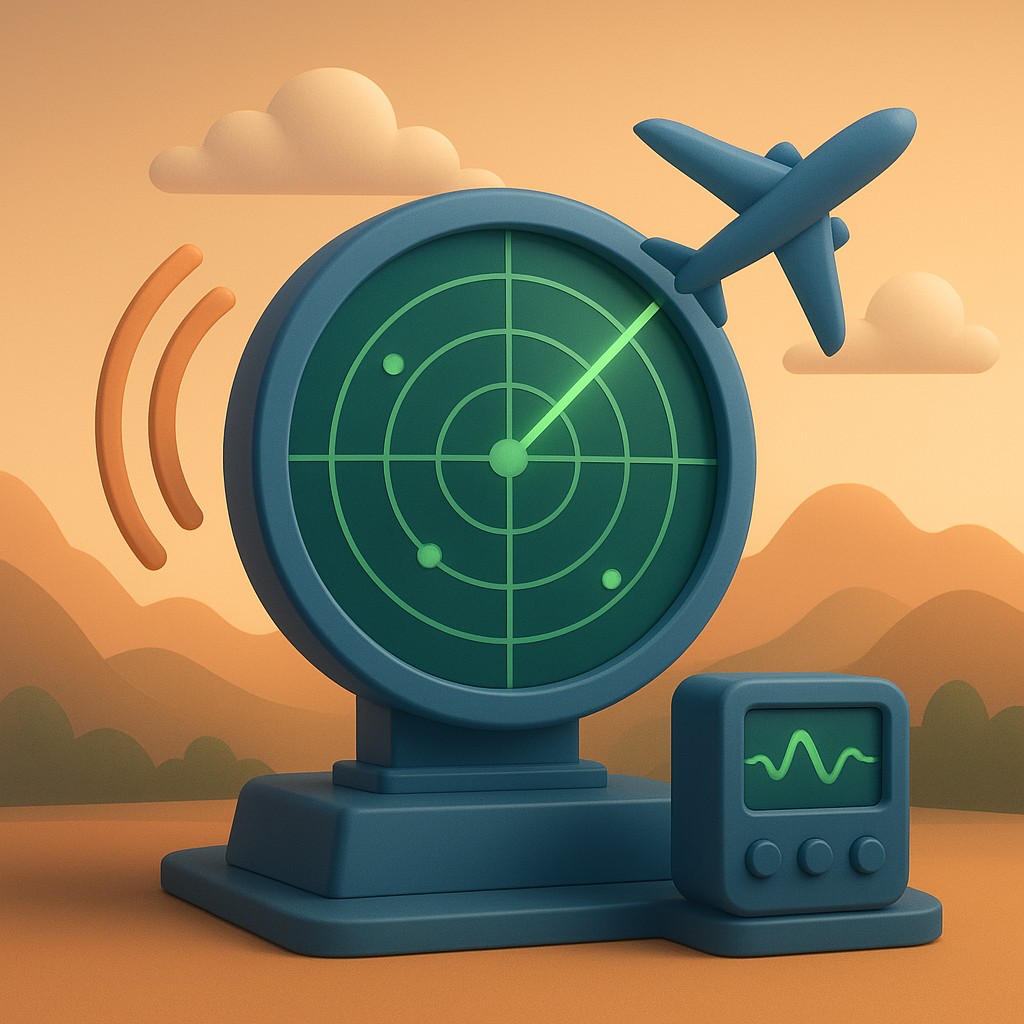
A common mistake is thinking that radar "sees" everything in high-definition images, like a movie camera. In reality, a standard radar sees "blips" or data points. Computers and human intelligence then interpret these points to say, "this is a hail cloud" or "this is a flock of migrating ducks." The circular screen with a rotating green line, so popular in submarine movies (which actually use sonar, the underwater sound equivalent of radar), is just a simplified way to help us visualize the space.
Another misconception is that radar is infallible. In fact, it has to fight against "clutter." The ground, ocean waves, or even swarms of insects can create "noise" echoes that clutter the screen. Engineers have to write sophisticated code to filter out this noise and keep only the relevant information. For example, a ship's navigation radar must be able to spot a small lifebuoy in the middle of choppy waves that are also reflecting waves back.
Finally, many people worry that radar technology is a health hazard because it uses electromagnetic waves. While it is true that you shouldn't stand directly in front of a powerful military radar while it’s running, due to the heat it produces (the microwave oven was actually inspired by a radar experiment!), civilian and automotive radars use extremely low power. They are part of the electromagnetic landscape we live in every day, just like FM radio or Wi-Fi.
Why This Technology Still Inspires Us
Radar is more than just a technical tool; it is an extension of our senses. It allows us to perceive the invisible, travel safely through the dark, and understand the moods of the atmosphere. Every time a plane lands smoothly on a moonless night, or a weather app warns you it will rain in exactly ten minutes, you are seeing the legacy of these radio waves working tirelessly for us.
Learning how radar works means realizing that the world is full of information just waiting to be decoded. It is an invitation to look beyond the limits of our eyes and appreciate the beauty of the physical laws that govern our universe. Whether you are a future engineer, an aviation fan, or just curious, remember that behind every bouncing signal is an opportunity to better understand the world around us. Radar is only the beginning of a technological adventure that continues to push the boundaries of what is possible, reminding us that even in total darkness, we are never truly blind.