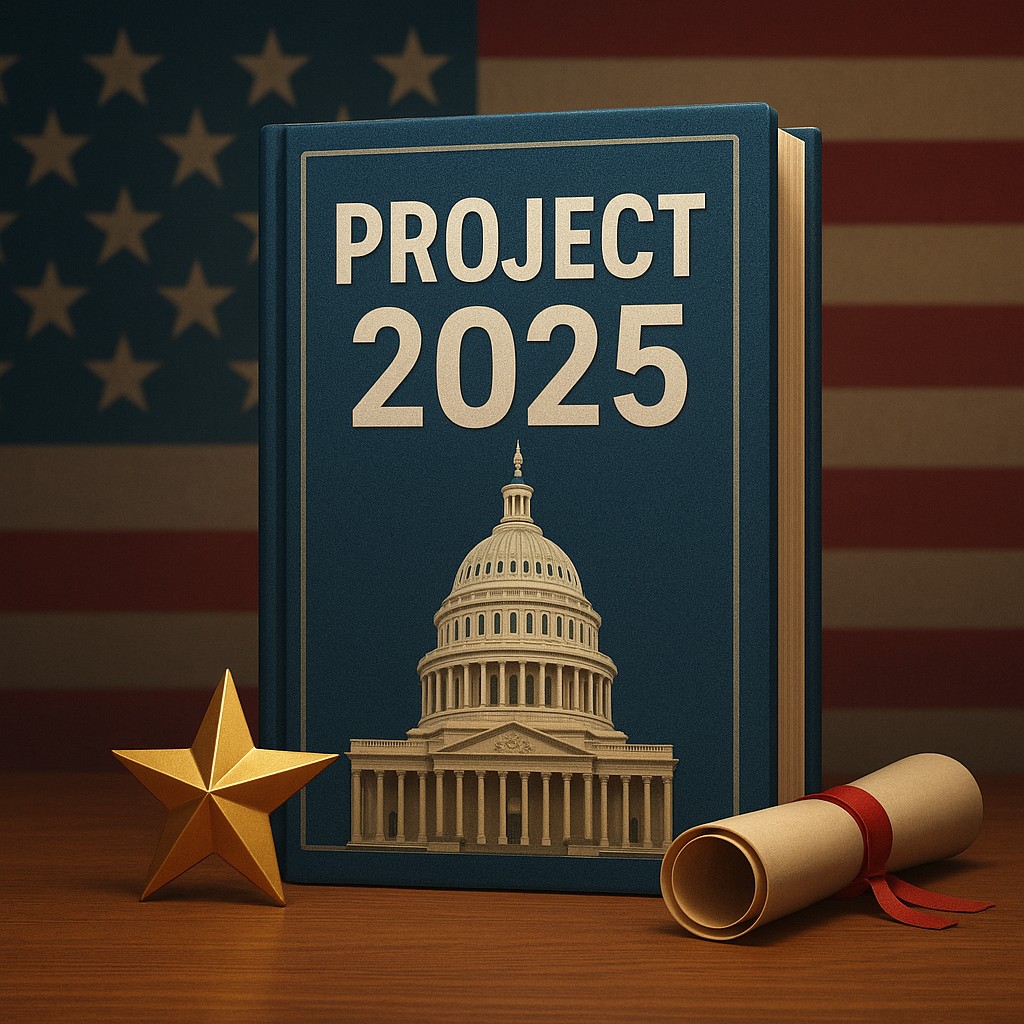
In recent months, if you’ve been within earshot of a political conversation—on social media, cable news, or even at the dinner table—you’ve probably heard murmurs about “Project 2025.” It sounds like a sci-fi flick title, maybe a top-secret mission to colonize Mars or replace federal workers with AI. But here’s the kicker: it’s real, at least in design—and it’s sparked heated debate in American politics. What exactly is Project 2025? Who’s driving it? And why has it suddenly become a talking point? The answer isn’t about spaceships or robots. It’s about the future of the U.S. government, the power of the presidency, and a bold blueprint for reshaping Washington, D.C., should certain political forces take control after the 2024 election.
At its core, Project 2025 isn’t a law, a bill, or an official government program. It hasn’t been passed by Congress or signed by any president—yet. Instead, it’s a detailed action plan put together by a network of conservative think tanks, advocacy groups, and former government officials, mostly aligned with the Republican Party and the American right. The goal? To prepare for a potential conservative presidency in 2025 by training thousands of loyal supporters, rewriting federal policies, and reorganizing the executive branch so that, from day one, a new administration can quickly push through an aggressive conservative agenda. Think of it not as a secret conspiracy, but as a ready-made instruction manual for running the federal government in a way that breaks sharply from recent decades. Whether you’re worried, curious, or just confused, understanding Project 2025 means looking past the noise to see the political ambition, ideology, and vision driving it.
What Exactly Is Project 2025—and Who’s Behind It?
To make sense of this, start with the main force behind it: The Heritage Foundation, one of the most powerful conservative think tanks in the U.S. Founded in 1973, Heritage has long pushed free-market economics, limited government, traditional values, and strong national defense. Over the years, it’s helped shape Republican policy on taxes, welfare, and foreign affairs. But Project 2025 marks one of its boldest moves yet—not just shaping ideas, but building a full-scale government-in-waiting.
Launched in 2022, Project 2025 is run by a group called the “Presidential Administration Project,” with Heritage leading the charge and support from over a dozen conservative organizations. These include the Family Research Council, the Koch-funded American Conservation Coalition, the America First Policy Institute, and others. Their mission is simple in theory but massive in scale: if a Republican wins the 2024 presidential race, they want to make sure the next White House isn’t slowed down by long hiring processes, internal pushback, or bureaucratic red tape. In the past, new presidents from both parties have taken months to fill key roles, learn how agencies work, and start making changes. Project 2025 aims to cut that lag to zero.
The plan includes training thousands of potential political appointees, drafting policy memos for every major federal agency, and releasing a 920-page guide called “Mandate for Leadership: The Conservative Promise.” This document lays out a step-by-step strategy for overhauling the federal government, covering everything from education and the IRS to the FBI and Defense Department. It’s not just about placing allies in key jobs—it’s about changing the culture of the federal workforce, reducing the power of career civil servants, and giving the president tighter control over agencies that are supposed to be independent.
Though the project isn’t officially tied to any single candidate—including Donald Trump, who may or may not back its full platform—it lines up closely with the MAGA (Make America Great Again) wing of the Republican Party. Critics say it could weaken democratic norms; supporters argue it brings accountability and returns power to elected leaders. Either way, it’s one of the most organized efforts ever by a political movement to prepare for governing in the U.S.
The Vision: A Government Transformed from the Inside Out
So what kind of government do the minds behind Project 2025 want to build? Picture a federal system where the president holds far more power, where agencies are staffed not just with experts but with loyalists who share the president’s beliefs, and where policies launch full-speed on Day One—without waiting for buy-in from career bureaucrats or moderate voices.
A key idea driving the project is the “unitary executive” theory. This legal and political view holds that all power in the executive branch should rest with the president. Under this model, independent agencies like the Federal Reserve or the Environmental Protection Agency should answer directly to the White House. That means more political appointees, fewer long-term civil servants making decisions, and tighter alignment between leadership and policy.
Many supporters see this as a matter of democracy. They argue that career officials—workers who stay in government through multiple administrations—have turned into an unelected “deep state” that resists the will of voters expressed in presidential elections. Project 2025 proposes replacing tens of thousands of these civil servants with political appointees who share the administration’s ideology. They estimate that up to 50,000 new political posts could be created or reshaped, allowing a future Republican president to rebuild agencies from scratch.
The plan also targets specific agencies for overhaul or downsizing. For example:
- The Department of Education could be sharply scaled back or eliminated, handing school control to states and local communities.
- The IRS might shift focus from auditing middle-class families to collecting revenue more efficiently.
- The Department of Energy could be redirected to support fossil fuel development instead of climate initiatives.
- The Department of Justice could change how federal prosecutors work, focusing more on immigration enforcement and less on what conservatives call “woke” social justice efforts.
These aren’t just policy tweaks—they involve restructuring agencies, rewriting hiring rules, and redefining missions. The blueprint also calls for using presidential tools like executive orders, regulatory rollbacks, and appointments to bypass Congress when possible. If fully carried out, the federal government wouldn’t just have new policies—it would run on a new set of rules.
Training Loyalists and Building the Next Government
One of the most striking and controversial parts of Project 2025 is its focus on staffing. Most administrations pick political appointees based on resumes, experience, and connections. Project 2025 flips that approach: it’s already training a large pool of potential appointees before any election happens.
Through its “Presidential Personnel Database,” the project is collecting data on conservative professionals—lawyers, economists, scientists, former military officers—who are ready to serve in a future Republican administration. These people aren’t just on a list. Many are going through training programs, ideological reviews, and crisis drills to prepare for high-pressure roles across federal agencies.
The curriculum covers everything from how the federal budget works to handling media interviews, managing congressional oversight, and spotting internal resistance within agencies. There are sessions on placing loyalists in power, managing or sidelining holdover staff, and making fast changes without getting caught in bureaucracy. In short, they’re building a shadow government—a ready-made team with the knowledge, beliefs, and drive to launch sweeping reforms the moment a new president takes office.
This effort builds on lessons from past Republican administrations. In 1981, when Ronald Reagan took office, Heritage released a similar document called “Mandate for Leadership” that shaped his early agenda. But today’s version is far more advanced. Unlike the 1980s, when transition teams scrambled to find qualified conservatives, Project 2025 has spent years laying the groundwork. They’ve built online systems, held national summits, and partnered with conservative colleges to identify promising candidates.
Critics say this level of planning borders on undemocratic. They argue that government should run on skill and professionalism, not loyalty tests and ideological conformity. What happens, they ask, if CDC scientists are ignored because their findings don’t match administration views? Or if environmental rules are scrapped not because they fail, but because they clash with political goals?
Supporters see it differently. They believe career bureaucrats have drifted away from public accountability and pushed policies that reflect elite opinions more than voter wishes. By placing leaders who answer to the president—and, by extension, the electorate—they argue Project 2025 restores balance and responsiveness to government.
Myth vs. Reality: Untangling the Truth About Project 2025
With a name that sounds like a spy operation and a plan to reshape the federal government, it’s no surprise Project 2025 has become a magnet for rumors, exaggerations, and fierce debate. Let’s set the record straight on some of the most common myths.
Myth 1: Project 2025 is a secret Republican plot.
Reality: It’s actually open and public. The Heritage Foundation promotes the project openly, hosts events, and has published its full policy agenda online. The 920-page “Mandate for Leadership” is free for anyone to read. While it’s politically driven, it’s not a hidden conspiracy.
Myth 2: Project 2025 guarantees a Republican win in 2024.
Reality: Nope. The project doesn’t decide election results. It’s a backup plan—a “what if” scenario. If a conservative wins, they’ll be ready. If not, the program might go on hold or shift direction.
Myth 3: Project 2025 wants to abolish the federal government.
Reality: While it calls for shrinking agencies like Education or Energy, the goal isn’t to wipe out government. Instead, it aims to restructure it—making it more efficient, ideologically aligned, and responsive to the president. Many services would continue, just under new leadership and goals.
Myth 4: Only extremists are involved.
Reality: The group includes a range of conservative voices—from mainstream think tank experts to more hardline activists. Some ideas are radical, but others reflect long-standing GOP views on taxes, regulation, and federal-state power. Not everyone agrees on every detail.
Myth 5: This is the first time anything like this has been done.
Reality: Similar efforts have happened before. Heritage did something like this for Reagan. Democratic administrations have also planned transitions. What’s new is the size, coordination, and ideological focus of Project 2025.
The confusion often comes from how the project mixes policy, people, and politics in a way that feels unusual. Most think tanks publish reports. Most campaigns build transition teams. Project 2025 does both—and more. It’s not just about ideas. It’s about execution. That’s what makes it stand out—and makes some people uneasy.
To clarify what Project 2025 aims to do and where it’s coming from, here’s how it compares to a typical presidential transition.
| Feature |
Traditional Presidential Transition |
Project 2025 Approach |
| Timing of Planning |
Begins after election |
Starts two+ years before election |
| Personnel Selection |
Based on experience, resumes, networks |
Pre-vetted database of ideological allies |
| Policy Development |
Done during transition period |
Pre-written plans for all major agencies |
| Agency Focus |
Stabilize and manage |
Overhaul, restructure, or downsize |
| Philosophy of Governance |
Balance between political appointees and civil service |
Expand presidential control; reduce civil service autonomy |
| Speed of Implementation |
Gradual, cautious ramp-up |
Rapid change beginning on Day One |
| Public Transparency |
Limited public details |
Openly published agenda and training materials |
This table shows that Project 2025 isn’t just another transition plan—it’s a full-scale government overhaul waiting in the wings.
The Bigger Picture: What It Means for Democracy and the Future of Government
Now step back. Project 2025 isn’t just about filling jobs or changing rules. It’s part of a deeper debate about how democracy should work in the 21st century. At its heart is a basic question: Should government be run by neutral experts, shielded from politics to ensure stability? Or should it directly reflect the president’s mandate, with staff and policy quickly aligned to the voters’ will?
This isn’t a new fight. The U.S. civil service was created in the late 1800s to end the “spoils system,” where government jobs were handed out as political rewards—often leading to corruption and poor performance. The idea was that some roles—like law enforcement or public health—should be filled by skilled professionals, no matter who’s in charge. But Project 2025 challenges that idea, arguing that too much independence has let agencies push progressive policies even when voters elect conservative leaders.
Supporters say the project brings back democratic accountability. They point to issues like social media content rules during the pandemic or aggressive environmental rules under past administrations, arguing that unelected officials are making choices that belong to elected leaders. By letting the president appoint more loyalists, they believe the government becomes more answerable to the people.
Critics, though, see a threat: the weakening of checks and balances. They fear that if agencies lose independence, they could become tools for political attacks. Could the FBI or IRS be used to target opponents? If science agencies are pressured to follow the administration’s line, could public health suffer? And if thousands of experienced civil servants are replaced by loyalists, could government become less competent—or even corrupt?
There’s also a cultural thread. Project 2025 reflects a growing belief among many conservatives that America is in moral and institutional decline—and that bold steps are needed to turn things around. It’s not just about taxes or borders. It’s about reshaping the national story. That’s why the project includes moral goals, like promoting “family-centered policies” and resisting what it calls “gender ideology” in federal programs.
Whether you support or oppose its goals, one thing is clear: Project 2025 shows how American politics is changing. The days of scrambling after elections and slow policy rollouts may be over, replaced by tightly organized, ideology-driven plans to take power fast and use it decisively.
And that leads to the most important point: understanding Project 2025 isn’t just about keeping up with conservative politics. It’s about seeing how power works in a democracy. It’s about asking who decides what happens in your life—from what’s taught in schools to how clean the air is to how your taxes are spent. It’s about realizing that behind every rule change, every agency shift, there’s a human story: people with ideas, ambitions, and deep beliefs about what’s right.
So the next time you hear about Project 2025, don’t just react with fear or praise. Look deeper. Read the documents. Follow the players. Ask questions. Because the future of government isn’t set by fate—it’s shaped by choices. And whether you lean left, right, or somewhere in between, your awareness, your voice, and your role matter. That’s not just how democracy survives. That’s how it thrives.