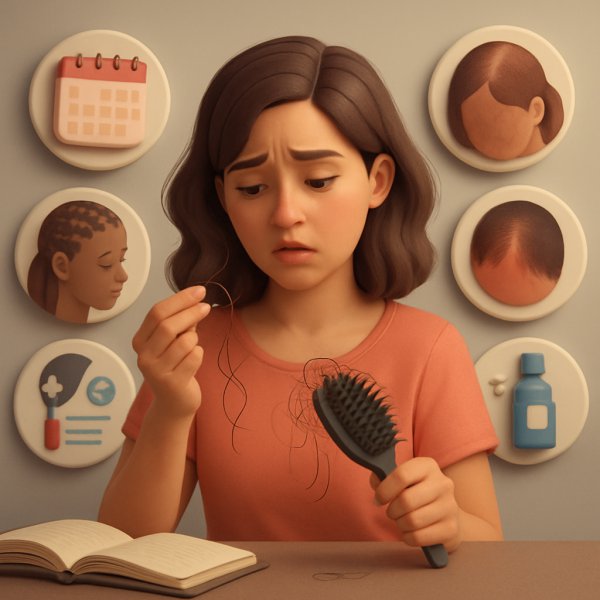
Imagine your hair as a small, stubborn garden - surprising facts to start you thinking
Did you know it is normal to lose about 50 to 100 hairs a day, and that most of those hairs have a clear lifecycle with built-in renewal? That little fact is both comforting and powerful, because it means most hair loss is a change in rhythm rather than total collapse. Once you understand the rhythm, you can often change it back with targeted, practical steps.
Think of each follicle like a seed in that garden - some seasons produce lush growth, some seasons are quiet, and some seasons react when the soil changes. The goal of this guide is to help you identify whether your garden needs better soil, gentler care, medical attention, or simply time to recover, and then give you simple, evidence-based steps to start improving things today.
The main culprits explained - clear descriptions of what might be causing your hair to thin
Hair loss in women is not one single problem, it is a symptom with many potential causes. The most common categories are pattern hair loss - often genetic and hormonally influenced - telogen effluvium - a widespread shedding triggered by stressors - autoimmune alopecia areata, traction-related damage from hairstyles, scarring conditions that permanently destroy follicles, and medical issues like thyroid disease or iron deficiency. Each has its own look, timeline, and best first steps, so figuring out which one you are facing is the key move.
Because causes differ, so do treatments. Some problems respond to simple lifestyle and hair-care changes, others to topical medicines or medical treatments, and some require investigation by a clinician. Below I walk through how to spot patterns, what tests are useful, and what practical actions commonly help. You will come away with ways to stop doing common harms, and a clear plan to talk to your doctor if needed.
What a normal hair cycle looks like and why shedding sometimes spikes
Every hair goes through three stages: anagen, the active growth phase; catagen, a short transition phase; and telogen, a resting phase that ends with shedding and replacement. At any one time, most follicles are in anagen, a small percentage are in telogen, and the balance determines how much hair you see in your brush. If many hairs are pushed prematurely into telogen - for example by illness, childbirth, crash diets, surgery, or significant stress - you get a visible shedding episode called telogen effluvium.
Telogen effluvium often starts 2 to 3 months after the trigger and can be dramatic, but it is usually reversible once the trigger is removed or addressed. In contrast, female pattern hair loss is gradual, shows thinning on the crown and part line, and reflects sensitivity of follicles to hormones over time. Knowing the timing - sudden heavy shedding versus gradual narrowing of the part - gives you a massive clue about what to do next.
Quick table to compare common types of hair loss and the first steps
| Pattern and clue |
Typical causes |
First steps to take |
| Sudden heavy shedding weeks to months after an event |
Telogen effluvium - stress, illness, postpartum, medication |
Review recent life events, check iron and thyroid, reduce stress, gentle care |
| Gradual widening of part and crown thinning |
Female pattern hair loss (androgenetic) |
Consult dermatologist, discuss topical minoxidil and other options |
| Patchy, round bald spots |
Alopecia areata - autoimmune |
See dermatologist - treatments vary from injections to topical immunotherapy |
| Thinning where hair is pulled tight, near hairline |
Traction alopecia from tight hairstyles, extensions |
Stop damaging hairstyles immediately, use gentle styles, see early for reversibility |
| Scalp scarring, redness, or pus |
Scarring alopecia - inflammatory destruction |
Urgent dermatology referral required |
Everyday habits that might be making things worse - the invisible saboteurs
Some hair loss is medical, and some hair loss you can directly influence by changing habits. Over-processing hair with frequent bleaching and perms chemically damages the hair shaft and can injure follicles. Repeated thermal abuse - high heat from flat irons and curling wands - weakens hair and causes breakage that looks like loss. Tight ponytails, buns, braids, and certain extensions repeatedly tug on follicles and lead to traction alopecia; early on it is reversible, late it becomes permanent.
Product overload and abrasive brushing matter too. Using heavy oils or silicones without regular cleansing can clog the scalp environment and irritate follicles, while rough brushing and towel-rubbing cause mechanical breakage. Even well-meaning supplements or topical "miracle" serums applied without knowing your bloodwork can waste time and mask true deficiencies. The good news is that many of these behaviors are fixable with small, consistent changes.
Practical triggers to watch for - check this short list and answer honestly
- Did you start a new medication, diet, or have a recent illness or surgery in the last 6 months?
- Have you changed hair-coloring or chemical treatments recently?
- Do you regularly wear tight hairstyles or extensions?
- Are you experiencing major life stress, new exercise patterns, or sleep disruption?
- Do you have symptoms of thyroid dysfunction, heavy menstrual bleeding, or digestive changes?
If you answered yes to one or more of these, that is actually good information - it points to likely causes and testable steps.
Real women, real outcomes - three short case studies you can learn from
Case study: "Emma, the new mom who thought her hair would not come back" - Emma noticed intense shedding three months after giving birth and panicked that her hair was gone. Her OB reassured her that postpartum telogen effluvium is common. She confirmed iron and vitamin D levels were borderline low, improved her diet, started iron supplements under medical guidance, made her hair routine gentler, and gradually saw regrowth over six to nine months. The lesson - timing and simple labs clarified a reversible cause and reduced anxiety.
Case study: "Maya, the stylist with a tight bun signature" - Maya wore tight buns every day for years, and over time noticed recession along her hairline. Her stylist switched to loose styles, she stopped extensions, and used a low-tension clip instead. After six months, she had visible regrowth at the margins. The lesson - traction damage is often preventable and partly reversible if you act early.
Case study: "Sophia, slow thinning and the bargain-minoxidil experiment" - Sophia had progressive part widening in her 30s and saw a dermatologist who diagnosed female pattern hair loss. She tried topical minoxidil consistently, adjusted lifestyle factors, and later added low-level laser therapy. Over 12 months she reported increased density and felt more confident. The lesson - pattern hair loss responds best to sustained, evidence-based therapy and monitoring.
A clear, evidence-based action plan you can start today - the checklist approach
If you are not sure where to start, use this stepwise checklist to move from confusion to control. These are practical actions that cover immediate care, evaluation, and treatments that are supported by clinical practice.
Immediate steps to begin today:
- Stop high-damage styling right now - no bleach, no daily hot tooling, avoid tight hairstyles. Small changes reduce ongoing harm and buy time for recovery.
- Take photos: front, top, and part line, once a month. Photographs are one of the best ways to objectively track change.
- Keep a 30-day hair diary noting new medications, diet changes, stress, and symptoms like heavy periods. Patterns often emerge from notes.
- Switch to gentle hair-care products and a soft towel or cotton T-shirt to dry hair; detangle with wide-tooth combs on damp hair.
Medical evaluation and tests to discuss with your clinician:
- Request basic blood tests: complete blood count, ferritin, iron studies, TSH, free T4, vitamin D, and if relevant, sex hormone testing. These tests help identify common, treatable causes.
- If shedding is sudden and severe, or you have scalp inflammation or patchy loss, see a dermatologist early - some conditions need prompt treatment to avoid permanent loss.
- For suspected female pattern hair loss discuss topical minoxidil; for autoimmune or scarring cases, specialized therapy is required.
Daily and weekly hair-care routine recommendations:
- Wash frequency: aim for what keeps your scalp comfortable - overwashing strips oils, underwashing can lead to buildup. Use sulfate-free, gentle shampoos and a conditioner focused on mid-lengths to ends.
- Heat styling: limit to special occasions, use the lowest effective heat setting, always apply a thermal protectant and avoid multiple passes with the iron.
- Styling: choose low-tension alternatives - loose ponytails, soft scrunchies, loose braids, or low buns with fabric-covered ties.
Treatments with evidence and what to expect:
- Topical minoxidil: a well-studied, commonly recommended option for female pattern hair loss and sometimes helpful in telogen effluvium recovery. It takes months to work and requires consistent use to maintain results.
- Address deficiencies: iron repletion when ferritin is low, vitamin D correction, or thyroid normalization can stop shedding and help regrowth. Always recheck labs with your clinician.
- Advanced options: platelet-rich plasma injections, low-level laser therapy, and surgical hair restoration are available for selected cases. Discuss risks, benefits, and timelines with a specialist.
Small experiments to teach your scalp - practical "what if" steps
- What if you paused chemical coloring for 3 months - would your hair feel stronger? Try it and compare photos and tactile changes.
- What if you replace your daily tight pony with a loose braid for a month - does the hairline feel less tender? Track any reduction in breakage.
- What if you correct a low ferritin value - does shedding slow after 2 to 3 months? Keep expectations realistic - hair regrowth is slow, but measurable.
A week-by-week gentle routine table you can try right now
| Day |
Morning |
Evening |
| Day 1 (Wash day) |
Gentle shampoo, conditioner on ends, apply leave-in protectant |
Air-dry or low heat, wide-tooth comb |
| Day 2 |
Dry shampoo if oily, soft pony or braid |
Scalp massage 2-5 minutes with fingertips to encourage circulation |
| Day 3 |
Co-wash or conditioning only, avoid product overload |
Brush lightly, sleep on silk or cotton |
| Day 4 |
Heat-free styling - loose braid or bun |
Nighttime scalp oil only on ends if dry, not on roots |
| Day 5 (Wash day) |
Repeat Day 1 routine, deep-conditioning mask if chemically treated |
Low-heat styling if needed, thermal protectant |
| Day 6 |
Protective style, avoid tight accessories |
Gentle scalp massage |
| Day 7 |
Scalp check and photo, review diary notes for the week |
Relaxation exercise to reduce stress hormone spikes |
Follow this plan for 4 to 8 weeks and compare photos and how your hair feels. Small consistent changes are often more effective than sporadic dramatic ones.
Myths that waste time - busted with short, clear corrections
"Only older women get hair loss" - False. Hair thinning can begin in 20s or 30s for many, and causes vary by age. Early evaluation helps.
"Shampoos can cure baldness" - False. No shampoo regrows large amounts of hair on its own; some shampoos improve scalp health and reduce breakage.
"Cutting hair makes it grow thicker" - False. Cutting removes split ends and changes shape, but does not change follicle activity. Healthy hair care prevents breakage and gives the illusion of thickness.
"Biotin is a magic fix" - False. Biotin helps only in rare cases of deficiency. Excess biotin can interfere with lab tests, so only take it if a clinician recommends it.
Quote to remember:
"Hair loss is rarely a single villain - more often it is a group of suspects. Find the main one first, then plan the intervention." - Practical wisdom distilled from dermatology practice
When to get urgent help - red flags you should not wait on
If your hair loss is extremely rapid over days to weeks, if you develop painful, inflamed, or pus-filled scalp areas, or if you have sudden patchy bald spots, see a dermatologist immediately because some causes need prompt intervention to prevent permanent damage. If you have systemic symptoms like unexplained weight changes, palpitations, heavy menstrual bleeding, or fatigue, see your doctor promptly because those signs suggest an underlying medical issue that may be causing or worsening hair loss.
Otherwise, if shedding is gradual but worrying, do not wait for a crisis - book a dermatology appointment, bring your photos and recent health history, and aim to have basic labs checked. Early detective work often saves months of anxiety and speeds recovery.
Questions to ask your clinician and resources to explore
Bring these questions to your appointment so you get focused answers:
- What type of hair loss do you think this is, and why?
- Which blood tests do you recommend, and what are the target ranges you want to see?
- Is topical minoxidil a reasonable next step, and what results should I expect?
- Are any of my current medications known to cause hair loss?
- If I stop chemical treatments and tight hairstyles, how long before I might see improvement?
Reliable places to read more include major dermatology organizations and peer-reviewed overviews on female hair loss. Look for resources from respected bodies like the American Academy of Dermatology and national health services, and search for recent reviews on telogen effluvium and androgenetic alopecia for women to get up-to-date summaries.
Final pep talk - practical optimism to close
Hair loss is often solvable, or at least manageable, with a combination of careful detective work, gentle everyday habits, and medical treatments when needed. Start with simple, reversible steps today - gentler styling, photos, and a basic blood panel - and use what you learn to build a longer-term plan with your clinician. Be patient with the timeline - hair regrows slowly, but steady small changes create visible improvements.
Small challenge to finish - take three photos now (front, top, and part) and commit to gentle styling for 30 days, then compare. You will likely feel calmer, more in control, and a bit proud of making a plan. Your hair, like any small garden, responds to consistent, thoughtful care.