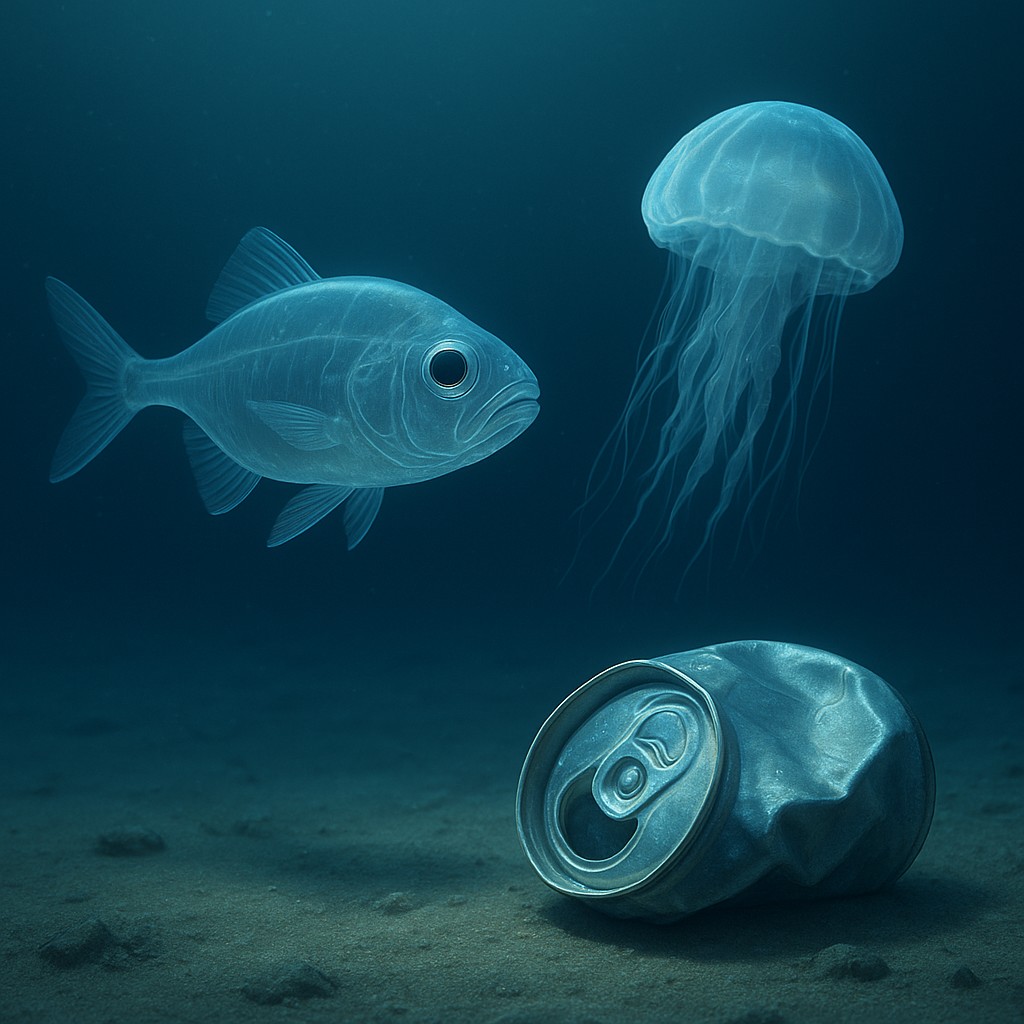
Imagine dropping an empty soda can into the deepest part of the Atlantic Ocean. By the time it hits the bottom, that aluminum cylinder would be crushed into something resembling a wad of chewed gum. The weight of the water above, reaching down for miles, exerts a force equivalent to having an African elephant stand on your thumb for every square inch of your body. Humans cannot survive here without the protection of titanium spheres and heavy engineering because our bodies are made of soft tissues and air-filled cavities that would collapse instantly under the weight of the abyss.
Yet, if you looked through the thick glass of a submersible at those same depths, you would see delicate, ghostly fish and translucent shrimp swimming casually past your window. They do not have metal shells or internal steel beams to stay safe. They are soft, squishy, and looks remarkably fragile. For decades, scientists wondered how these biological machines could possibly function when the pressure is high enough to warp the very shape of the molecules that make life possible. The answer is not a harder skeleton, but a clever bit of molecular scaffolding that turns the water inside their bodies into a structural strength rather than a weakness.
The Chemistry of Being Squashed
To understand how deep-sea creatures survive, we first have to look at what pressure actually does to a living cell. It is not just about crushing lungs or air pockets, though that is a major problem for any animal with a swim bladder (the gas-filled organ fish use to float). The more dangerous threat happens at a microscopic level. Life depends on proteins, which are long chains of amino acids folded into specific, three-dimensional shapes. You can think of a protein like a complex key; if the key’s shape is bent by even a fraction of a millimeter, it will no longer fit its lock, and the chemical reaction it was supposed to start simply stops.
Under the crushing weight of the deep ocean, water molecules are forced into the tiny folds and cracks of a protein’s structure. This intrusion acts like a microscopic wedge, prying the protein apart and forcing it to unfold, a process called "denaturing." When proteins lose their shape, the body’s internal engine grinds to a halt. Enzymes stop breaking down food, signals stop traveling through the nervous system, and the heart stops beating. Most surface creatures would die in the deep not because they were flattened like a pancake, but because their internal chemistry stopped working.
This creates a "chemical ceiling" for life. Every organism needs stable proteins to survive. For a long time, researchers believed there was a hard limit to how deep a fish could go before its own biology failed. However, evolution is remarkably resourceful. Instead of fighting the water, deep-sea organisms have found a way to "harden" their internal fluids using a class of molecules called piezolytes. These are specialized organic molecules that act as chemical stabilizers, ensuring that the heavy hand of the ocean does not rearrange the furniture inside a cell.
The Invisible Brace of TMAO
Among the various piezolytes discovered by marine biologists, one stands out as the heavyweight champion of the abyss: trimethylamine N-oxide, or TMAO for short. TMAO is a small, simple molecule that serves a massive purpose. Its primary job is to manage how water molecules behave when they are under stress. While ocean pressure tries to force water into the sensitive folds of a fish’s proteins, TMAO acts as a protective shield. It prefers to interact with water molecules rather than the proteins themselves, creating a protective "hydration shell."
This interaction effectively organizes the water. In the presence of TMAO, water molecules become more structured and less likely to wander into places they do not belong. Think of it like a crowded subway car. Without any order, people might get pushed into the conductor’s booth or jammed against the doors, breaking the controls. But if you have a specialized team of guards (the TMAO) holding people in a tight, orderly formation, the doors can still open and close, and the train keeps running. By bracing the water structure, TMAO prevents proteins from collapsing, allowing fish to keep their bodies working even under several tons of pressure.
The amount of TMAO in a fish’s body is not random; it is perfectly tuned to the depth where the fish lives. The deeper the fish, the more TMAO it carries in its tissues. Scientists have observed a direct link: for every five or six hundred meters of depth, the amount of TMAO in the fish’s cells increases. This is why a shallow-water cod tastes and smells very different from a deep-sea grenadier. The deeper the inhabitant, the more "reinforced" its cells must be.
Measuring the Depths of Adaptation
Using piezolytes is a brilliant solution, but it comes with a biological trade-off. While these molecules protect the fish from pressure, they also change the saltiness and chemical balance of the fish’s internal fluids. This creates a clear contrast between how different organisms handle ocean stress.
| Feature |
Shallow-Water Fish |
Deep-Sea (Abyssal) Fish |
| Piezolyte Concentration |
Very low or none |
Extremely high levels of TMAO |
| Protein Stability |
Sensitive to pressure; breaks down easily |
Highly stable due to chemical bracing |
| Body Structure |
Firm muscles, dense bones |
Jelly-like flesh, soft bones |
| Primary Survival Strategy |
Speed and camouflage |
Metabolic stability under pressure |
| Smell After Death |
Slow to develop "fishy" odor |
Rapidly develops strong ammonia scent |
This table shows that surviving the deep sea requires a total-body commitment. It is not just about one molecule; it is a fundamental shift in how the body is built. Deep-sea fish often have much higher levels of dissolved solids in their cells than their surface-dwelling cousins. This is essentially a form of biological antifreeze, but instead of protecting against ice, it protects against the crushing weight of the world. However, there is a limit to how much TMAO a fish can hold. If the concentration gets too high, the fish would become saltier than the seawater, which would suck the water right out of its body through osmosis. This chemical limit is likely the reason we do not see fish in the very deepest trenches, which are instead ruled by smaller, shell-less creatures.
The Cost of Protection and the Stench of Death
Every evolutionary advantage has a price, and for deep-sea fish, that price is paid in smell. If you have ever walked through a fish market and noticed a sharp, stinging, slightly metallic scent, you are actually smelling TMAO breaking down. When a fish dies, bacteria and enzymes immediately begin to rot its tissues. In marine fish, this process turns the odorless TMAO into trimethylamine (TMA) and, eventually, ammonia. These are the molecules responsible for the "fishy" smell we associate with old seafood.
Because deep-sea creatures are packed with incredibly high levels of TMAO to survive the pressure, they smell much more intense than surface fish once they are brought to the docks. A deep-sea shark or a giant isopod is essentially a concentrated stink-bomb waiting to be triggered by death. In some cultures, this high concentration is actually put to use. For example, the traditional Icelandic dish hákarl is made from Greenland shark, which lives in deep, cold waters and is saturated with TMAO. The meat is actually toxic if eaten fresh because the concentration of these molecules is so high; it must be fermented for months to let the chemicals break down into a safer, though still incredibly smelly, form.
This pungent legacy is a reminder of the extreme environments these animals call home. The smell is not just a sign of rot; it is the ghost of a biological defense mechanism that allowed the animal to live where we could never go. It is a chemical record of a life spent under the weight of a mountain of water.
Lessons from the Molecular Scaffold
The story of the piezolyte changes how we think about "strength" in nature. We often imagine survival means being tough, hard, or impenetrable. We think of crabs with thick shells or turtles with armor. But the deep-sea fish teaches us that sometimes the best way to survive extreme stress is from the inside out. By changing the way its internal fluids interact, the fish creates a bridge between itself and its hostile home. It does not fight the pressure with a shield; it accepts the pressure and uses a molecular brace to keep its delicate parts in place.
This concept of "internal bracing" has big implications for how we understand biology and even how we might design new technology. Researchers are currently looking at how piezolytes might be used to stabilize vaccines or preserve delicate tissues for medical use. By mimicking the way TMAO protects deep-sea proteins, we might find ways to keep our own sensitive molecules from breaking down under heat, cold, or physical stress. It turns out that the "stinky" secret of the abyss is actually a masterclass in high-pressure engineering.
The next time you encounter a fishy smell at a harbor or a seafood restaurant, remember that you aren't just smelling old dinner. You are smelling the remains of an elegant molecular solution to one of the most punishing environments on Earth. The abyss is not just a place of monsters; it is a laboratory of chemical brilliance where life has found a way to stand tall by simply holding onto its water.