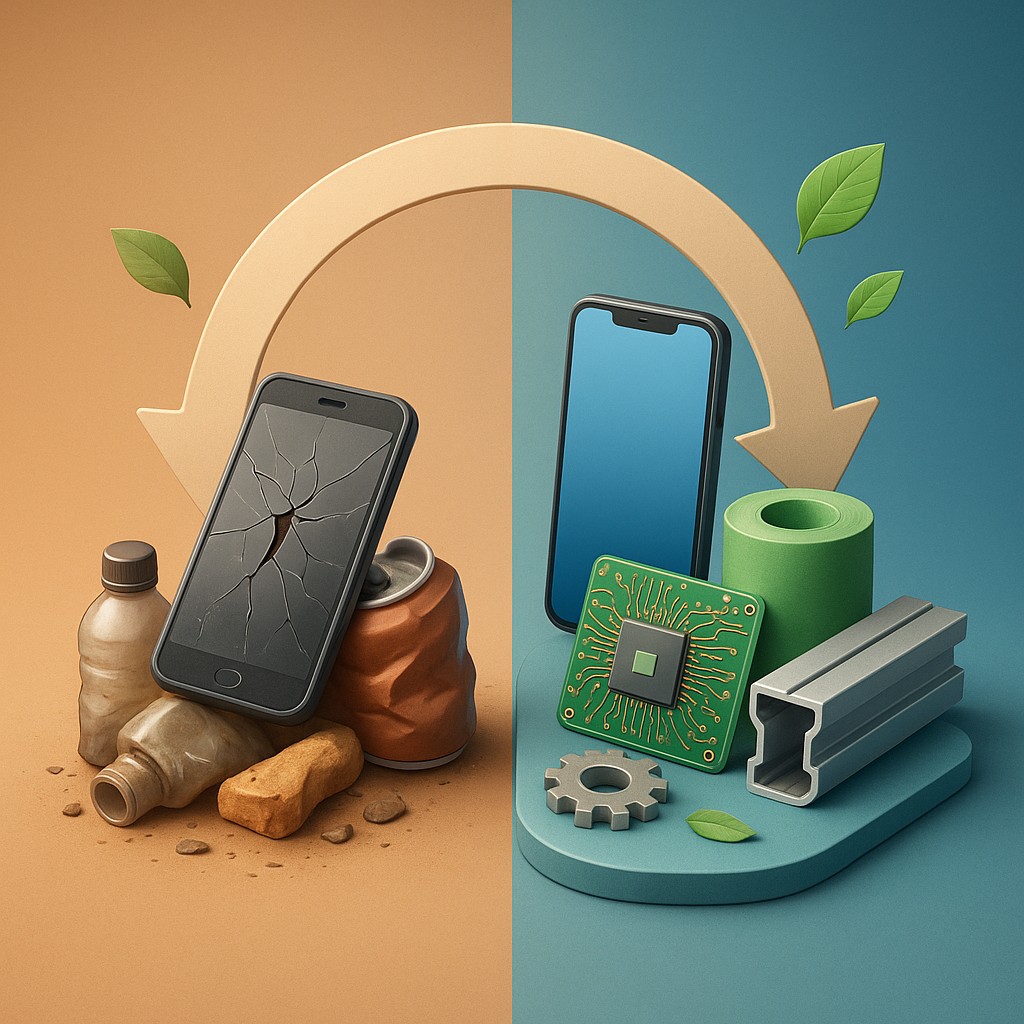
Imagine for a moment that your favorite smartphone is not just a piece of electronics destined for a junk drawer, but a temporary loan of specialized molecules. In our current economy, we operate on a linear "take-make-waste" conveyor belt. We dig metals out of the ground, fuse them into complex gadgets, and when the battery dies or the screen cracks, we toss them into a landfill. At best, we "downcycle" them. This is a process where high-quality plastic from a laptop is ground down into low-grade garden furniture, which eventually becomes brittle and ends up in the trash anyway. It is a slow-motion descent into worthlessness that treats our planet like an infinite vending machine and a bottomless trash can.
But there is a radical alternative hiding in plain sight, a concept often called "Cradle to Cradle" design. In this world, we stop thinking about products as disposable items and start viewing them as banks for "technical nutrients." These are materials like specialized polymers, high-grade aluminum, and rare earth metals that were never meant to be part of the natural world. Unlike an apple core that can rot and nourish the soil, a computer chip is "technical," not biological. By designing these items so they can be snapped apart and rebuilt without losing their strength, we can create a closed-loop industrial system. This is the story of how we stop making trash and start managing endless cycles of value.
The Flaw in the Downcycling Trap
Most of what we call recycling today is actually just a polite way to delay the inevitable. When you toss a plastic water bottle into a blue bin, it isn't usually turned back into another high-quality bottle. Instead, it is melted down with various impurities, which weakens the plastic's molecular chains. This "downgraded" material might become a polyester carpet or a fleece jacket. Once 그 jacket wears out, the fibers are too short and contaminated to be processed again, so it heads to the incinerator or the landfill. We haven't solved the waste problem; we have just given the trash a brief detour through our wardrobes.
The technical nutrient framework argues that this is a design failure, not a consumer failure. The problem starts on the engineer’s drafting board. When a manufacturer glues a glass screen to a plastic frame and solders the battery to the motherboard, they create a "monstrous hybrid." This term describes a product made of materials fused so tightly that they cannot be separated into pure streams. If you cannot extract pure copper from a wire or pure polymer from a casing, the material's value is lost forever. To fix this, we must treat every product as a temporary assembly of high-value parts, waiting to be "harvested" for the next generation of goods.
Designing for the Great Disassembly
Effective technical nutrient cycles require a complete reversal of the manufacturing status quo. Instead of using permanent glues and complex chemical blends, companies are beginning to use "design for disassembly." Imagine a washing machine held together by smart fasteners that unbolt when exposed to a specific frequency of heat or light. In this scenario, when the machine reaches the end of its life, it doesn't go to a scrapyard to be crushed. Instead, it goes to a recovery facility where it is dismantled in seconds. The high-grade steel, the copper coils, and the glass door are separated into pristine piles, ready to be fed directly back into the production line for a new machine.
This approach creates a massive shift in how we perceive ownership. If a company knows they will get their materials back in five years, they are motivated to use the highest quality materials possible. After all, if the aluminum in your laptop is an asset that the company will use again in 2030, they want it to be top-tier. This has led to the rise of "product as a service." You might not buy a lightbulb; you might buy "lighting" from a company that maintains the hardware. They eventually swap out the components for newer versions and take the old parts back to their factory to be repurposed. In this model, the manufacturer becomes a material manager, and the customer becomes a temporary user.
The Secret Ingredient of Material Purity
The greatest enemy of a zero-waste supply chain is contamination. In the biological world, mixing a salad is fine because everything eventually turns back into soil. In the industrial world, mixing two different types of high-grade plastic is a disaster. It creates a "Franken-material" that is neither as strong as the first plastic nor as flexible as the second. To keep the technical loop running forever, we need a rigorous system to label and track materials. This ensures that when a product is taken apart, we know exactly what we are holding.
| Feature |
Linear Economy (Take-Make-Waste) |
Circular Economy (Technical Nutrients) |
| Material Goal |
Lowest cost for immediate use |
Long-term asset retention and purity |
| End of Life |
Landfill, incineration, or downcycling |
High-quality recovery and remanufacturing |
| Design Priority |
Aesthetics and rapid assembly |
Disassembly, modularity, and repair |
| Ownership |
Consumer owns the "trash" |
Manufacturer manages the "nutrient" |
| Material Quality |
Degrades over time (loss of value) |
Maintained indefinitely (constant value) |
Standardization is the unsung hero of this revolution. International standards, such as ISO 11469 for identifying plastics or the emerging Digital Product Passport (DPP) in Europe, act as a birth certificate for every component. A technician or an automated sorting robot can scan a code on a car bumper and instantly see the specific chemical recipe of that plastic. This allows for "closed-loop recycling," where the polymer is cleaned and turned into a new car bumper with no loss in quality. By maintaining this molecular purity, we effectively eliminate the need to mine new raw materials from the earth.
Modular Architecture and the End of Obsolescence
One of the most frustrating parts of modern life is planned obsolescence. You have likely felt the irritation of a perfectly good device becoming useless because one small part, like a charging port or a single capacitor, has failed. In a technical nutrient cycle, this is seen as an economic waste. If a product is built with modular architecture, parts can be upgraded or replaced without tossing the whole unit. This isn't just about repair; it is about keeping the "skeleton" of the product in use while rotating the worn-out parts back into the industrial loop for processing.
Think of it like a professional kitchen. The heavy-duty ovens and stoves stay for decades, while the pots, pans, and ingredients move through the system. In a zero-waste supply chain, the "infrastructure" of the product (the frame of a car or a house) is designed to last a century. Meanwhile, the "technical nutrients" (the electronics or the insulation) are designed to be swapped out and returned to the manufacturer. This creates a rhythm of industrial life that mimics the seasons, but with steel and silicon instead of leaves and wood.
Overcoming the Complexity of Global Logistics
The move toward a technical nutrient model faces significant hurdles. Our current global supply chain is built for one-way traffic. Shipping a freighter full of cheap goods from a factory to a consumer is easy; building a "reverse logistics" network to bring those goods back to the factory is incredibly complex. It requires a rethink of how we transport and sort materials at scale. Furthermore, many current products were designed in an era where "away" was a place where things could actually be thrown. We are currently sitting on a mountain of old waste that was never meant to be taken apart.
However, the pressure to change is mounting because of both the environment and the economy. As the cost of mining raw materials rises and the risks of sourcing rare metals grow, the items we have already manufactured become literal gold mines. Companies are realizing that it is often cheaper to "mine" their old products for parts than to dig a new hole in the ground. This shift turns waste management departments into purchasing departments. It turns the "end" of a product's life into a "transformation point," ensuring that the industrial machine can keep running without eating the planet alive.
The Cultural Shift Toward Stewardship
Moving toward a world of technical nutrients requires us to change how we relate to our belongings. We have been trained to see "new" as better and "used" as inferior. But in a circular loop, the material is timeless. The gold in your phone is the same age as the gold in a pharaoh's crown; it does not wear out. When we embrace the idea of technical nutrients, we stop being mere consumers and start being stewards of the materials in our hands. We begin to value the integrity of the loop as much as the usefulness of the device.
By demanding products designed for disassembly and supporting companies that take responsibility for their material footprint, we spark a smarter version of human ingenuity. We can have our high-tech gadgets and clean oceans too. The future isn't about doing without; it is about doing things differently. As we get better at tracking, sorting, and remanufacturing our technical assets, we move closer to an industrial system that is finally in harmony with our finite world. It is time to treat our synthetic world with the same respect we give the natural one, turning our "waste" into the fuel for a never-ending cycle of innovation.