Imagine the atmosphere as an overflowing bathtub. For decades, the global conversation has focused almost exclusively on closing the tap by cutting emissions from cars, factories, and power plants. While stopping the flow is vital, the tub is already spilling over and soaking the floor. To prevent a total flood, we need to find a way to pull the plug and drain some of the water. This is the core idea behind carbon removal. Recently, this field has been dominated by high-tech visions of "Direct Air Capture" machines - giant, futuristic fans that suck carbon dioxide out of the sky and pump it deep underground.
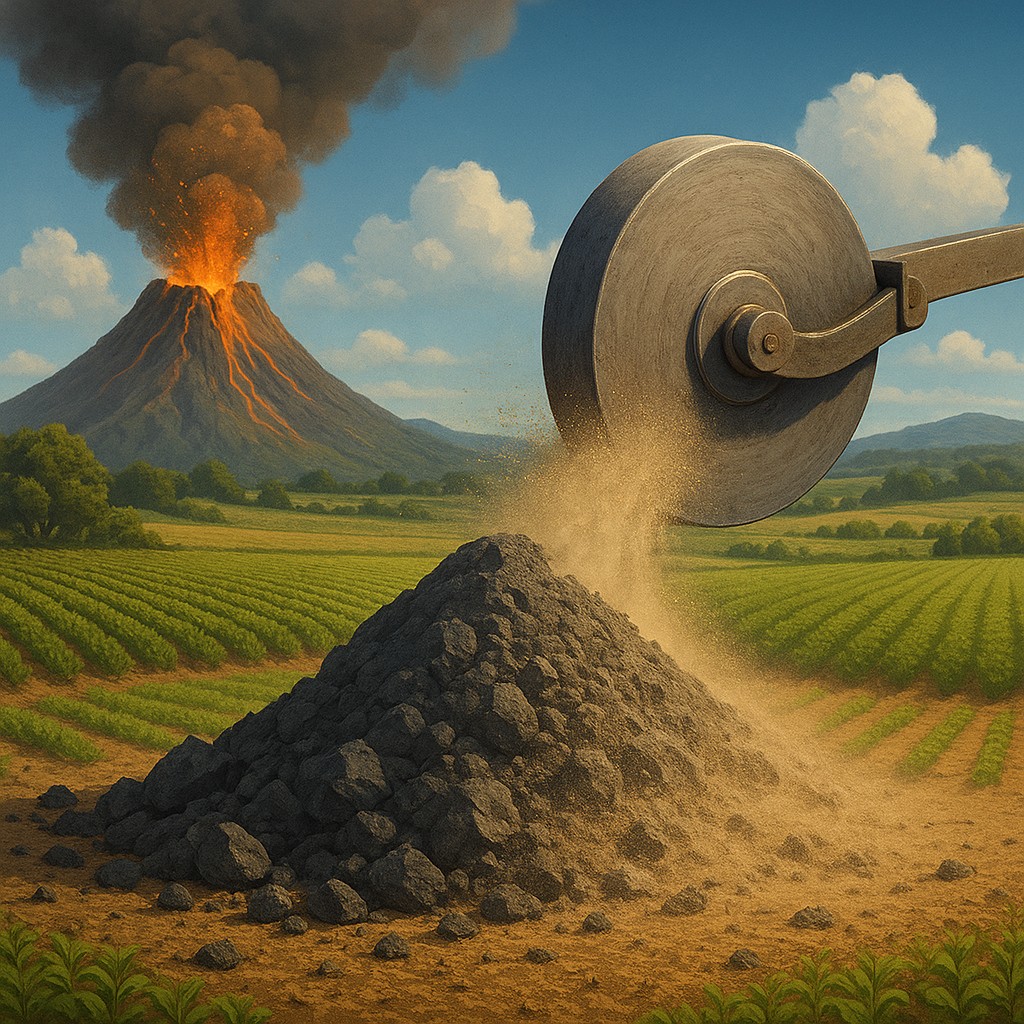
However, a quieter, much older contender is entering the ring. This method doesn't require massive amounts of electricity or complex chemical filters. Instead, it relies on a process the Earth has been using for billions of years: the slow, grinding relationship between rocks and rain. By taking specific types of volcanic rock, crushing them into a fine powder, and spreading them across the world’s farmland, we might be able to turn the entire agricultural landscape into a massive, natural sponge for greenhouse gases. This technique, known as Enhanced Rock Weathering, shifts the focus from trying to outsmart nature with machinery to simply putting nature's own chemistry on fast-forward.
The Chemistry of a Crumbling Mountain
To understand how a pile of dust could help save the climate, we first have to look at how the Earth regulates its own temperature over vast stretches of time. When rain falls through the atmosphere, it reacts with carbon dioxide to form a very weak acid called carbonic acid. When this slightly acidic rain hits silicate rocks, such as basalt, it triggers a chemical reaction. This process breaks down the rock and transforms the atmospheric carbon dioxide into bicarbonate ions. These ions are stable, dissolved minerals that eventually wash into streams and rivers, eventually reaching the ocean, where they stay locked away for hundreds of thousands of years.
The problem with this natural process is that it is agonizingly slow. In the wild, it takes thousands of years for a mountain to weather down enough to make a dent in atmospheric gas levels. Enhanced Rock Weathering (ERW) essentially takes that thousand-year timeline and compresses it into a single growing season. By grinding the rock into a fine powder, we vastly increase the surface area available for the reaction. A single large boulder has very little surface area relative to its weight, but if you grind that boulder into trillions of microscopic particles, every single speck becomes a tiny, active site for carbon capture the moment it touches damp soil.
The beauty of this mechanism lies in its permanence. Planting a forest is a wonderful way to store carbon, but it is "leaky" because trees can burn down or rot, releasing their gas back into the air. In contrast, rock weathering creates a geological "sink." Once the carbon is converted into bicarbonate and washed into the sea, it is effectively removed from the atmosphere for good. It also offers a second benefit to the oceans: by delivering these alkaline minerals to the water, it helps fight ocean acidification, making the seas a better home for coral reefs and shellfish.
From Volcanic Residue to Fertilizer
While the main goal of spreading crushed basalt is to capture carbon, the secondary benefits to the soil are what make it a winning deal for the people actually doing the work: the farmers. Basalt is essentially a multivitamin for the earth. It is rich in nutrients like magnesium, calcium, and phosphorus, as well as trace elements that are often used up in heavily farmed soil. When the rock dust dissolves, it releases these nutrients, which can increase crop yields and reduce the need for expensive synthetic fertilizers.
Furthermore, the chemical reaction that traps carbon also helps stabilize soil pH. Many agricultural soils become acidic over time due to the use of nitrogen fertilizers, which can stunt plant growth. Traditionally, farmers apply crushed limestone to balance this acidity. However, limestone (calcium carbonate) actually releases some carbon dioxide when it reacts with the soil. Basalt achieves a similar balance while absorbing carbon dioxide instead. It is a rare "win-win-win" scenario where the environment, the farmer’s wallet, and the health of the soil all improve at once.
| Feature |
Mechanical Direct Air Capture (DAC) |
Enhanced Rock Weathering (ERW) |
| Primary Energy Source |
High-intensity electricity or heat |
Natural, passive chemical reactions |
| Storage Method |
Underground injection as a gas |
Stable bicarbonate in water and oceans |
| Side Benefits |
None (only carbon removal) |
Soil health, crop yield, ocean alkalinity |
| Scalability |
Limited by plant construction costs |
Uses existing global farmland |
| Permanence |
High (if storage remains sealed) |
Extremely high (geological timescales) |
| Infrastructure |
Massive industrial facilities |
Trucks, grinders, and farm spreaders |
The Logistics of Moving Mountains
If this sounds too good to be true, it is worth looking at the massive logistics involved. Carbon dioxide is a heavy, widespread gas, and to remove it at a scale that matters, we need to move an astronomical amount of rock. We are talking about billions of tons of basalt. This introduces a "carbon debt" that must be paid before the process actually helps the planet. We have to mine the rock, grind it into dust using heavy machinery, and transport it by truck or train to the fields. If the energy for these tasks comes from burning coal or diesel, we might end up releasing more carbon than the rocks eventually soak up.
The success of ERW depends on a few specific factors. First, the rock must come from high-quality silicate deposits, ideally from mining by-products that have already been dug up, such as quarry leftovers or waste from steel production. Second, the distance it travels matters immensely. Spreading rock dust on a farm located fifty miles from a quarry is a win for the climate; shipping that same dust across an ocean might be a wash. Most researchers suggest focusing on "regional loops," where the rock and the soil are relatively close to each other.
There is also the question of how long it takes for the rock to react in the soil. Not every bit of dust breaks down at the same speed. Temperature, rainfall, and even the type of crops being grown affect how quickly the basalt dissolves. Scientists are currently refining complex models to track exactly how much carbon is being captured in real-time. This is crucial because, in the growing market for carbon credits, companies want to be certain that the ton of carbon they paid to remove is actually at the bottom of the ocean and not just blowing around a dusty field.
Addressing Fears and Hidden Costs
One common myth about rock weathering is that it is an "interference" with nature that might lead to toxic buildups. Critics sometimes worry that spreading volcanic dust on fields will contaminate our food with heavy metals. While some rocks contain trace amounts of metals like nickel or chromium, basalt is generally chosen specifically because it is "clean" and safe for living things. In fact, many of the minerals in basalt are the same ones found in the expensive organic soil conditioners people buy at garden centers.
Another misconception is that this process turns soil into something hard like concrete. In reality, the amount of rock dust used is relatively low, and the particles are so fine that they blend into the soil rather than forming a crust. Instead of turning the field into stone, the process actually mimics the natural silt deposits that make river deltas, such as the Nile or the Mississippi, so fertile. It is less like paving a field and more like giving it a life-giving mineral treatment.
We must also distinguish ERW from other geoengineering ideas, like spraying chemicals into the sky or dumping iron into the ocean. Those methods often involve high risks of sudden climate "shocks" or disruptions to food chains. Rock weathering, by contrast, is a land-based, local, and gradual approach. It uses the same materials the Earth has used for eons; it just spreads them out more efficiently. If we stopped doing it tomorrow, the climate wouldn't snap back dangerously; we would simply lose the benefit of the ongoing carbon capture.
Tracking the Invisible Progress of Stones
Measuring the success of a mechanical carbon capture plant is easy: you simply read a meter on a pipe. Measuring the success of enhanced rock weathering is a much more complex scientific challenge. Because the reaction happens across millions of acres of soil, we cannot put a sensor on every square inch. Instead, researchers use "chemical signatures" to verify the process. They look at certain markers in the soil water and track the increase in alkalinity as the water moves from the field into local streams.
Recent breakthroughs in sensor technology and satellite imaging are making this process much more transparent. We can now use remote sensing to monitor soil moisture and temperature, feeding that data into formulas that predict the weathering rate with high accuracy. This data-driven approach is turning a theoretical geological concept into a measurable industrial process. As these verification methods improve, the financial world is becoming more willing to invest the billions of dollars needed to scale up the logistics of rock crushing.
The ultimate goal is to make this part of the daily routine for global agriculture. If carbon removal becomes a secondary "crop" for farmers, funded by international carbon markets, it creates a powerful reason for land managers to join in. Rather than being told to cut their production or change their lifestyles, farmers are being invited to the front lines of a global cooling system. This shift in perspective, moving from agriculture as a source of emissions to agriculture as a source of solutions, is one of the most hopeful developments in modern environmental science.
Embracing a Future Built on Stone
As we look toward the middle of the century, it is clear there is no single "silver bullet" for the climate crisis. We need high-tech fans, wind turbines, and reforestation projects. But there is something uniquely grounded about the idea of using the very bones of the Earth to heal its surface. Enhanced rock weathering reminds us that the solutions to our most modern problems are often hidden in our planet's oldest processes. It asks us to look at a handful of dust not as waste, but as a silent, powerful ally in the search for a stable future.
By turning our vast farmlands into active participants in the carbon cycle, we do more than just lower a number on a graph. We reconnect our industrial world with the geological rhythms of the Earth. We begin to treat the planet not just as a resource to be used, but as a complex, living system that we have the power to help. The path forward may be paved with crushed stone, but it leads toward a cooler, greener, and more resilient world. Every bag of basalt spread on a field is a small, solid promise that we are ready to do the hard work of restoration, one grain of rock at a time.