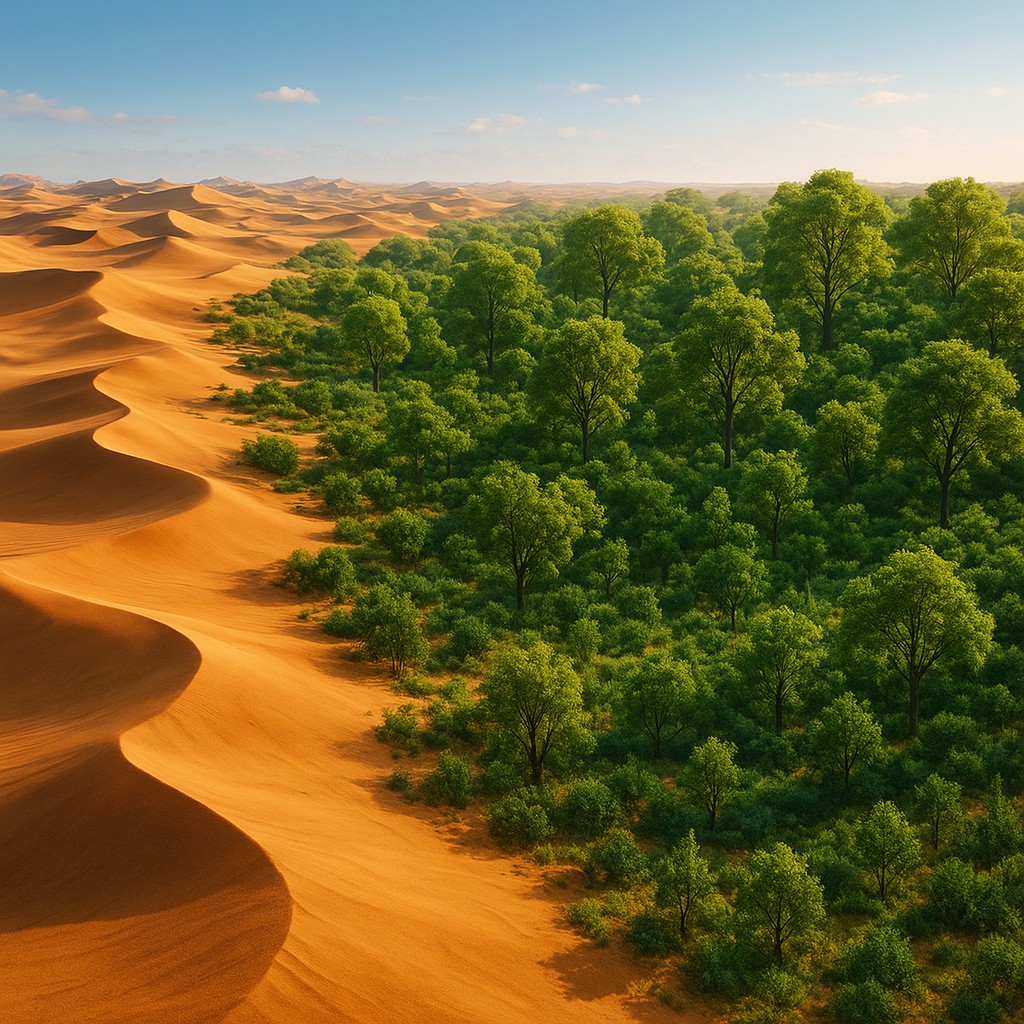
Imagine a place so unforgiving that its very name, Taklamakan, is often translated as "the place you never leave." Located in the heart of China’s Tarim Basin, this desert is the world’s second-largest shifting sand desert. It is an ocean of golden dunes stretching across more than 330,000 square kilometers. For centuries, this land was a symbol of pure desolation, known for blinding sandstorms and brutal temperatures that made farming or building a home nearly impossible. Simply put, it was a massive biological void that seemed destined to remain a wasteland of dust.
Yet, a fascinating rumor is currently making waves in scientific and environmental circles: this sandy titan is changing its personality. Thanks to decades of massive tree-planting and ecological restoration, what was once a primary source of atmospheric dust is starting to act as a "carbon sink" - absorbing more carbon dioxide than it releases. This dramatic turnaround did not happen by magic. It is the result of one of the most ambitious environmental engineering projects in human history, turning a barren desert into a living laboratory for the fight against climate change.
The Secret of China’s Great Green Wall
To understand how a desert can start "breathing in" CO2, we must look at the Three-North Shelter Forest Program, better known as the Great Green Wall. Launched in 1978, this massive project aims to plant a 4,500-kilometer barrier of forests, shrubs, and grasses to stop the Gobi and Taklamakan deserts from spreading. This is not just about planting a few trees here and there. It is about building a biological infrastructure capable of anchoring the sand and changing the local climate.
Scientists long believed that deserts were carbon-neutral because they lacked the dense greenery needed for large-scale photosynthesis. However, recent studies conducted over 25 years along the edges of the Taklamakan suggest the situation has changed. By introducing hardy species like the Euphrates poplar and the tamarisk, Chinese engineers have successfully stabilized the soil. Once the sand stops moving, microbial life returns. Plants then begin to capture carbon from the air and store it in their tissues and, more importantly, in the soil itself.
This process is fueled by an unexpected shift in weather patterns. By planting billions of trees, workers have changed the texture of the land and the humidity of the air. This "greening" seems to encourage more frequent rain during the wet season, creating a helpful cycle. The more it rains, the more the plants grow, and the more CO2 they capture. It is no longer just a wall against the sand; it has become a silent carbon pump working under the desert sun.
The Complex Science of Carbon Absorption
Saying a desert absorbs CO2 might sound wrong. We usually think of tropical rainforests like the Amazon for that job. However, the Taklamakan is a perfect example of how dry lands can help regulate the planet's temperature. This absorption does not just happen through leaves. It comes from a complex interaction between underground roots and the chemical processes within the desert soil. In areas where plants have been restored, the rate of carbon sequestration - the process of capturing and storing atmospheric carbon - has soared, beating the early predictions of climate models.
An essential point to understand is the difference between an "emitter" and a "sink." A bare desert can sometimes release carbon stored in ancient layers of earth during heavy erosion. By covering these areas with plants, we seal off those emissions while adding a new layer of active capture. Researchers now use advanced satellite data and models from the NOAA (National Oceanic and Atmospheric Administration) to measure these gas flows. The results shows that the edges of the Taklamakan have moved from being neutral to being net storage sites. This is a feat that sounded like science fiction forty years ago.
Here is a quick look at how these areas have evolved:
| Feature |
Original State (Before 1980) |
Current State (Restored Zones) |
| Plant cover |
Less than 1% |
Significant increase (man-made oases) |
| Soil stability |
Shifting sand and unstable dunes |
Biological crusts and anchoring roots |
| Carbon role |
Potential source or neutral |
Active carbon sink |
| Rainfall |
Extremely rare and unpredictable |
Local upward trend |
| Sandstorms |
Frequent and violent |
Notable reduction in intensity |
The Challenges of a Man-Made Ecosystem
Despite the excitement, this is not a simple "green wand" solution. Creating a forest where nature did not intend one takes massive resources, especially water. The Tarim Basin relies heavily on melting glaciers from nearby mountains like the Tian Shan. Using too much water to irrigate new forests could eventually dry up underground water supplies or take vital resources away from local communities. It is a delicate balance that engineers must watch very closely.
Furthermore, biodiversity in these artificial forests is often lower than in natural ones. A man-made forest is sometimes a "monoculture," meaning it only has one type of plant, which can make it easy prey for diseases or insect swarms. Critics also point out that while the CO2 absorption is real, it is modest compared to total global emissions. However, the Taklamakan’s importance lies in the "proof of concept": if we can turn one of the driest places on Earth into a carbon sink, it opens huge possibilities for restoring damaged lands everywhere else.
It is also worth noting that the Taklamakan sands are not fully "tamed." The heart of the desert remains a wild, shifting landscape. Efforts focus mainly on the "veins" and "borders" of the desert, where human activity meets fragile ecosystems. The trees act as protective armor for towns and roads, such as the famous highway that crosses the desert, which is lined with hedges watered by drip irrigation to keep it from being buried in sand.
Myths and Realities of Desert Transformation
It is easy to exaggerate when talking about projects like this. You might hear that the Taklamakan has become a lush jungle or that China has "erased" the desert. This is not true. The Taklamakan is still there; it is still vast and dangerous. What has changed is its ecological rhythm. You cannot turn a sand desert into a northern forest in just a few decades. Success is found instead in creating a mosaic of oases, forest belts, and stabilized grasslands that work together to tip the region's carbon balance.
Another common mistake is thinking that only trees matter. In reality, desert grasses and low shrubs are just as vital. They use less water than tall trees and are often better at trapping fine sand. This mix of different plant layers is what allows the Taklamakan to absorb carbon over the long term. Scientists are watching carefully to see if this storage is permanent or if a long drought could release all that carbon back into the air, highlighting the need for constant care.
Finally, it is important to clarify that this does not solve the climate crisis on its own. Planting trees is a powerful tool, but it must go hand-in-hand with cutting greenhouse gas emissions at the source. The Taklamakan shows us what is possible with hard work and engineering, but it also reminds us that nature needs time, care, and stable climate conditions to keep these new carbon sinks alive.
A Green Future for Arid Lands
The story of the Taklamakan’s transformation is a powerful testament to the Earth’s resilience and human innovation. Moving from a feared "biological void" to an ally in the fight against global warming is a major symbolic and scientific win. It proves that even the most desolate landscapes can be restored if we understand natural cycles and act with purpose. By learning to work with carbon and water cycles, we are turning natural barriers into protective lungs for the planet.
Above all, this journey teaches us that hope is not a passive feeling, but something we build. Every tree planted in the shifting sands of the Tarim Basin is a promise to future generations - a bet that we can repair what we have damaged. As you look at global environmental challenges, let the Taklamakan be an inspiration: if one of the most hostile deserts in the world can begin to heal and breathe again, then no ecosystem is beyond saving. Green is gaining ground, one root at a time.