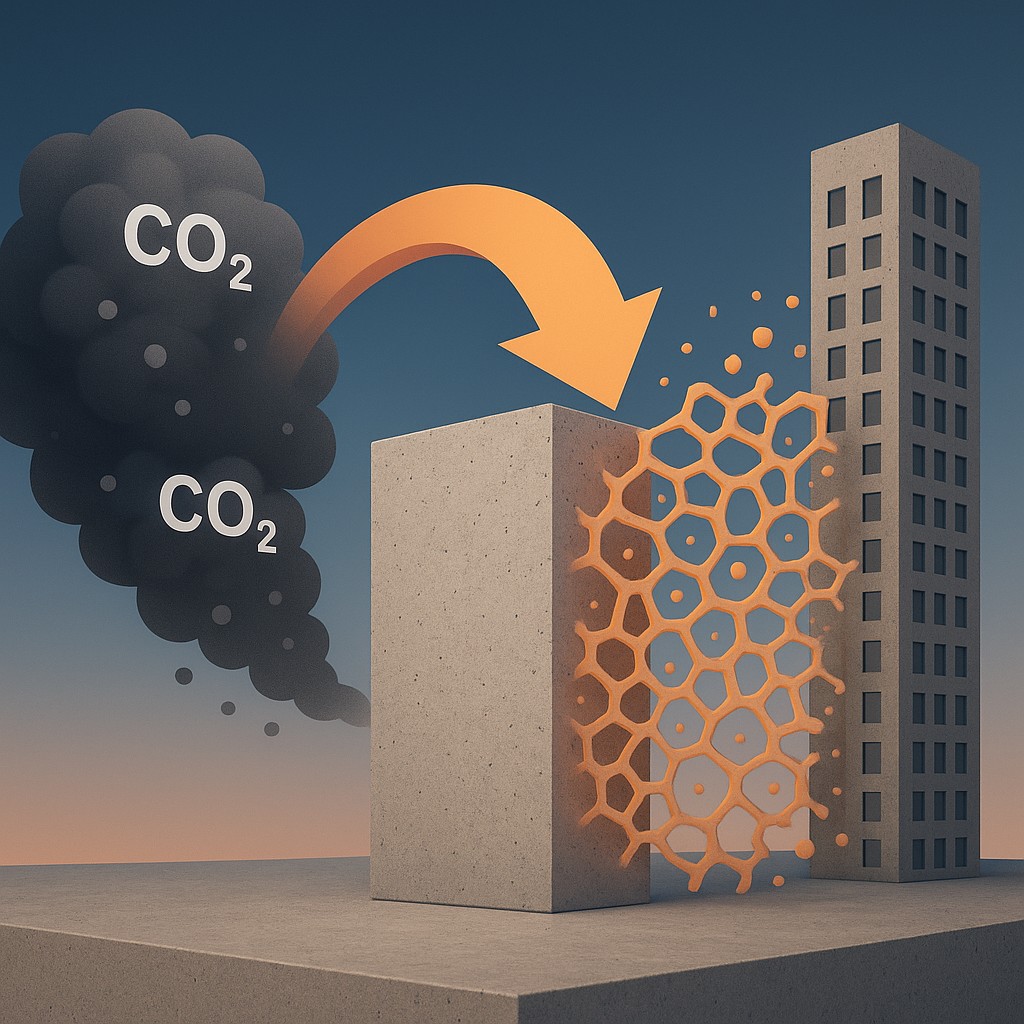
The world is currently built on a foundation that breathes out poison every time we stir the pot. Concrete is the most used substance on Earth after water. It forms the literal skeleton of our civilization, from the pipes under our streets to the towers touching the clouds. Unfortunately, the recipe for this artificial stone is a climate disaster. To make cement, the "glue" in concrete, we must bake limestone in kilns that reach temperatures hotter than lava. This process releases a double blow of carbon dioxide: half from the massive amounts of energy needed to heat the ovens, and the other half from the chemical reaction of the stone itself as it breaks down.
But humanity is remarkably good at turning trash into treasure when backed into a corner. Engineers are now flipping the script. They are treating CO2 not as a waste product to be avoided, but as a secret ingredient that can actually improve the quality of our buildings. By injecting captured carbon dioxide into concrete while it is still wet, we are beginning to transform our urban jungles into vast, silent warehouses that lock away greenhouse gases for centuries. This is not just a clever way to hide pollution. It is a fundamental shift in how we view the chemistry of construction, moving from a process that weakens the planet to one that strengthens our infrastructure by breathing in what we need to get rid of.
The Microscopic Architecture of Mineralization
To understand how a gas can make a skyscraper stronger, we have to look at what happens at the molecular level inside a cement mixer. When water meets cement powder, a complex chemical dance begins. This process, called hydration, creates a paste that eventually hardens into stone. However, as this paste sets, it naturally develops microscopic gaps and pores. These tiny holes are the "Achilles' heel" of concrete. They are areas where cracks can start and where water or chemicals can seep in, leading the structure to break down over time. Standard concrete is durable, but it is far from perfect; it is essentially a very hard sponge with millions of tiny holes.
When engineers inject recycled CO2 into this wet mix, the gas does not just sit there in bubbles like a carbonated soda. Instead, it goes through a process called mineralization. The CO2 reacts almost instantly with calcium ions in the cement to form calcium carbonate, the same material found in seashells and limestone. These newly formed mineral crystals are nano-sized, meaning they are small enough to settle into those tiny microscopic gaps. By filling these holes with solid mineral "shims," the CO2 creates a much denser and more uniform internal structure. This density is the key to making the material stronger, allowing it to withstand more weight and pressure than traditional mixes.
Turning Buildings into Carbon Vaults
The most important part of this breakthrough is that the storage is permanent. Many carbon capture solutions involve pumping gas underground into old oil wells or salt caverns, which requires constant monitoring to make sure the gas does not leak back out. Carbonated concrete, however, creates a chemical bond that is nearly impossible to break under normal conditions. Once the CO2 has turned into calcium carbonate within the concrete block, it is "mineralized." It will not escape even if the building is eventually torn down or crushed. The carbon is locked in a solid state for as long as the mineral exists, which can be thousands of years.
This turns every sidewalk, bridge, and basement into a literal carbon vault. While the amount of CO2 captured in a single cubic yard of concrete might seem small, the scale of global construction is so massive that the total effect is staggering. We use roughly 30 billion tons of concrete every year. If even a fraction of that total were treated with carbon injection, we would be creating a global network of carbon sinks that requires no extra land and provides a useful service. It is a rare example of a "circular" technology where the waste from one industry, such as emissions from a factory or power plant, becomes a vital performance booster for another.
Comparing the Old Guard and the New Wave
To appreciate this leap forward, it helps to see how carbon-negative concrete stacks up against the traditional stuff we have been using since the days of the Roman Empire. While the two materials look identical to the naked eye, their internal chemistry and environmental footprints are worlds apart. The following table highlights the key differences between the standard manufacturing process and the new mineralized approach.
| Feature |
Standard Concrete |
Carbon-Negative (Mineralized) Concrete |
| Carbon Footprint |
High (Major polluter) |
Lower (Acts as a carbon sink as it sets) |
| Internal Structure |
Contains microscopic gaps and pores |
Denser, with gaps filled by nano-crystals |
| Compressive Strength |
Baseline industry standard |
Increased (often 10% to 15% higher) |
| Chemical Reaction |
Hydration only |
Hydration plus mineralization |
| Longevity |
Prone to wear and tear through pores |
More durable due to higher density |
| Carbon Storage |
None |
Permanent atmospheric CO2 storage |
The Kiln Problem and the Path Forward
While the ability to inject and store carbon is a massive win, it is important to stay realistic about the "carbon-negative" label. As of right now, even if we inject a significant amount of CO2 into the mix, the production of the cement itself still requires those massive, fossil-fuel-burning kilns. The CO2 we capture during the mixing process is often only a portion of what was released while cooking the limestone. To reach a truly "net-zero" balance where we remove more than we emit, we have to solve the energy side of the equation as well.
This means the future of green construction is a multi-sided attack. One group of engineers is working on the mineralization process described here, while another group is looking for ways to power kilns with electricity, hydrogen, or concentrated solar heat. There are also researchers experimenting with "alternative binders," which are materials that can replace limestone cement entirely by using industrial byproducts like ash or slag. When you combine mineralized CO2 injection with these ultra-low-carbon cements, the dream of a building that cleans the air begins to look less like science fiction and more like a standard building permit.
Scaling the Solution Across the Sky
One of the biggest hurdles for any new technology is the "status quo" bias. The construction industry is famously careful about taking risks, and for good reason: if a new type of concrete fails, bridges fall and buildings collapse. However, because mineralization actually increases the strength of the material, it is catching on much faster than other green alternatives. Engineers are finding that they can actually reduce the total amount of cement needed in a mix because the CO2-boosted concrete is so much more efficient. This creates a powerful financial incentive: if you can use less of your most expensive ingredient (cement) by adding a waste product (CO2), you save money while saving the planet.
This economic "sweet spot" is where real change happens. We are moving away from a model where being environmentally friendly is a luxury or a sacrifice. Instead, we are entering an era where the most sustainable choice is also the most durable and cost-effective choice. As cities continue to grow and the demand for infrastructure rises, the ability to build with "smart" stone will become a cornerstone of urban planning. We are essentially learning to build with the very thing that once threatened to tear our climate apart.
The transition from a carbon-emitting world to a carbon-absorbing one will not happen overnight, but the transformation of concrete offers a roadmap for how we can get there. It teaches us that nature's own mechanisms, like the slow creation of limestone, can be sped up and harnessed through clever engineering. By reimagining our most basic building blocks, we aren't just constructing shelters; we are crafting a more resilient future, one carbon-infused brick at a time. The next time you walk down a city street, imagine the walls around you not as dead weight, but as active participants in a global effort to heal the atmosphere. The sky is no longer the limit; it is the reservoir for the very materials we will use to build the world of tomorrow.