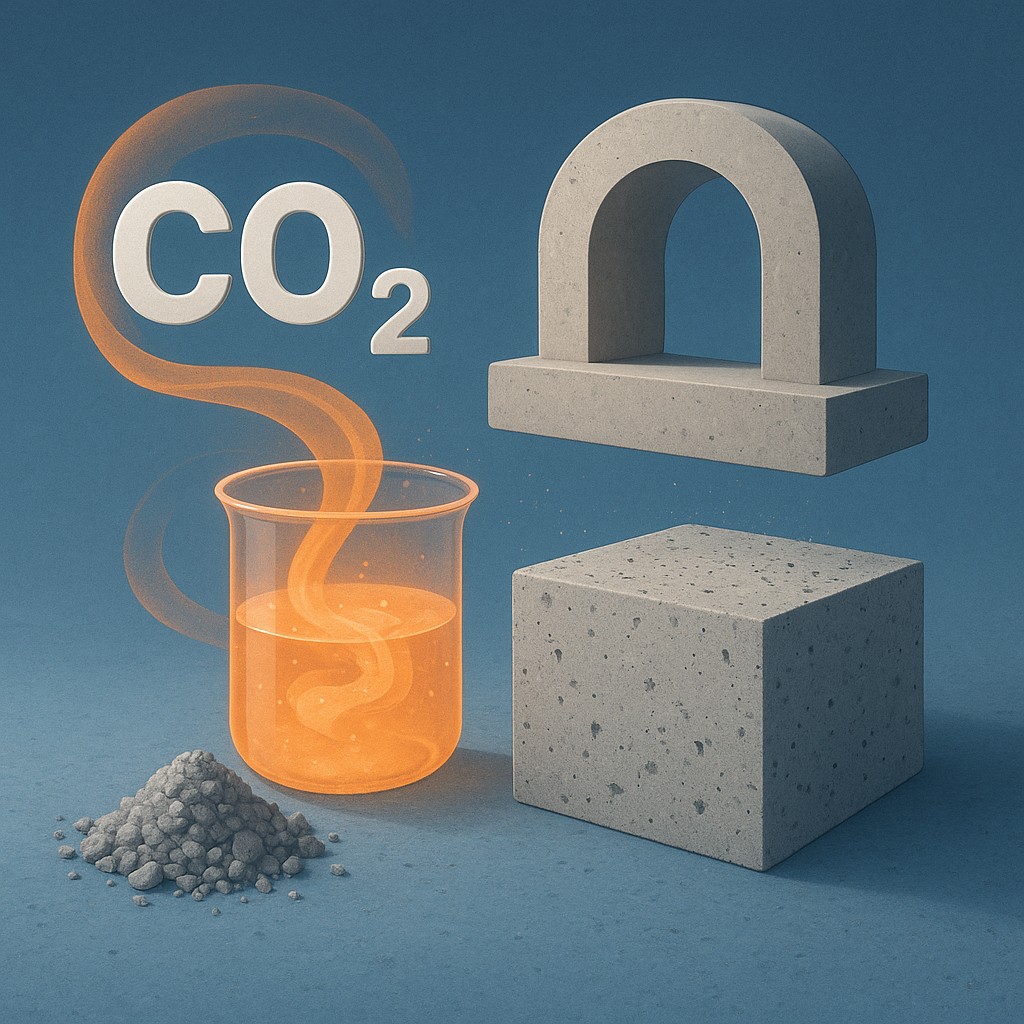
We tend to think of the buildings around us as static objects, silent observers in a city that seemingly never sleeps. It is easy to overlook the ground beneath our feet and the walls at our backs, but every skyscraper, bridge, and sidewalk represents a massive, chemistry-heavy industrial footprint. Concrete, the world’s most widely used human-made material, has long been a quiet giant in our global emissions tally. This is largely because the chemical process required to produce cement is inherently energy-intensive and carbon-heavy.
However, the tide is turning. Instead of viewing concrete as a source of environmental tension, engineers are beginning to treat it as a giant, permanent sponge. By rethinking the mixing process, we are witnessing a transition from traditional, extractive construction toward a future where our urban density actually helps balance the atmospheric books. This is not just a tweak to a cement recipe, but a fundamental shift in how we conceive of civil infrastructure as a meaningful participant in climate restoration.
The Chemistry of Turning Gas into Stone
At its most basic level, concrete is a mixture of water, aggregate, and cement. The cement acts as the glue, holding the rock and sand together. The problem is that the kiln process used to create this glue emits vast amounts of carbon dioxide. New technologies now interrupt this cycle by introducing captured industrial CO2 directly into the mixture as it swirls inside a mixing truck or a batch plant.
When this captured gas hits the wet cement, it undergoes a process called mineralization. The CO2 reacts with calcium ions present in the cement to form microscopic crystals of calcium carbonate, which is essentially the same stuff that makes up limestone. By injecting the gas into the mix, we are effectively forcing the concrete to build its own internal reinforcements. These billions of tiny, trapped crystals act as a structural filler, densifying the pores within the material and making the finished product even stronger than it was before the treatment.
This process is elegant because it turns a waste product into a utility. The CO2 is no longer floating in the atmosphere or sitting in a storage tank; it is chemically locked into the physical structure of a bridge piling or a structural beam. Once the concrete is poured and cured, that carbon is trapped for the entire lifespan of the structure. Even when a building is eventually demolished at the end of its life, the carbon remains safely tucked away in the rubble as mineralized limestone, provided it is handled responsibly.
Breaking Down the Traditional Versus Regenerative Model
To understand the scale of this shift, we have to recognize how profoundly different this is from the way we have built for the last century. Traditional concrete manufacturing is a one-way street, consuming raw materials and churning out carbon as a byproduct of producing the high-heat chemical reaction needed to create clinker. Regenerative concrete, by contrast, creates a closed-loop system where industrial emissions serve a secondary productive purpose, effectively shortening the supply chain of building materials while cleaning up the air.
The following table highlights the differences between the conventional industrial approach and this emerging restorative methodology.
| Feature |
Traditional Concrete |
Carbon-Sequestering Concrete |
| Material Goal |
Structural integrity only |
Integrity plus carbon storage |
| CO2 Status |
Purely a harmful byproduct |
A reactive ingredient |
| Microstructure |
Varies by density |
Reinforced by limestone crystals |
| Environmental Impact |
High carbon footprint |
Low net-carbon footprint |
| End-of-Life |
Standard waste management |
Potential for secondary reuse |
The transition from the left column to the right column represents a massive optimization of human industry. We are moving from a state of pure consumption to one of utility-driven sequestration. It is the architectural equivalent of deciding that your car should filter the air while it drives you to work as opposed to simply belching exhaust behind you.
Clearing Up Common Misconceptions
Whenever we talk about green cement, the skeptics inevitably arrive with a few valid questions that deserve clear answers. One common fear is that by adding gas to the mix, you might be weakening the concrete and creating a structural hazard, as if we were bubbles in a bath. In reality, the technical data suggests the opposite. The mineralized crystals actually fill the microscopic voids that usually exist in traditional concrete, making the resulting material denser and often slightly more resilient under load.
Another frequent misconception is that this is simply carbon-offset theater, where companies buy credits to pretend they are being sustainable. That is not the case here. This is physical sequestration, not a paper trade. If you infuse a ton of CO2 into a bridge, that carbon is not in the sky. It is physically present in the molecular structure of the bridge. It cannot leave, it cannot leak, and it certainly does not require a complex credit trading scheme to verify its existence.
Finally, some critics argue that the energy required to capture and transport CO2 negates the environmental benefit. It is true that the logistics of capturing carbon from a high-heat industrial furnace and moving it to a concrete plant require energy, but the advancements in localized capture technology are rapidly improving the math. As we continue to refine the energy inputs for these capture systems, the lifecycle analysis of the concrete becomes increasingly positive. We are currently in the early-adopter phase of this technology, where the gains are already measurable even before the infrastructure for large-scale carbon delivery is fully optimized.
The Economic and Practical Hurdles Ahead
If the science is so effective and the benefits are so obvious, why isn't every sidewalk in the city currently acting as a carbon vault? The primary barrier, as is often the case with industrial innovation, is the sheer cost of retrofitting existing, massive cement plants with the necessary hardware. Cement production is an incredibly capital-intensive industry, and plant operators are naturally cautious about making heavy investments into machines that require specialized capture and injection logistics.
Overcoming this requires a mix of policy incentives and commercial demand. Many jurisdictions are beginning to implement, or at least discuss, Buy Clean policies that incentivize government projects to prioritize low-carbon materials. When the largest consumer of concrete in any nation-the government-starts picking the carbon-sequestering option for its infrastructure projects, the market shifts almost overnight. This creates the demand necessary for plant owners to justify the capital expense of installing those CO2 injection systems.
Furthermore, we are seeing a trend toward localized batch plant solutions. Instead of needing to overhaul a massive multi-billion-dollar cement furnace, some companies now focus on the mixing trucks themselves or the local ready-mix plants. By decentralizing the injection point, we bypass the need to re-engineer every massive, centralized kilning plant, making the technology significantly more accessible and cheaper to deploy. It is a classic bottom-up approach to a massive top-down problem, and it is proving to be far more agile than the skeptics predicted.
A Future Built on Solid Foundations
When you look at a building site today, you might see dust, noise, and chaos. But if you look closer and understand the chemistry happening behind the scenes, you are seeing a quiet revolution in our relationship with the planet. We are turning our cities into physical hard drives for carbon storage, rewriting the code of the materials we have used for millennia to serve a dual purpose.
This evolution in construction reminds us that even our biggest, most stubborn problems can be solved by changing how we handle the boring, everyday inputs of our industry. It is not always about inventing a magic new material that changes space flight or digital intelligence; often, it is about taking the concrete we already use, the CO2 we already produce, and finding a way to make them shake hands. As this technology scales, the next time you walk across a plaza or drive over an overpass, you can rest assured that the infrastructure beneath you is doing more than just holding your weight-it is helping hold the line against a warming world, one crystal of limestone at a time.