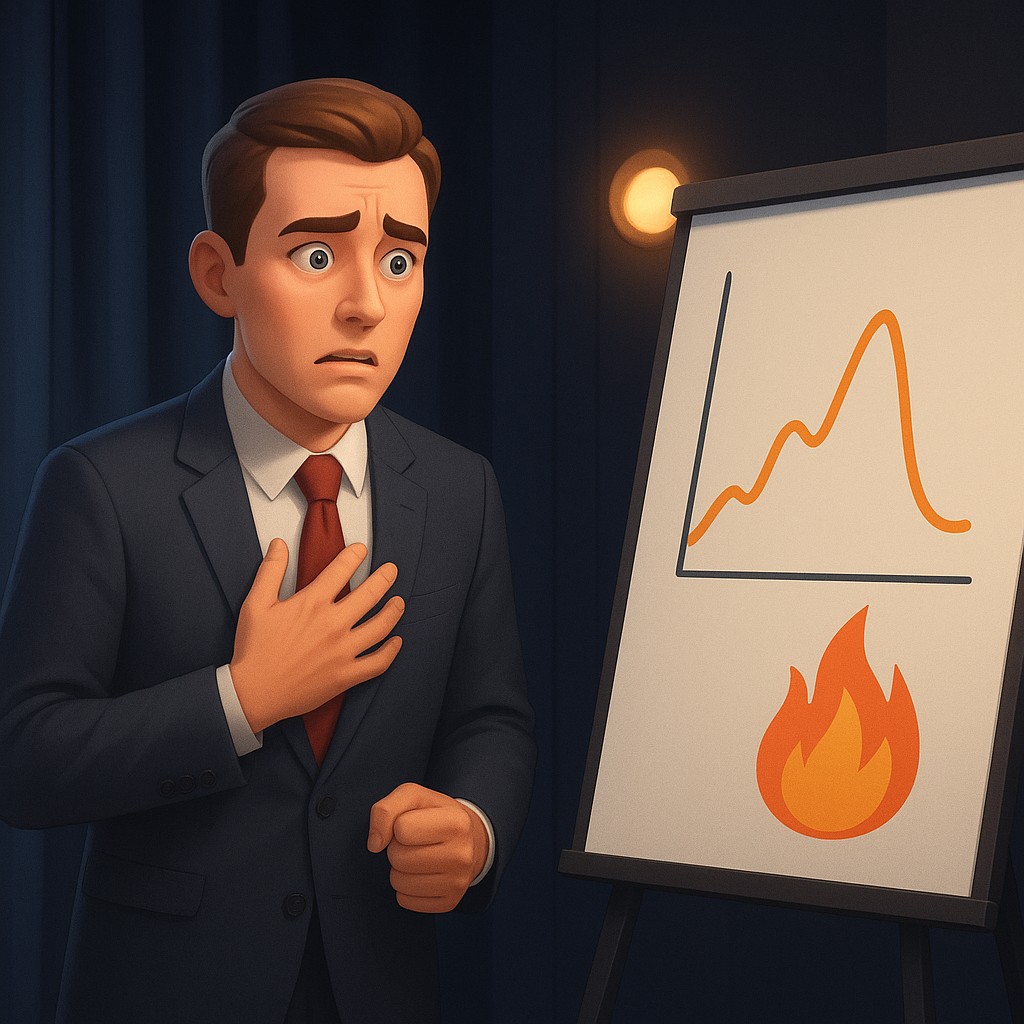
Imagine you are standing backstage, just moments away from a high-stakes presentation to a board of skeptical investors. Your heart is hammering against your ribs like a trapped bird, your palms are slick with sweat, and your stomach feels like it has been recruited for a competitive gymnastics routine. For decades, the standard advice for this situation has been to take a deep breath and tell yourself to calm down. We try to force our pulse to slow and our breathing to steady, treating our body's physical reaction like a fire that must be put out before we can function.
The problem is that trying to "calm down" when you are vibrating with adrenaline is like trying to stop a freight train with a yoga mat. It creates a psychological tug-of-war where you are not only stressed about the event, but also stressed about the fact that you are stressed. Effective leaders, however, have begun leaning into a much more elegant and natural strategy. Instead of fighting the surge, they learn to pivot. By understanding that the physical sensations of fear and those of intense anticipation are basically the same, we can use a mental "flip" to turn a paralyzing threat into high-octane fuel for performance.
The Shared Biology of Fear and Fire
To understand why we can transform anxiety into excitement, we first have to look under the hood at our autonomic nervous system, the part of the body that handles automatic functions like your heartbeat. When we face a challenge, our body triggers the sympathetic nervous system, releasing a cocktail of hormones like adrenaline and cortisol. This is the classic "fight or flight" response, designed to prepare us for physical action. From a purely biological standpoint, your body does not have a unique "anxiety" button and a separate "excitement" button. Instead, it has a general "get ready" button.
This state is known as physiological arousal. Whether you are about to plummet down the first drop of a roller coaster or you are watching a lion approach your campsite, your body responds with the same racing heart, dilated pupils, and heavy breathing. The physical hardware is identical; it is the mental software, our cognitive appraisal (how we judge a situation), that decides whether these sensations are "bad" (anxiety) or "good" (excitement). Because anxiety and excitement are both high-energy states, it is much easier to hop from one to the other than it is to crash from high-energy anxiety into a low-energy state of calm.
Moving Beyond the Calmness Myth
For years, many of us believed that the ideal state for a leader was a Zen-like tranquility, a sort of emotional baseline where nothing could rattle them. However, recent psychological research suggests that trying to suppress physical energy often backfires. In studies where participants were told to "relax" before a public speaking task, they often performed worse and felt more under pressure than those who were told to embrace their energy. Suppression requires significant mental effort, using up the very brainpower you need to solve problems or remember your speech.
When you tell yourself to "calm down", you are essentially labeling your body’s preparation as an error that needs fixing. This triggers a "threat response", where the brain perceives the situation as something dangerous that could lead to loss or failure. In a threat state, our blood vessels constrict and our decision-making becomes rigid. But when we label that same energy as "excitement", we trigger a "challenge response." In this state, our blood vessels remain open, allowing for better oxygen flow to the brain, and our focus becomes expansive rather than defensive. We stop worrying about what might go wrong and start looking for the opportunities to win.
The Mechanism of Arousal Reappraisal
The technical term for this mental pivot is "arousal reappraisal." It is a two-step process that replaces the "Why is this happening to me?" story with a "What can I do with this?" story. A leader using this technique does not ignore the racing heart; they acknowledge it as proof that their body is providing the resources needed for success. It is the difference between seeing a storm as a disaster or seeing it as a way to power a wind turbine. You are not changing the weather; you are changing your infrastructure.
Consider the role of a surgeon or an elite athlete. They do not hope for zero adrenaline; they count on it. They know that the surge in their system sharpens their vision and speeds up their reaction times. By vocalizing this, saying out loud "I am excited" or telling a team "We are primed for this", we are effectively rewriting the caption of our internal experience. This simple shift in language can actually change how the heart pumps blood and how the brain processes information during the event.
| Feature |
Anxiety (Threat Response) |
Excitement (Challenge Response) |
| Physical Sensation |
Racing heart, sweaty palms, tension |
Racing heart, sweaty palms, tension |
| Blood Flow |
Constricted vessels, less oxygen to brain |
Open vessels, peak oxygen to brain |
| Mental Focus |
Avoidance, fear of failure, rigid |
Opportunity, desire to succeed, fluid |
| Linguistic Frame |
"I am nervous" or "Calm down" |
"I am excited" or "I am ready" |
| Performance Impact |
Higher error rate, "choking" |
Enhanced focus, "flow" state |
Leading the Team through the Shift
Great leaders do not just apply this to themselves; they act as the "meaning-makers" for their entire organization. When a team is facing a daunting deadline or a sudden market shift, the collective atmosphere can quickly turn to dread. A leader who senses this tension might be tempted to say, "Don't worry, everything will be fine." While well-intentioned, this can feel dismissive and fails to address the very real physical energy the team is feeling. They are worried, and being told not to worry often feels like an impossible command.
Instead, an effective leader validates the energy and then pivots the label. They might say, "I can feel the energy in this room. That’s because we care about this project, and our bodies are gearing up to help us hit this goal. We’re not nervous; we’re ready." This gives the team permission to feel their physical symptoms without judging them. It transforms the "butterflies" in their stomachs from a sign of weakness into a sign of preparation. This shared shift can prevent a team from spiraling into a cautious, defensive posture and instead encourage the bold, creative thinking required for high-level problem solving.
Distinguishing Performance Stress from Burnout
While remapping your nerves is a superpower for performance stress, it is vital to understand its limits. This technique is designed for acute, "spiky" stress caused by specific challenges, such as a big game, a presentation, or a difficult negotiation. It is a tool for peak performance in the moments that matter. However, it is not a cure-all for the chronic, grinding stress that leads to workplace burnout. One is a temporary surge of energy intended to be used and then released; the other is a long-term depletion of resources due to systemic issues.
If a workplace is toxic, if employees are chronically overworked, or if there is a lack of support, telling people to "just get excited" is not leadership, it is gaslighting. Burnout is marked by exhaustion, cynicism, and a sense that your work does not matter. No amount of mental reframing can fix a broken business model or a lack of psychological safety. Leaders must be careful to use reappraisal to help their teams thrive in big moments, while also doing the hard work of fixing the root causes of long-term stress. Reframing helps you navigate the rapids, but it won't fix a hole in the bottom of the boat.
Practical Steps for Reframing the Narrative
Integrating this into your daily routine is less about deep meditation and more about quick, decisive changes in how you speak. The next time you feel that familiar spike of adrenaline, try to catch yourself before you label it as anxiety. Instead of fighting the sensation, try these three simple steps:
- Acknowledge and Label: Identify the physical sensation. Tell yourself, "My heart is beating fast because I am preparing for something important."
- State the Pivot: Say it out loud if you can. "I am excited." Research shows that even if you don't fully believe it at first, speaking the words helps steer the brain toward a challenge mindset.
- Identify the Opportunity: Ask yourself what the "win" looks like. Focus on what you want to achieve rather than what you want to avoid.
By practicing this in low-stakes situations, like a challenging workout or a small meeting, you build the mental muscle memory needed for the truly "big" moments. You begin to view your body's stress response not as an enemy to be defeated, but as a powerful ally that shows up exactly when the stakes are highest.
As you step into your next big challenge, remember that the intensity you feel is not a warning sign of failure. It is actually your body’s way of handing you a battery pack. You have the choice to view that energy as a weight that pulls you down or as a propellant that launches you forward. By mastering the art of mental reframing, you stop being a victim of your nerves and start being the architect of your own peak performance. Every racing heart is a signal that you are alive, you care, and you are ready to make your mark.